Gümüşler Monastery: the smiling Virgin near Niğde
What makes Gümüşler Monastery worth the drive from Göreme?
Gümüşler Monastery, just outside Niğde, holds one of the best-preserved Byzantine fresco cycles in the region, including a rare depiction of a smiling Virgin. It sees far fewer visitors than the Göreme Open-Air Museum, and it is best visited alongside Niğde itself rather than as a stand-alone trip.
A cave monastery that most Cappadocia itineraries skip
Most first-time visitors to Göreme fill their days with the Göreme Open-Air Museum, the fairy chimney valleys, and one of the underground cities. Gümüşler Monastery rarely makes that list, and that is largely a matter of geography rather than quality. It sits close to Niğde, on the southern edge of the region, well outside the loop that the Red, Green and Blue Tours cover. Getting there means a dedicated trip south, not a stop bolted onto a day that already includes Ürgüp or Avanos.
That distance is also the reason it stays quiet. Where the Göreme museum can feel like a queue with a view between 10am and 3pm, Gümüşler on an ordinary day might have a dozen other visitors scattered across the whole complex. The trade-off is honest: you give up convenience for a calmer, closer look at some of the best-preserved Byzantine painting in the region.
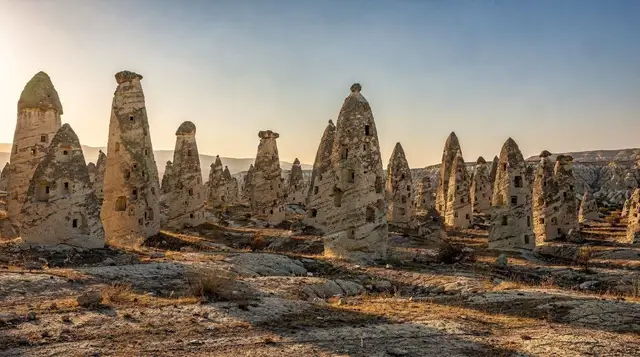
It is worth being clear about scale before you go. Gümüşler is not a large or dramatic ruin. There is no soaring rock spire, no cliff-face of dozens of visible chambers like Zelve or Çavuşin. It is a modest monastic complex cut around a central courtyard, and its reputation rests almost entirely on the condition of one fresco cycle. If you come expecting a monumental site, you will be underwhelmed. If you come for the paintings, it delivers.
The smiling Virgin fresco
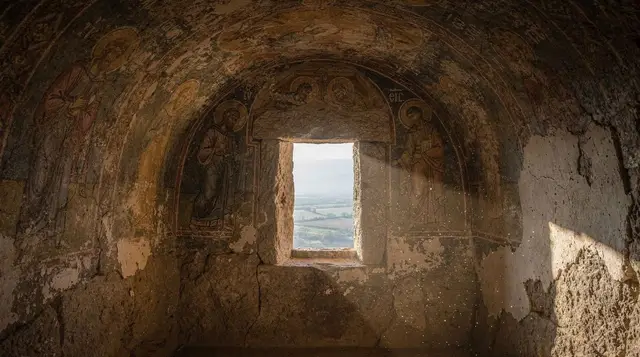
The single reason Gümüşler appears in guidebooks at all is a fresco of the Virgin Mary in which her expression reads, unmistakably, as a smile. In the Byzantine painting tradition that dominates Cappadocia’s rock-cut churches, sacred figures are painted solemn, formal and largely interchangeable in expression from one church to the next. A warm, individual expression like this one is genuinely rare in the region’s surviving religious art, and it is the detail that guides and art historians point to first.
The fresco has survived in unusually good condition. The chamber that holds it was sealed off for a long period, which kept it out of direct light, damp, and the general wear that has stripped colour from painted surfaces at more exposed sites such as parts of Çavuşin’s Church of Saint John the Baptist. The result is a cycle where facial features, pigment, and fine detail are still legible in a way that is unusual even by the standards of the region’s better cave churches.
Do not expect an experience on the scale of the Karanlık Kilise in Göreme, which covers far more wall and ceiling surface with a fuller narrative cycle and correspondingly charges a separate entry fee on top of the museum ticket. Gümüşler’s fresco work is more contained. What it offers instead is proximity and quiet: you can usually stand in front of the smiling Virgin for as long as you like without another visitor’s shoulder in the frame, which is close to impossible in Göreme’s museum at midday.
Inside the monastic complex
Beyond the fresco chamber, Gümüşler is built the way most Cappadocian religious complexes are: carved directly into the soft volcanic rock, organised around a shared open space rather than laid out as a single building. Here that space is a genuine interior courtyard, open to the sky, with monastic rooms, storage areas, and the church itself cut into the rock walls around it. Walking the site means moving from room to room at ground level and on a couple of short raised sections, without the steep staircases or narrow tunnels that make somewhere like the underground cities or Zelve more physically demanding.
Alongside the church and fresco chamber, look for the everyday spaces of monastic life: storage rooms cut into the rock, what is identified as a kitchen area, and a defensive tunnel connecting parts of the complex, a feature that turns up again and again across the region’s rock-cut sites, from the underground cities near Derinkuyu and Kaymaklı down to smaller hermitages. It is a useful reminder that these sites were built for daily, working religious communities rather than as showpieces.
The complex is compact enough to see properly in well under an hour. Signage is limited compared with the Göreme museum, so a guide or a pre-read guidebook adds real value here if you want context on what you are looking at rather than just admiring the fresco on its own merits.
Getting there from Göreme, and why it pairs with Niğde
Gümüşler sits a few kilometres north of Niğde town, which itself is around 1 hour 15 minutes from Göreme by car. Add another 10 to 15 minutes to reach the monastery from Niğde, and you are looking at close to 1 hour 30 minutes each way from base. That is a longer drive than almost anything on the standard tour circuits, which is exactly why it does not get bundled in with Red or Green Tour stops.
Because of that distance, treat Gümüşler as a destination paired with Niğde, not a quick detour on the way to somewhere else. Niğde’s old town has its own layer of Seljuk and Ottoman architecture worth half an hour or so, and the province stretches south towards the Aladağlar mountains, a genuinely different landscape from the tuff valleys around Göreme. A day built around Gümüşler and Niğde, with time in hand for the drive, makes far more sense than trying to squeeze the monastery in alongside Soğanlı or Kaymaklı in the same afternoon.
There is no direct dolmuş service from Göreme to Gümüşler, so independent travel means a rental car for the day, or a taxi arranged with a driver willing to wait. Most visitors without their own transport book an organised tour instead.
How busy does it get
Gümüşler’s low visitor numbers are its main selling point against the Göreme museum, and the comparison holds up in practice. The Göreme Open-Air Museum runs at or near capacity through the late morning and early afternoon, particularly from April to October. Gümüşler, sitting outside every coloured tour route and requiring its own dedicated drive, simply does not attract that volume of traffic. Tour groups that do visit tend to be smaller, private, or themed around history and food rather than the high-volume group tours that fill car parks at Göreme, Zelve and the underground cities.
That is not a promise of having the site to yourself. Tour buses on the specific itineraries that include Gümüşler will still arrive at points through the day, so there is no single guaranteed quiet hour the way there might be right at opening elsewhere. But relative to the sites inside the main tour loop, it is a consistently calmer visit.
Practical visit information
| Details | |
|---|---|
| Distance from Göreme | Around 1 hour 15 minutes to Niğde, plus 10 to 15 minutes to the monastery |
| Time needed on site | 45 minutes to 1 hour |
| Best paired with | Niğde old town, or a wider day trip toward the Aladağlar |
| Crowd level | Low to moderate; quieter than Göreme’s Open-Air Museum on almost any day |
| Access without a car | Limited; no direct dolmuş, so a tour or rental car is the practical option |
| Physical difficulty | Moderate; ground-level rooms with some short raised sections, easier underfoot than the underground cities |
Ticket prices at Turkish heritage sites move often enough that a fixed figure printed here would likely be wrong within months. Check current pricing locally or through your tour operator rather than relying on an old number carried over from a previous season.
Combining Gümüşler with other south Cappadocia sites
Because the drive south is long enough to plan around, most visitors build a full day rather than a single stop. Common pairings include:
| Combination | Why it works |
|---|---|
| Gümüşler + Niğde old town | Shortest addition; keeps the day to a half-day trip plus travel |
| Gümüşler + Soğanlı valley | Both are quiet, both sit south of the main tour loop, similar driving direction |
| Gümüşler + Aladağlar | Trades a second historical site for mountain scenery, better for hikers |
| Gümüşler + Kaymaklı underground city | Combines a fresco site with a very different kind of rock-cut architecture |
Trying to combine Gümüşler with sites north of Göreme, such as Ihlara valley or Avanos, in the same day is possible on paper but stretches the driving to a point where you will spend more time in the car than at any site. If Ihlara is a priority, it is worth its own day; see the three-day itinerary for a structure that separates north and south without doubling back.
Booking a tour versus going independently
Given the driving distance and the lack of public transport, an organised tour is the more common route for visitors without a rental car, and it has a real advantage here beyond logistics: Gümüşler’s limited on-site signage means a guide adds genuine context that self-guided visitors otherwise miss.
A few tour options cover the monastery specifically. The Gümüşler Monastery Aladağlar Park tour pairs the fresco site with the mountain scenery to the south, which suits visitors who want a landscape change from the fairy chimney valleys. For a route that links Gümüşler with one of the underground cities in a single day, the Kaymaklı and Gümüşler tour covers both without requiring your own transport.
If food and local history matter as much as the fresco itself, look at the Gümüşler history and food culture tour, which builds the day around context rather than a checklist of sites. And for travellers already planning a Soğanlı valley day, the private Soğanlı Valley and Keslik Monastery tour covers similar quiet, southern terrain and can sometimes be adjusted to include Gümüşler as an add-on; confirm the exact stops before booking.
Driving yourself gives more control over timing, particularly useful if you want to linger in front of the fresco without a group schedule pulling you along. Roads to Niğde are well-paved and the route is straightforward, so this is one of the easier independent drives in the region compared with, say, navigating the unmarked tracks around Mazı and Gaziemir.
Where Gümüşler fits in a longer Cappadocia trip
For visitors staying three days or fewer, Gümüşler is a reasonable thing to leave out. The Göreme Open-Air Museum covers the core cave-church experience more efficiently, and time is better spent on the Kaymaklı or Derinkuyu underground cities and one of the walking valleys close to Göreme.
For visitors with four days or more, or anyone who has already done the Göreme museum and the underground cities on a previous trip, Gümüşler earns its place. It rewards a slower pace and genuine interest in the fresco work over ticking off the region’s biggest names, and the drive south to Niğde shows a different, less-touristed side of the province than the fairy chimney valleys around base. For a broader look at how these sites cluster, the museums-art category and the day trips hub both cover nearby options worth weighing against Gümüşler before you commit a full day to it.
Frequently asked questions about visiting Gümüşler Monastery
How far is Gümüşler Monastery from Göreme?
It is roughly 1 hour 15 minutes to Niğde, plus another 10 to 15 minutes to the monastery itself, so budget close to 1 hour 30 minutes each way by car.
Is Gümüşler Monastery worth visiting if I have already seen the Göreme Open-Air Museum?
Yes, for a different reason. Göreme’s museum is about the density and scale of rock-cut churches. Gümüşler is about one exceptionally well-preserved fresco cycle in a quiet setting, so the two do not overlap much.
What is the smiling Virgin fresco?
It is a fresco of the Virgin Mary in which her expression reads as a gentle smile, an unusual choice in Byzantine religious art from this region, where figures are almost always shown solemn or neutral. It survives with its colour largely intact because the chamber stayed sealed and out of the weather for centuries.
Can I visit Gümüşler Monastery without a car?
It is difficult. There is no direct dolmuş route from Göreme, so most independent travellers rent a car or join an organised tour that covers Niğde or the Aladağlar area on the same day.
How long should I plan for the visit?
The monastery itself takes 45 minutes to an hour to walk through. Most people add on a stop in Niğde old town, which brings the visit closer to half a day once travel time is included.
Is Gümüşler Monastery crowded?
No. It is one of the quieter rock-cut sites in the region because it sits south of the usual Red, Green and Blue Tour routes. Expect a handful of other visitors rather than tour-bus crowds.
Is Gümüşler part of any of the standard coloured tours?
No. It falls outside the Red, Green and Blue Tour circuits, which is exactly why it stays quiet. It is usually booked as its own tour or paired with the Aladağlar mountains or Soğanlı valley.
Museum & art tours on GetYourGuide
Verified deep-linked GetYourGuide tours. Book through these links and we earn a small commission at no cost to you.
GetYourGuide does not provide a product photo for this activity — the image shows the meeting point, photographed by us.