An abandoned village, not a chimney field
Zelve gets bracketed with Paşabağ on every Red Tour itinerary, and the two sites sit a few minutes apart, but they show completely different things. Paşabağ is about the rock: double- and triple-capped fairy chimneys and the hermit’s cell carved into one of them. Zelve is about the people who left.
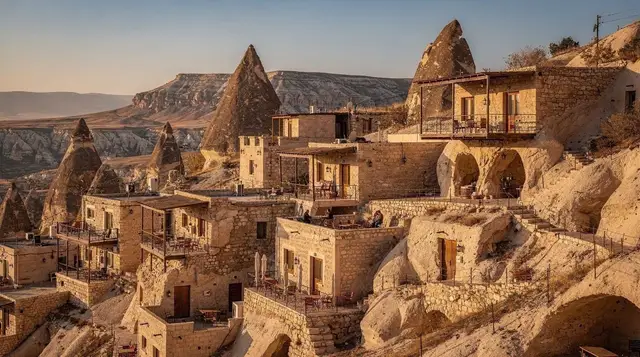
This was a working village of houses, a mosque, a church and a mill, all cut into the soft tuf of three narrow valleys, inhabited until the Turkish government evacuated it in 1952 because the rock was crumbling and collapsing around the residents. Families were resettled a few kilometres away in what became the “new” village of Zelve, and the old one has stood empty ever since. If you want the double-chapped chimneys, that’s a different stop. Zelve is the empty village.
That distinction matters for what you should expect on the ground. There’s no ticket booth selling a tidy walk past labelled highlights. Zelve is three valleys of collapsed and half-collapsed dwellings, connected by paths, tunnels, ladders and steps, with the ruins of communal buildings scattered through them. Some of it is easy walking. Some of it means stooping through a rock-cut tunnel or climbing a metal ladder bolted to the cliff face. It rewards curiosity more than it rewards a checklist.
Three valleys, one ticket
A single entry ticket covers all three valleys, which run roughly parallel and are linked by a short tunnel and connecting paths near the entrance. There’s no fixed route: most visitors walk into the first valley, work along it as far as they want to go, cut across, and work back along the second before deciding whether the third is worth the extra time. Signage is minimal. A site map near the entrance gives a rough idea of where the church, the mosque and the mill sit, but the pleasure of Zelve is partly in wandering into a doorway without knowing what’s behind it.
Because the valleys aren’t a loop with a clear beginning and end, it’s easy to backtrack without meaning to, or to miss a side valley entirely. Budget extra time if you want to see all three properly rather than the first one and part of the second, which is what most rushed visits amount to.
Valley one: houses, a tunnel and the old mosque
The first valley, closest to the entrance, holds the bulk of the housing: multi-storey dwellings cut into the cliff, connected internally by stairs and short passages, with pigeon holes drilled into the rock faces above them, used for centuries to collect droppings as fertiliser. A rock-cut mosque with a squared-off minaret sits along this valley, plain inside compared with the painted churches elsewhere in the region, since Zelve’s later population was Muslim rather than Christian. A narrow tunnel connects this valley to the second; it’s dark, low in places, and not for anyone uneasy in a confined space.
Look for the wear patterns on doorframes and floors, the ledges cut for oil lamps, and the soot staining on ceilings from centuries of cooking fires. None of it is labelled. It rewards slowing down more than it rewards moving fast between named sights, in contrast to a stop like the Göreme open-air museum, where each church has a number and a description board.
Valley two and three: the church and the mill
The second valley holds the remains of a church, its apse and a few faded traces of decoration still visible, along with more housing cut into the upper levels of the cliff, reached by routes that are noticeably steeper than in the first valley. A rock-cut mill sits further along, its grinding stone still in place, evidence of Zelve as a working settlement rather than a monastic retreat. The third valley sees the fewest visitors of the three: fewer buildings, more open ground, and a quieter walk if the first two have felt busy.
Between the valleys, several vantage points look back over the whole site: rows of empty windows and doorways stacked up the cliff face, no glass, no roofs, nothing to suggest anyone still lives there. It’s a useful photograph if you want something other than a chimney against blue sky, which is what most Cappadocia photography ends up being.
How long it actually takes
| Approach | Time | What you see |
|---|---|---|
| Quick look | 45 minutes | First valley only, mosque, main tunnel |
| Standard visit | 1–1.5 hours | All three valleys, church, mill |
| Slow, with photography | 1.5–2 hours | All three valleys plus side paths and viewpoints |
Most people on an organised tour get 45 minutes to an hour at Zelve as one stop among several, which is enough for the first valley and a look into the second. If Zelve is the point of your day rather than a stop on the way to somewhere else, allow closer to 1.5 hours and go early, before coach groups arrive from around 10am.
Steps, ladders and who should think twice
This is the detail that separates Zelve from a stroll through a garden of chimneys: getting around the site involves rock-cut steps worn uneven by decades of use, at least one metal ladder connecting levels within the valleys, and a low tunnel between the first and second valley that requires stooping. None of it is roped off or padded. Handrails exist in a few places, not everywhere.
That combination rules out or complicates a visit for several groups: anyone with limited mobility, most pushchairs (there’s nowhere to leave one and nothing stroller-friendly once you’re inside), young children who need carrying on uneven ground, and anyone with a fear of heights or enclosed spaces who won’t enjoy the tunnel or the exposed upper walkways.
It is absolutely not a site to attempt in flip-flops or sandals; the rock is dusty, sometimes loose underfoot, and the ladder rungs are metal. Closed shoes with some grip are the minimum. For context on what does and doesn’t suit different visitors across the valleys generally, see hiking safety in the valleys and the wider roundup of best hikes in Cappadocia.
What’s closed, and why
Not every carved room and passage at Zelve is open. Some sections are fenced off because the same erosion that forced the village’s evacuation in 1952 hasn’t stopped: rockfall risk is an ongoing management issue, and the site authority closes specific chambers or routes periodically for safety rather than restoration. Don’t expect every doorway you see to be one you can walk through. If a path is roped or a chamber is gated, it’s for a structural reason, not an oversight, and climbing past a barrier at a site built on crumbling volcanic tuf is a genuinely bad idea, not just a rule for its own sake.
Getting to Zelve from Göreme
Zelve sits about 10 minutes from Göreme by car, on the road toward Avanos, and it’s usually paired with Paşabağ on the way. A taxi from Göreme runs a short, fixed fare each way; renting a scooter or car for the day works out cheaper if you’re combining Zelve with Paşabağ, Devrent Valley and Avanos, all of which sit within about 15 minutes of each other.
Dolmuş minibuses connect Göreme to Avanos and can drop you near the site, though services thin out later in the afternoon, which matters if you’re not driving yourself back. Most visitors see Zelve as part of an organised Red Tour rather than working out the logistics independently, which removes the transport question entirely.
When to go
Arrive at opening or in the last couple of hours before closing to avoid both the heat and the coach groups that fill the first valley from mid-morning. Summer afternoons in the valleys climb into the low-to-mid 30s Celsius with almost no shade anywhere on site, and the tuf reflects heat back at you; carry water. Spring (April to June) and autumn (September to October) give the most comfortable walking conditions and avoid the worst of the crowds and the heat alike. Winter closes down the ladders and steeper paths less often than you’d expect, but snow and ice on rock-cut steps make an already uneven site genuinely hazardous, so check conditions if visiting between December and February.
Zelve compared with the Göreme open-air museum
| Zelve | Göreme open-air museum | |
|---|---|---|
| What it is | Abandoned troglodyte village | Cluster of painted rock-cut churches |
| Main draw | Houses, mosque, mill, tunnels | Byzantine frescoes, notably the Karanlık Kilise |
| Crowds | Lighter, spread across three valleys | Dense, especially 10am–3pm |
| Walking difficulty | Uneven steps, ladders, one tunnel | Mostly stairs, more managed |
| Time needed | 45 min–1.5 hours | 1.5–2 hours |
If frescoed churches and a well-signed route are what you want, the Göreme open-air museum is the better use of time. If you’d rather explore a real, empty settlement with fewer boards telling you what you’re looking at, Zelve is the stronger choice, and the two aren’t mutually exclusive on a longer stay.
Combining Zelve with the rest of the Red Tour
Zelve is a fixed stop on the north-of-Göreme circuit that local agencies sell as the Red Tour, alongside Paşabağ, Devrent Valley, Avanos and usually a viewpoint over Uçhisar. For the full breakdown of what each colour-coded tour actually covers and how they differ, see Red Tour, Green Tour, Blue Tour explained.
A day built around this route works well as a half-day tour that pairs Zelve with Paşabağ and the surrounding valleys, or as a fuller itinerary through a small-group Red Tour that adds Avanos and a viewpoint stop if you want Zelve alongside the rest of the northern route in one booking.
Some operators also pair Zelve with an underground city rather than the standard Red Tour stops, which suits travellers who’d rather skip the busier Derinkuyu or Kaymaklı crowds. One option worth knowing about is a tour combining Zelve with the quieter underground city at Özkonak, and for a broader look at the region’s underground sites, see Derinkuyu underground city and Kaymaklı underground city.
Travellers building a day specifically around underground cities sometimes book a guided The Underground Cities tour that can be combined with a Zelve stop rather than the standard surface-level Red Tour.
If Zelve is one stop in a longer stay, it fits naturally into a first full day alongside Göreme itself — see Cappadocia in one day or the 1-day itinerary for how the timing works across a single packed day, or spread it over two with Cavusin and its own abandoned old village for a second dose of empty, crumbling houses without repeating the same site.
What to bring
Closed shoes with grip, not sandals; a small torch or a phone light for the tunnel between the first and second valleys, since interior lighting is minimal; water, since there’s no shade and no shop inside the site; and a spare 15–20 minutes of patience if you arrive at the same time as a coach group, since the narrower passages and the tunnel don’t allow much overtaking. Entry is by ticket at the gate or by the regional museum pass where accepted; carry small notes in Turkish lira since there’s no reliable card payment at the site itself.
Zelve open-air museum: questions before you go
How long does Zelve take to visit?
Plan on 45 minutes for a quick look at the first valley, or 1 to 1.5 hours to see all three valleys, the church, the mosque and the mill properly. Photographers or anyone exploring side paths should allow closer to 2 hours.
Is Zelve the same place as Paşabağ?
No. They’re separate sites a few minutes apart on the same road north of Göreme. Paşabağ is a short stop focused on double- and triple-capped fairy chimneys, including the hermit’s cell of Saint Simeon. Zelve is a much larger abandoned village of houses, a mosque, a church and a mill, inhabited until 1952.
Are there ladders or steep steps at Zelve?
Yes. Getting between levels within the valleys involves uneven rock-cut steps and at least one metal ladder, plus a low tunnel connecting the first and second valleys that requires stooping. Handrails exist in some sections but not throughout.
Is Zelve suitable for children or people with mobility issues?
It’s manageable for older children who can climb steps and manage a low tunnel, but it isn’t suitable for pushchairs, and it’s a difficult site for anyone with limited mobility or a fear of heights or confined spaces, given the uneven terrain and the tunnel.
Can I combine Zelve with the Göreme open-air museum in one day?
Yes, and it’s a common pairing since the two sites cover different ground: Zelve for an abandoned village, Göreme’s museum for painted rock-cut churches. Allow around half a day for both, including transport between them.
What should I wear to visit Zelve?
Closed shoes with grip are the minimum, given the uneven steps, the ladder and the loose, dusty tuf underfoot. Flip-flops or sandals are a genuine hazard here, not just uncomfortable.
Are all three valleys always open?
Not necessarily. Zelve’s rock is still eroding, the same process that forced the original evacuation in 1952, and individual chambers or paths are periodically closed for safety. Expect some doorways and passages to be fenced off rather than assume everything visible is open.