Why Devrent has no churches or houses
Every other valley near Göreme has some layer of human history carved into it — a Byzantine chapel, a troglodyte room, a pigeon house cut into a cliff face for collecting droppings as fertiliser. Devrent Valley, also sold under the name Imagination Valley, has none of that. There’s no evidence anyone ever settled here in any organised way. What you’re looking at is unmodified erosion: tuff, the compressed volcanic ash spread across the region by eruptions of Erciyes and Hasan Dağı, worn down over millennia by wind and rain into columns, cones and rounded knobs, with harder caprock protecting some of them from collapsing entirely.
That absence of construction is the whole point of the place, and it’s also where a lot of tour narration overstates things. Guides on the Red Tour sometimes talk up Devrent as if it were a major sightseeing stop on the same level as Paşabağ or Zelve. It isn’t, and treating it that way sets the wrong expectation. Devrent is a short, striking view of geology doing something unusual — nothing more, nothing less. Knowing that in advance means you won’t feel short-changed by a 15-minute stop, and you won’t waste time looking for a museum, a church or a village that was never here.
What you’ll actually see
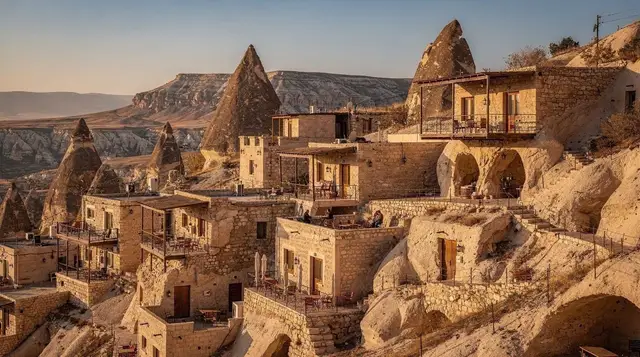
The valley opens up on both sides of the road as a field of cone-shaped and irregularly eroded rock formations, pale grey-beige, in shapes that read differently depending on the light and, honestly, on suggestion. The most commonly pointed-out formation resembles a camel, and most drivers and guides will stop specifically at the viewpoint where it’s visible. Beyond that, visitors and locals alike have assigned shapes to various rocks over the years — a seal, a pair of embracing figures, a snake — but these are informal names, not official ones, and no two guides describe exactly the same set.
There’s no path system to follow and no numbered stops. You pull off at one of two or three viewpoints along the road, walk a short distance to a raised vantage point, and look out over the formations. A handful of small stalls sometimes appear near the main pull-off selling drinks, scarves and trinkets, but there’s no permanent infrastructure — no ticket booth, no visitor centre, no marked trail.
Devrent versus Paşabağ and Zelve
Tour operators frequently bundle these three stops together because they sit within a few minutes’ drive of each other north of Göreme, but they’re genuinely different kinds of site. Confusing them before you go is common, and it’s worth sorting out in advance.
| Site | What it is | Typical time needed | Entry fee |
|---|---|---|---|
| Devrent Valley | Eroded rock shapes, no structures | 15-20 minutes | None |
| Paşabağ | Multi-capped fairy chimneys, a hermit’s cell | 20-30 minutes | None |
| Zelve | Former troglodyte village, inhabited until 1952 | 60-90 minutes | Ticketed |
If your time is genuinely tight and you have to cut one of the three, Devrent is the easiest to shorten or skip without losing much: it’s a view, not an experience you walk through. Zelve, by contrast, rewards a proper hour or more, since it has actual rooms, tunnels and a real sense of a place people lived in.
How much time to give it
Fifteen to twenty minutes covers it for most people: park, walk to the viewpoint, take photos, get back in the car or on the bus. Independent travellers sometimes linger a little longer to look for more shapes among the formations, but there’s a natural point — usually five or ten minutes in — where you’ve seen what there is to see from that spot. Unlike Ihlara Valley or the Rose Valley trails, there’s no extended walking route that opens up more scenery the longer you stay. Budgeting more than half an hour here, in most cases, means standing in open sun rather than seeing anything new.
This matters for planning the rest of the day. A Red Tour typically runs six to seven hours and packs in the Göreme Open-Air Museum, Paşabağ, Zelve, Devrent, Avanos and a viewpoint stop near Uçhisar. Devrent being genuinely short is what keeps that schedule realistic — if it demanded an hour like Zelve does, the day simply wouldn’t fit.
a private half-day tour that pairs the fairy chimney valleys with Devrent at a slower pace than the group buses is one way to see it without the fixed schedule of a shared coach, if the standard Red Tour stop feels too rushed for your taste.
Getting there
Devrent sits directly on the road between Avanos and the Paşabağ-Zelve junction, roughly 15 minutes’ drive from central Göreme. There’s parking right at the main viewpoint, which makes it one of the easiest stops in the region to reach independently — no gate, no walk-in, no booking.
- By rental car: 15 minutes from Göreme, well signed, parking on-site.
- By dolmuş: not directly served; this is a car-or-tour stop rather than a public-transport one.
- By tour: included in most Red Tour itineraries sold in Göreme, Ürgüp and Avanos.
- By taxi: a short add-on if you’re combining it with Paşabağ, Zelve and Avanos in a hired car for a couple of hours.
If you’re driving yourself and building your own version of the northern loop, a sensible order is Göreme, Çavuşin, Paşabağ, Zelve, Devrent, then Avanos for lunch and a pottery workshop, finishing with the Uçhisar viewpoint on the way back. That roughly mirrors what the group tours do, minus the waiting for other passengers.
the standard Red Tour circuit covering the open-air museum, Paşabağ, Zelve, Devrent and Avanos in one day is the version most Göreme agencies sell, and it’s the simplest way to see all of the northern valleys without organising transport yourself.
Visiting as part of the Red Tour
Because Devrent is rarely visited on its own, it’s worth understanding where it sits in the wider Red Tour sequence, and why the order matters. Most itineraries save Devrent for later in the day, after the Göreme Open-Air Museum in the morning and Paşabağ or Zelve around midday. By the time the bus reaches Devrent, groups are often tired and the light can be flat and harsh if it’s early afternoon — one more reason the stop is kept short by design rather than by accident.
If you’re choosing between the Red Tour, Green Tour and Blue Tour, Devrent only appears on the Red route, which covers the valleys and villages north and east of Göreme. The Green Tour heads south to the underground cities and Ihlara Valley; the Blue Tour goes further southeast to quieter sites like Soğanlı. None of the three can be combined into a single day — each runs six or more hours in a different direction, and Red plus Green on the same day simply isn’t offered by operators because the driving alone would eat the day.
Photography notes
The formations photograph best with low, angled light — early morning or the last hour or two before sunset — when shadows pick out the texture of the eroded rock rather than flattening it under midday sun. Midday visits, which is when most tour buses arrive, tend to produce flatter, less dramatic images. If photography is a priority and you’re driving yourself, aim for a Devrent stop close to sunrise or sunset rather than mid-tour.
Wide shots work better than close-ups here — the appeal is the field of shapes together, not any single formation in isolation, with the exception of the camel-shaped rock, which most visitors photograph on its own from the main viewpoint. For a broader sense of how the region’s formations compare across sites, the Cappadocia viewpoints guide covers where else to get elevated views, and the balloon photography spots guide is useful if you’re timing a Devrent visit around sunrise balloon watching in the area.
Practical tips
The single most useful piece of advice for Devrent is about shade, or the lack of it. The viewpoints sit in open, exposed terrain with no trees and minimal cover. In July and August, when afternoon temperatures regularly reach 30 to 35 degrees, even a 20-minute stop in direct sun is uncomfortable without water and a hat. Because the stop is short by nature, most people manage this without difficulty, but it’s worth keeping a bottle of water in the car for it rather than assuming you’ll be inside somewhere.
There’s minimal walking involved, so this is one of the more accessible stops in the region for anyone who struggles with uneven terrain — a real contrast with Zelve’s stairs and tunnels or the steep paths in Rose Valley and Red Valley. The main viewpoint is reachable on a short, mostly level path from the parking area.
There’s no significant safety concern specific to Devrent — no cliff edges to speak of at the main viewpoints, no caves to get lost in. The general regional advice still applies: closed shoes, sun protection, and water in the car, especially if you’re stringing together several stops on a self-drive day.
Nearby stops to combine
Devrent works best as one piece of a longer loop rather than a destination in its own right. The most natural pairings are the other Red Tour stops immediately around it:
- Paşabağ, 10-15 minutes away, for the multi-capped fairy chimneys and Saint Simeon’s hermitage.
- Zelve, similarly close, for the abandoned troglodyte village with real rooms and tunnels to explore.
- Çavuşin, on the way back toward Göreme, for the old church and the collapsed village above it.
- Avanos, a short drive north, for the pottery workshops along the Kızılırmak river.
For travellers building their own single day without a fixed tour, the one-day Cappadocia itinerary and the 1-day itinerary page both work Devrent into a wider northern loop with realistic timing. And if what you actually want is a fuller written comparison of Devrent against the other imagination-themed and fairy-chimney valleys, the dedicated Devrent Imagination Valley guide goes into more depth on the formation names and the geology behind them.
a sunrise photo tour that catches the balloons over the valleys near Göreme before continuing on to the northern sightseeing stops is worth considering if you want to combine an early start with a Devrent visit in softer light, rather than arriving mid-tour under a harsh midday sun.
The bottom line
Devrent Valley is a 15-to-20-minute roadside stop, not a site to build a morning around. It has no churches, no cave dwellings, no ticket booth and almost no shade, and its appeal is entirely in the shapes of the eroded rock seen from a couple of fixed viewpoints. Go in expecting exactly that — a quick, striking look at what wind and rain have done to volcanic tuff over thousands of years — and it delivers. Go in expecting a walkable valley like Ihlara or a historic site like Zelve, and it will feel thin. Pair it with Paşabağ and Zelve, as most Red Tours already do, keep the visit brief, and spend the time you save on the sites nearby that genuinely do reward an hour or more.
Frequently asked questions about Devrent Valley
What makes Devrent Valley different from Paşabağ and Zelve?
Paşabağ has fairy chimneys with double and triple caps and a hermit’s cell carved into one of them. Zelve is a former troglodyte village, inhabited until 1952, with rock-cut rooms, tunnels and stairs you climb through. Devrent has none of that: no churches, no cave rooms, no habitation of any kind. It’s pure rock erosion, viewed from the road.
How long should I spend at Devrent Valley?
Fifteen to twenty minutes is typical. There’s a short pull-off with viewpoints where you look at the formations, take photos and move on. It isn’t a walking site in the way Rose Valley or Ihlara Valley are, so budgeting more than half an hour usually just means standing in the sun.
Is Devrent Valley included in the Red Tour?
Yes, in most versions sold in Göreme. The Red Tour typically covers the Göreme Open-Air Museum, Paşabağ, Zelve, Devrent, Avanos and a viewpoint over Uçhisar. Devrent is usually one of the shorter, later stops, sandwiched between Zelve and Avanos or Paşabağ.
Can I visit Devrent Valley without a tour?
Easily, if you have a rental car or hire a taxi for a couple of hours. It sits directly on the road between Avanos and the Paşabağ-Zelve turnoff, about 15 minutes from Göreme, with parking right at the viewpoint. There’s no ticket and no gate — you park, look, and move on.
Is there an entrance fee for Devrent Valley?
No. Devrent is an open, unfenced landscape beside the road, unlike the Göreme Open-Air Museum or the underground cities, which charge admission. You can stop for as long or as short a time as you like.
Is there shade or shelter at Devrent Valley?
Almost none. The viewpoints sit in open, exposed terrain with no trees and little cover. In summer this is a reason to keep the stop brief rather than linger, and to visit earlier or later in the day if you can choose the timing.
Do I need to walk far to see the formations at Devrent Valley?
No. The main shapes people come to see, including the formation nicknamed the camel, are visible from the roadside pull-offs without any real walking. This is a drive-and-look stop, not a hiking valley.