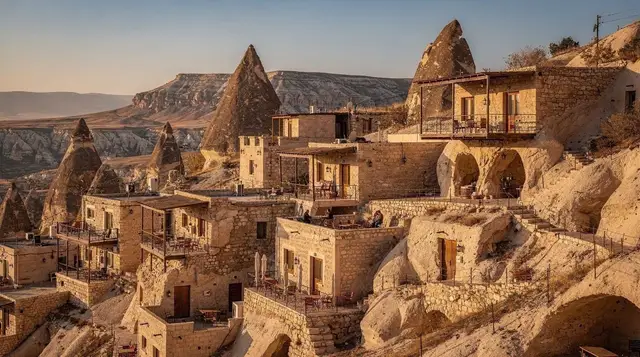
Paşabağ is a roadside cluster of fairy chimneys a few kilometres north of Göreme, and it’s the single most photographed rock formation in the region for a simple reason: several of its chimneys carry not one balanced cap but two, and in one case three, stacked like an unlikely tower of hats. Locals call it Monks Valley, a nod to the hermits who once carved chapels into some of the columns. It isn’t a valley in the sense of Rose Valley or Ihlara — there’s no canyon, no river, no multi-hour walk. It’s a wide, open basin you can cross on foot in half an hour, which is exactly why it works so well as a quick, high-payoff stop.
What makes the double and triple caps
Every fairy chimney in Cappadocia formed the same way: soft volcanic tuf eroded around a harder cap of basalt, which shielded the column beneath it from rain while the surrounding rock wore away. Most chimneys end up with a single mushroom-shaped cap. At Paşabağ, a handful of columns picked up two caps, and one holds three, one balanced above another in a way that looks structurally implausible until you remember it took thousands of years to arrive at that shape, not an afternoon.
Geologists explain the double caps as evidence of two separate volcanic ash layers of different hardness settling on top of each other before erosion carved the softer rock away around both. The effect reads, at ground level, as sculpture rather than geology, and it’s the reason Paşabağ appears on so many Cappadocia postcards.
The hermitage of Saint Simeon is cut into the base of the tallest triple-capped chimney, a small chamber with a chimney flue that Byzantine monks used for solitary retreat between the sixth and thirteenth centuries. You can see the opening from the path; it isn’t open to walk into, and there’s no queue or ticket involved — you look up, take the photograph, and move on.
Paşabağ, Zelve and Devrent compared
These three sit within a few minutes of each other along the same stretch of road north of Göreme, and confusing them is easy until you’ve been to all three. Here’s what actually separates them.
| Paşabağ | Zelve | Devrent Valley | |
|---|---|---|---|
| What’s there | Double and triple-capped fairy chimneys, a hermit’s chapel | Abandoned troglodyte village, three valleys, rock-cut houses and a tunnel | Eroded rock shapes only, no structures |
| Time needed | 20-30 minutes | 45-90 minutes | 20-30 minutes |
| Terrain | Flat, short, paved in parts | Uneven, staircases, a low tunnel | Flat, no shade |
| Entrance fee | None | Yes, separate ticket | None |
| Distance from Göreme | 10 minutes | 10 minutes (adjacent to Paşabağ) | 15 minutes |
| Best for | Photography, a quick stop | Exploring cave interiors, history | Shape-spotting, a very short leg-stretch |
Zelve was inhabited until 1952, when the Turkish government evacuated it over rockfall risk; its houses, a mosque and a monastery are still cut into the cliff face and open to walk through. Devrent Valley, sometimes called Imagination Valley, has no churches and no dwellings at all — just wind-carved shapes that visitors read as animals or, less charitably, as a valley best appreciated in fifteen minutes and then left behind. Paşabağ sits between the two in substance: more sculptural than Devrent, less to explore than Zelve.
Walking the valley
The car park sits right at the edge of the site, and a wide, mostly flat gravel-and-paved path loops through the main cluster of chimneys in a single circuit. There’s no elevation to speak of, no scrambling, and no need for hiking boots — trainers are fine, though the ground can be dusty in summer and slick after rain, as it is across most of the Cappadocia valleys. Side paths branch off toward individual formations and are looser underfoot, so if you’re managing a stroller or have limited mobility, the main loop near the car park covers the highlight views without needing the smaller trails.
Twenty minutes covers the essential walk-through; thirty gives you time to circle back for a second look at the triple-capped column in different light, or to find a quieter angle away from the main viewing point where every tour bus stops. There’s no shade of any real substance, so on a summer afternoon this is a short, hot stop rather than somewhere to linger — one more reason the early-morning or late-afternoon visit works better than midday.
Getting there
Paşabağ is roughly 10 minutes from Göreme by car or taxi, on the same road that continues to Zelve and on to Avanos. There’s no dolmuş that stops directly at the site, since it’s a roadside pull-off rather than a village, so independent travellers generally arrive by rental car, taxi, or as part of an organised tour. If you’re driving yourself between Çavuşin, Zelve and Avanos, Paşabağ sits conveniently on the same stretch and costs you almost no extra time to fold in.
Visiting as part of the Red Tour
Paşabağ is one of the fixed stops on the Red Tour, the half-day circuit that also typically covers the Göreme Open-Air Museum, Zelve, Devrent Valley, Avanos and a viewpoint over Uçhisar. Because every operator running the Red Tour arrives here around the same mid-morning to early-afternoon window, the car park and the first viewing area can feel genuinely crowded for a stretch of an hour or two, with several coaches unloading at once.
a Göreme and Paşabağ Valley day tour covers this stop alongside the open-air museum, while a version that folds in Zelve as well runs as a combined Zelve and Paşabağ tour. If you’d rather do the full northern circuit in one booking, a Red Tour covering Paşabağ, Zelve, Devrent and Avanos is the standard option most agencies in Göreme sell under that name.
Travelling independently avoids the group timing entirely. Arriving under your own steam around 8am, or in the last two hours before sunset, means the car park is often close to empty and the light on the chimneys is considerably more flattering than the flat overhead sun of midday.
Combining Paşabağ with a balloon morning
Several balloon photography add-ons and post-flight breakfast stops use the open ground near Paşabağ and Zelve, since the valley floor here gives an unobstructed view of balloons rising over the wider basin at sunrise. If you’re not flying yourself but want to watch and photograph the launch, a dedicated balloon photo zone tour positions you at viewpoints in this area for the sunrise window before continuing on to the valley itself. It’s worth noting this is a photography vantage tour, not a flight, and a useful option for anyone travelling with someone unable or unwilling to fly.
Practical notes
There’s no entrance fee and no ticket gate at Paşabağ, which sets it apart from Zelve and the Göreme Open-Air Museum, both of which require a separate ticket. The car park has a small row of stalls selling drinks, snacks, onyx trinkets and pottery from nearby Avanos — prices here run higher than in Göreme’s centre, and there’s no pressure to buy. Toilets are available near the car park, sometimes for a small charge. There’s minimal shade across the whole site, so carry water if you’re visiting in the June-to-August stretch of Cappadocia’s dry continental summer, when afternoon temperatures regularly reach the low thirties.
Where Paşabağ fits in your itinerary
For a first Cappadocia visit, Paşabağ works best as a supporting stop rather than a destination in its own right — it doesn’t need its own half-day, and building an itinerary around it alone would waste time better spent at Zelve or in Rose Valley. It slots naturally into a one-day Cappadocia itinerary alongside the open-air museum and Uçhisar, or into a fuller three-day plan as part of a northern-valleys morning. If your main goal for the region is ballooning, pairing an early Paşabağ visit with a balloon flight guide read the night before will help you judge whether conditions and timing line up.
Anyone building a broader northern loop should read up on how Red, Green and Blue Tours are structured before booking, since Paşabağ only appears on the Red route — pairing it with a Green Tour stop on the same day isn’t physically possible, as the two run in opposite directions from Göreme on separate days. For travellers weighing whether to see the valleys with an operator at all, the case for and against is laid out in seeing Cappadocia without a tour.
Photographing the chimneys
Because the site is so compact, the real decision at Paşabağ is not where to walk but where to stand. The first viewing area beside the car park is where every group stops, and it gives the classic frontal view of the triple-capped column. Walk a little further along the loop and the same column starts to overlap with its neighbours, which gives a more layered picture and usually fewer people in the frame. A low angle makes the stacked caps look taller; stepping back and including the open basin around them shows how small the formation is against the landscape.
Light does most of the work here. Early in the day the tuff glows warm and the shadows between the columns are soft, while at midday the rock looks pale and flat. If you are building a photography-led trip, the balloon photography spots guide and the wider viewpoints guide will help you decide which mornings to give to the sky and which to give to the rock. The three-day photography itinerary shows how a stop like this can be fitted around sunrise and sunset sessions.
Why the name Monks Valley
The name belongs to a long tradition in the region. Cappadocia’s soft rock was easy to dig, and hermits and small religious communities carved cells, chapels and storerooms into cliffs and columns well away from towns. Paşabağ is one of the places where that history is visible from the path itself, in the opening at the base of Saint Simeon’s chimney. For a fuller picture of what those communities left behind, read about cave churches and frescoes, then visit the painted interiors that are open to the public at the Göreme Open-Air Museum or in Çavuşin.
The more detailed story of this particular valley, the hermit and the layout of the site, is covered in the guide to Paşabağ and Monks Valley. It is worth reading if the short walk here has made you curious about the people behind the rock.
A sensible order for the northern road
Paşabağ rarely stands alone, so the order in which you take the stops matters more than the stop itself. Coming from Göreme, the road reaches Çavuşin first, then Paşabağ and Zelve side by side, then continues towards Avanos. Taking them in that sequence means you never double back. If you are choosing between spending the saved time at Zelve or at Devrent, the Zelve guide and the Devrent guide explain what each offers, and the Avanos walking guide covers what to do when you reach the river.
Many visitors treat the whole stretch as a morning and keep the afternoon for something slower. If that appeals, a slow day in Cappadocia is a good model, and Cappadocia in one day shows how to squeeze the highlights in when time is short. People who prefer not to follow a tour bus can compare options in guided tour versus self-drive and in getting around without a car.
Travelling with family or limited mobility
Paşabağ is one of the easier stops in the region for mixed groups. The main loop is flat and short, there is no ticket queue, and children can see the strange stacked caps without a long walk. Younger travellers tend to enjoy spotting the tallest column and guessing how it stays upright. Practical advice for the whole region is in Cappadocia with kids and Cappadocia with limited mobility. Keep in mind that the side paths are looser underfoot, so stay on the main loop with a stroller or wheelchair and let the others explore the branches.
The lack of shade is the main thing to plan around. In the hot months, bring water and a hat, and schedule the stop for early morning or the end of the day. The packing list and the guide to Cappadocia in summer cover what to carry, while Cappadocia in autumn and Cappadocia in spring describe the gentler seasons when this stop is at its most pleasant.
Choosing between a tour and going alone
Paşabağ is a case where both approaches work. A tour removes the need to arrange transport and puts the stop in context with the other valleys, which suits first-time visitors who want a guide to explain what they are looking at. Going alone gives you control over timing, which matters here because the difference between a crowded car park and an empty one is largely a question of the hour. If you drive yourself, the car rental guide and driving in Cappadocia are useful, and the Red Tour versus Green Tour comparison explains why this stop sits on the Red route. For the crowd pattern across the day, the blog post on Cappadocia crowds hour by hour is a helpful companion.
Nearby stops worth adding
Immediately next door, Zelve Open-Air Museum rewards the extra 45 minutes to an hour with actual buildings to walk through — houses, a mosque, and a low tunnel connecting two of its three valleys. A short drive further brings you to Devrent Valley, which needs barely more time than Paşabağ itself and makes a natural third stop on the same outing.
Çavuşin, with its Church of Saint John the Baptist and abandoned hillside village, sits on the same road back toward Göreme and adds real historical depth if you have the time. Travellers continuing on to Avanos can round off the day with a pottery workshop on the banks of the Kızılırmak river, a contrast in pace from the valley-hopping earlier in the day.