Çavuşin: church and old village guide
What is there to see at Çavuşin?
Çavuşin has two separate sights: the Church of Saint John the Baptist, one of the oldest rock-cut churches in Cappadocia and partly collapsed, and an abandoned cliffside village of troglodyte houses directly above it. Both sit beside the modern village, on the road between Göreme and Avanos, and take under an hour to see together.
Two sights in one village
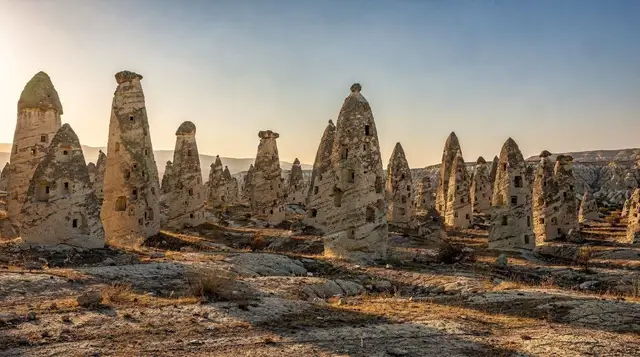
Çavuşin gets folded into day-trip itineraries as a five-minute photo stop, and that undersells it slightly. There are two distinct things to see here, stacked on top of each other. At street level, beside the modern village where people still live, is the Church of Saint John the Baptist, one of the oldest rock-cut churches in the region. Above it, filling the cliff face, is an abandoned troglodyte village that was inhabited until rockfall made it unsafe and the population moved down to the valley floor. They’re often described together as “Çavuşin” without much distinction, but they’re different experiences: one is a roofed, if damaged, church you walk into; the other is an open cliff you climb through.
This isn’t the same place as Zelve, a few minutes further along the same road, which has its own guide and its own ticket. Çavuşin has no equivalent of Zelve’s three valleys and marked circuit — it’s smaller, unticketed on the village side, and rougher underfoot.
The Church of Saint John the Baptist
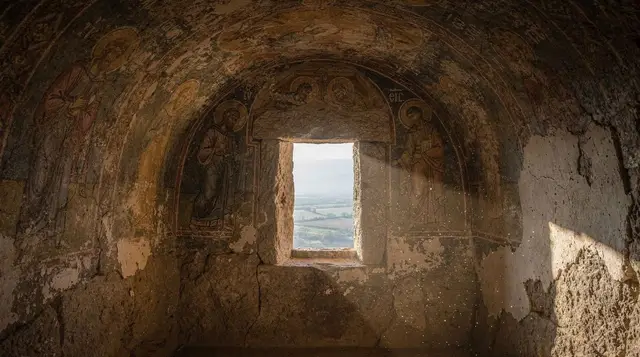
The church sits at road level, cut into the base of the same cliff that carries the old village above it. It’s among the oldest churches in Cappadocia, and it shows: the façade has partly collapsed, and what survives is a fraction of a larger structure. Inside, faded frescoes remain on the ceiling and upper walls, weathered rather than restored, which is part of what makes it feel different from the more complete churches at the Göreme Open Air Museum — this one reads as a ruin you’re allowed to stand inside, not a preserved exhibit.
There’s a small entrance fee to go in. It’s a five-minute visit on its own; the frescoes are dim and the space is compact, so bring a torch or your phone’s light if you want to see the ceiling properly. If churches and frescoes are the specific draw for you, the broader picture across the region — which sites have the best-preserved paintings and why — is covered in the cave churches and frescoes guide, and the single best-preserved example, the Karanlık Kilise inside Göreme’s museum, has its own page.
The old village on the cliff
Above and behind the church, the cliff face is honeycombed with the abandoned houses of the old village — carved rooms, doorways, and the odd staircase, stacked over several levels up the rock. People lived here until the structure was judged unstable, at which point the village relocated to the valley below, where it still functions as an ordinary Cappadocian town with houses, a mosque, and a handful of cafés rather than a heritage site.
You can walk up into the old village and through a number of the rooms. This is the part worth being clear-eyed about: access is informal. There’s no ticket booth, no marked route, and no maintained staircase — you follow whatever paths previous visitors have worn into the rock and scramble where the rock requires it. That’s a real difference from the Göreme Open Air Museum, where walkways, railings, and signage keep the route predictable. At Çavuşin, some sections are fenced off because they’ve collapsed or are judged too unstable to enter, and it’s worth respecting those barriers rather than working around them — the whole point of Çavuşin’s old village is that it’s still eroding.
Wear shoes with grip, expect to use your hands on a couple of the climbs, and don’t push into rooms that look freshly cracked or that require an awkward reach to enter. The light is best in the morning, when the sun catches the cliff face directly and the interior chambers get enough daylight to see by without a torch.
Why it’s a stop, not a destination
Çavuşin sits directly on the road between Göreme and Avanos, about five minutes from Göreme by car and roughly ten from Avanos. That position is most of the reason it works as well as it does: nobody plans a dedicated trip out to Çavuşin, but almost everyone passes it anyway on the way to Avanos’s pottery workshops, to Paşabağ, or to Zelve. Treat it as a 30-to-45-minute stop folded into that drive rather than a half-day plan of its own.
This is also where Çavuşin overlaps with the region’s organised circuits. It sits inside the loop covered by the Red Tour, the northern day-tour route that also takes in the Göreme museum, Paşabağ, Zelve, Devrent, and Avanos, so if you’ve booked a Red Tour you may already pass through without arranging anything separately.
| Combine Çavuşin with | Distance from Çavuşin | Why |
|---|---|---|
| Paşabağ | ~5 minutes | Same road toward Avanos, the mushroom-shaped chimneys with double and triple caps |
| Zelve | ~5 minutes | Larger ticketed open-air site with three valleys, a proper contrast to Çavuşin’s informal climb |
| Avanos | ~10 minutes | Pottery workshops on the Kızılırmak river, a natural end point for the drive |
| Devrent Valley | ~10 minutes | Flat, ten-minute stop with no church or village, just eroded rock shapes |
Doing it without a tour
Çavuşin doesn’t need a guide. There’s no complex layout to navigate, the church has a small sign at the entrance, and the old village is simply a cliff you climb — a guide adds context about the frescoes and the village’s history but isn’t necessary to see the site. A rental car or taxi from Göreme covers it easily as part of a loop toward Avanos; the general logistics of seeing the region’s sights independently, including where dolmuş minibuses do and don’t reach, are set out in seeing Cappadocia without a tour.
If you’d rather have it arranged, Çavuşin usually appears as one stop among several rather than the focus of a booking. A Red Tour that includes Zelve and lunch typically passes through here on the same loop:
a Red Tour combining Zelve, the open-air museum route, and lunchFor a more focused look at the region’s church sites specifically, including Çavuşin alongside others on a private itinerary, there’s:
a private full-day tour of Cappadocia’s sacred churchesor, in a smaller-group format:
a luxury private tour built around the region’s rock-cut churchesTravellers who want the village and valley side of the region rather than another church circuit can look at:
a guided tour through Cappadocia’s quieter valleys and villagesHow to pace the visit
The easiest mistake at Çavuşin is to treat it like a museum with a fixed route. There isn’t one, and that’s the reason to slow down. Start at the church, since it gives you the context for everything above it: this is a place where people prayed, and the same cliff later became where they lived. Once you’ve seen the faded paintings, step back onto the road and look up at the cliff as a whole before you climb. From a distance the doorways and window openings read as a pattern, and it’s easier to pick a route up when you can see which levels connect.
Then climb in stages. Go up one level, look into the rooms, and come back to the path before deciding whether to go higher. The rooms are quiet and the rock absorbs sound, so you’ll notice how still the interior feels compared with the road below. Take your time with the view back over the modern village and the fields; it’s one of the better places in the area to understand how the settlement sat against its cliff, and it costs nothing.
If you’re travelling with others, agree on a turning point before you start. Someone who is happy on the first level may not want the third, and the climbs are easier to judge from the ground than halfway up. That matters even more with children, who tend to run ahead on rock; our notes on Cappadocia with kids cover how to choose sites that suit them, and the hiking safety guide sets out the habits that apply here too.
Photographing the cliff and the church
Çavuşin rewards a few minutes with a camera more than most quick stops do. The cliff face is the main subject, and its texture changes with the angle of the sun. In the morning, when the light hits the rock directly, the doorways and carved openings stand out sharply. Later in the day the same face can look flat. If you’re building a photo-focused day around the northern road, the balloon photography spots guide and the viewpoints guide will help you decide where else to spend your light.
Inside the church, avoid forcing a flash onto the paintings. The frescoes are faded, and a phone light held at an angle shows more than a flat blast of white. Be considerate of anyone else standing in the small space; it fills quickly with a couple of people. Outside, give the fenced sections a wide berth when you frame a shot, and never step past a barrier to get a better angle.
Before and after Çavuşin
Because the stop is short, what surrounds it shapes the day. Coming from Göreme, many travellers combine it with the Göreme walking guide the evening before, so they arrive in the morning already familiar with the local rock formations. Heading on, the road leads naturally to Paşabağ and its monks’ valley, to the Zelve open-air museum, and to the potters of Avanos.
A taxi or rental car makes the sequence painless, and the logic of choosing between them is laid out in driving in Cappadocia and guided tour versus self-drive. If you’ve booked a small-group or private arrangement, Çavuşin often slots in without any extra effort, because the route already runs past it. For travellers who prefer a church-focused day, the hidden valleys and village option above suits those who want fewer ticketed sites and more time in places that are still lived in.
What Çavuşin is not
It’s worth being direct about scale. Çavuşin is not a substitute for the Göreme Open Air Museum, which has around a dozen churches and takes 90 minutes to two hours to see properly, nor for Zelve, which spans three valleys. Çavuşin is one damaged church and one cliff of houses. If your time in the region is limited to a single day, it fits comfortably alongside other short stops on a one-day itinerary, but it shouldn’t be the anchor of the day on its own.
It also isn’t a place to expect facilities. There’s no visitor centre, no café at the site itself, and no shade beyond what the cliff casts — the modern village below has a few small cafés if you need a break before or after.
Who will enjoy it most
Çavuşin suits travellers who like to feel a place rather than be told about it. If you enjoy poking into empty rooms, noticing how a household once fitted into solid rock, and reading a ruin without a panel explaining it, you’ll get a lot from the cliff. If you’d rather have everything interpreted and tidy, the Göreme Open Air Museum guide is the better fit, and Çavuşin then works best as a quick contrast on the same day.
It also suits people who are tired of crowds. Because the village side has no ticket booth and no fixed circuit, groups tend to pass through briefly and move on, which leaves long gaps when you can have a doorway or a view to yourself. Visitors with limited mobility should read Cappadocia with limited mobility first, since the church is easy to reach from the road but the climb into the old village is not.
Finally, it’s a good stop for anyone building a loose, unhurried day. Pair it with a coffee in the modern village, a look at the pottery in Avanos, and a slow drive back, and it becomes part of the kind of day described in a slow day in Cappadocia.
Practical notes
- Getting there: on the main road between Göreme and Avanos; a taxi from Göreme takes about five minutes, and it’s an easy stop if you’re driving yourself toward Ürgüp or Avanos via the northern loop.
- What to bring: closed shoes with grip for the climb into the old village, a phone light or torch for the church interior, and water — there’s no shade on the cliff face.
- Timing: the church and old village together take 30 to 45 minutes; morning light works best for photographing the cliff and for seeing inside the upper rooms.
- Ticketing: a small fee for the Church of Saint John the Baptist; the old village and its paths are open without a ticket.
- Safety: stay off any section that’s fenced or visibly cracked. The climbing routes are worn into the rock by previous visitors rather than built or maintained, which is the trade-off for having the old village open at all.
Çavuşin church and old village: FAQ
Is Çavuşin worth a stop if I’ve already seen the Göreme Open Air Museum?
Yes, for a different reason. Göreme’s museum is curated and busy; Çavuşin is a single old church plus a cliff of abandoned houses you climb into yourself, with no ticket queue and far fewer visitors.
Is the old village at Çavuşin safe to walk around?
Mostly, if you stay on the worn paths and keep off collapsed sections. Access to the upper houses is informal rather than maintained, so there are no railings, uneven rock steps, and drops that aren’t signposted.
How long does Çavuşin take to visit?
Allow 30 to 45 minutes for the church and old village together, more if you want to climb through several of the houses. It works as a short stop on the way to or from Avanos rather than a half-day destination.
Is Çavuşin the same as Zelve?
No. Zelve is a separate, larger open-air site a few minutes further on, with its own entrance fee and three valleys of dwellings. Çavuşin is a village with a church and a cliff you can walk up to freely.
Do I need a ticket for Çavuşin church?
There’s a small entrance fee for the Church of Saint John the Baptist. The old village and the paths up the cliff around it are open and unticketed.
Can I combine Çavuşin with Paşabağ and Avanos in one trip?
Yes, and it’s the natural pairing. All three sit on the same road within about ten minutes of each other, so a single taxi or rental car covers all three without doubling back.
Museum & art tours on GetYourGuide
Verified deep-linked GetYourGuide tours. Book through these links and we earn a small commission at no cost to you.
GetYourGuide does not provide a product photo for this activity — the image shows the meeting point, photographed by us.