Cappadocia with limited mobility: what's realistic
Is Cappadocia accessible for someone with limited mobility?
Partly. Car-reached viewpoints at Uçhisar and Ortahisar, several valley overlooks, and the main paths of the Göreme Open-Air Museum are workable. The underground cities at Derinkuyu and Kaymaklı, the valley trails, and the stepped descent into Ihlara Valley are not — the terrain and construction rule them out regardless of how the visit is arranged.
Cappadocia was not built for wheelchairs or for anyone who struggles with stairs and uneven ground. The region’s whole appeal — fairy chimney valleys, cave churches, underground cities cut into soft rock — is also exactly what makes so much of it physically hard to reach. This page is not a reassurance piece. It sets out, place by place, what a visitor with limited mobility can genuinely do in and around Göreme, and what they cannot, so a trip can be planned around the real terrain rather than around a brochure photo.
What actually works if you have limited mobility
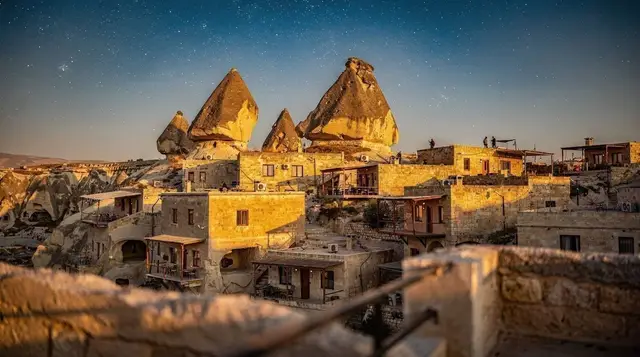
The best news first: Cappadocia’s most photographed views do not require walking far. Uçhisar, the region’s highest point, has a lower viewpoint reached directly by road, from which the rock outcrop and the valleys below are clearly visible without climbing into the Uçhisar Castle itself, which does involve narrow stone stairs. Ortahisar is similar — the town sits at street level around its own rock outcrop, and much of it can be seen without approaching the Ortahisar Castle stairway.
Several valley overlooks along the road between Göreme and Uçhisar work the same way: a car pulls into a roadside car park, and the view opens up a few steps from the vehicle. This is also how most people watch the hot air balloons at sunrise — from a fixed spot, on level or gently sloping ground, rather than from inside a valley trail.
The Göreme Open-Air Museum is a partial yes. Its main path through the site is a reasonably even walkway, and it’s possible to see the exteriors of most of the rock-cut churches, several rock-cut kitchens and monastic cells, and the general layout of the site without difficulty. Where it breaks down is at each individual church entrance — nearly all are reached by their own short stone stairway or a low, sloped doorway, and there’s no ramped alternative.
The separately ticketed Karanlık Kilise, the best-preserved of the group, is entered the same way. A realistic plan is to walk the main path and view several churches from their entrances, treating the interiors as a bonus rather than a given. The full walk-through is covered in the museum guide and the Dark Church guide.
Devrent Valley, the so-called Imagination Valley, is one of the few valley sites that’s genuinely workable. It has no churches and almost no elevation change — the eroded chimney shapes are visible from the car park and from a short, flat stretch of path. Paşabağ, with its distinctive multi-capped chimneys, can also be appreciated from the roadside without walking among the formations, though getting closer to the rock-cut hermitage inside one of the chimneys does involve uneven ground and a narrow stair.
A number of restaurants and cafés in Göreme, Ürgüp and Avanos operate from ground-floor premises with level or near-level entrances — it’s worth asking directly when booking rather than assuming, since many of the region’s best-known viewpoint cafés are built up a slope specifically for the view.
Where the terrain genuinely says no
It’s worth being direct about this rather than qualifying it. The two draws that most visitors put at the top of a Cappadocia list — the underground cities and the valley hikes — are not realistically accessible with limited mobility, and no amount of planning or a private guide changes the physical construction of the sites.
The underground cities
Derinkuyu descends roughly 85 metres through eight levels open to the public, and Kaymaklı spreads across four levels that are wider but have noticeably lower ceilings. Both were carved as defensive spaces, not as places anyone was meant to move through comfortably — the connecting passages are narrow, low enough in places to force adults to stoop for long stretches, and the vertical movement between levels is entirely by rock-cut stone stairs with no ramp, lift or level alternative route.
There is no shortened or accessible circuit at either site. The full picture of how the tunnels are laid out is in the Derinkuyu guide and the Kaymaklı guide — both are worth reading before deciding whether to attempt even a partial visit near the entrance.
The valley trails
Rose Valley, Red Valley, Pigeon Valley and Meskendir Valley are all walked on bare tuff — a soft volcanic rock that erodes into an uneven, often dusty and sometimes sloped surface. None of these trails is paved, none has handrails, and the paths frequently split without a clearly marked accessible option. This is true even close to the trailheads; the difficulty doesn’t wait until deep into the walk. If a Cappadocia itinerary is built primarily around these valleys, this is the point to swap that plan for the viewpoints and car-reached sites covered above.
Ihlara Valley
Ihlara Valley is the clearest case where a single physical feature settles the question. The main access point is a stairway of roughly 380 steps down from the plateau rim to the canyon floor, and it’s the only practical way in from that end. There’s no accessible alternative entrance to the four-kilometre walked stretch between the stairway and the hamlet of Belisırma, and the Selime monastery at the valley’s far end involves its own rock-cut stairs and sloped chambers. The full route is set out in the Ihlara Valley hiking guide — read it as a description of what’s being ruled out, not as an accessible plan.
A site-by-site summary
| Site | Realistic for limited mobility | Why |
|---|---|---|
| Uçhisar viewpoint (base) | Yes | Car-reached, short level approach |
| Ortahisar town | Mostly | Street-level views; castle interior has stairs |
| Göreme Open-Air Museum, main path | Partially | Even walkway; each church entrance has steps |
| Devrent Valley | Yes | Flat, short, viewable from the road |
| Paşabağ (roadside view) | Mostly | Chimneys visible from car park; close approach is uneven |
| Derinkuyu / Kaymaklı underground cities | No | Stooped corridors, stone stairs, no accessible level change |
| Rose, Red, Pigeon, Meskendir valleys | No | Uneven, unpaved, often sloped tuff |
| Ihlara Valley | No | Roughly 380-step descent, no alternative entrance |
| Selime monastery | No | Rock-cut stairs and sloped interior chambers |
Cave hotels: nothing here can be assumed
Sleeping in a cave-cut room is the default way to stay in Göreme, and it’s genuinely one of the region’s better experiences — but it’s also the category where a general answer would actively mislead. A cave hotel spans two very different kinds of building: a room that’s truly carved into the rock, which tends to be reached by stone steps and often sits above ground level with no lift, and a room built in cave style with conventional masonry, which can be arranged on the ground floor with a level threshold. From photographs alone, the two are close to indistinguishable.
What this means in practice: check accessibility with each specific hotel before booking, not with the category as a whole. Ask directly about the number of steps from the street to the room, whether a ground-floor or garden-level room exists, the width of doorways, and whether the bathroom has a step up into it — a detail that’s common even in otherwise easy-access rooms. The general shape of what to expect from cave-hotel construction is covered in Cave hotels explained, and a wider view of where to base a stay is in Where to stay in Cappadocia.
Getting around without long walks
A private car, ideally with a driver or guide for the day, is the most workable way to see Cappadocia with limited mobility — not because it removes every obstacle, but because it removes the walk between them. A private tour can stop at each viewpoint, wait at the car, and skip any site that turns out to be worse in person than expected, which a fixed-group bus itinerary can’t do. It’s also the only way to structure a day around the sites in the “works” column above without wasted time or unplanned stairs.
A tour along these lines is genuinely useful here — a private day tour of Cappadocia’s highlights can be shaped around viewpoints and level ground rather than a preset walking route, which a shared minibus tour cannot offer.
Self-driving is an option covered in Car rental in Cappadocia and Driving in Cappadocia, and it gives the same flexibility without a driver’s cost, though it removes the option of someone else handling parking and navigation on unfamiliar roads. Dolmuş minibuses, the shared vans that link Göreme, Ürgüp, Uçhisar and Avanos, are cheap and frequent but involve a step up at the door and no accessible route once dropped off — more on how they work in Public transport in Cappadocia and Getting around without a car.
For the classic minibus circuits — worth knowing even if only parts are workable — the Red, Green and Blue tour guide explains what each covers; the Red Tour in particular includes several car-reached viewpoints alongside the underground-city and valley stops that won’t be practical. A version built around the accessible portions, such as a guided Red Tour taking in Göreme’s northern viewpoints, can still be worth booking selectively — ask the operator in advance which stops can be skipped or shortened.
Balloons, wine and other seated or standing options
Watching the sunrise balloons is one of the most reliably accessible experiences in the region, since it requires standing or sitting at a fixed, car-reached point rather than walking a route — a sunrise balloon-viewing tour by SUV covers exactly this, without any expectation of flying. Actually flying is a separate decision: boarding a balloon means stepping over the side of a wicker basket with internal compartments and no ramp or lift, so it needs a direct conversation with the operator about what’s involved before booking, not an assumption either way.
Wine tasting is another category that tends to work well, since Cappadocia’s cellars in and around Ürgüp are generally accessed at ground level and the tasting itself is seated — a full-day tour combining sightseeing with a wine tasting pairs car-reached viewpoints with a low-effort stop later in the day.
Pacing the day and choosing the hours
Limited mobility is as much about energy as about terrain, so the shape of the day matters. Cappadocia rewards early starts: the light is soft, the car parks are quieter, and the viewpoints can be taken in without being jostled. A sensible rhythm is one main outing in the morning, a long seated lunch, a rest back at the hotel through the hottest or coldest part of the day, and one short, easy stop in the late afternoon. Trying to fit in every stop is the quickest way to spoil the ones that work.
Build in slack between stops. A driver who knows the region will be happy to wait while you sit with a tea, and several viewpoints reward simply staying put and watching the light change on the rock. The viewpoints guide lists the places where that works best, and the point of choosing them is that the view does the work, not the legs.
Practical details that make a difference
A few small preparations remove most of the friction. Ask the driver or guide in advance where the vehicle can stop closest to each site, since car parks differ a great deal in how near they are to the view. Carry a folding seat or a walking stick if you use one at home; surfaces that look level from the car are often loose gravel or dusty tuff underfoot, and shoes with a firm sole are far more useful than anything fashionable. Bring water and a hat in the warmer months, and warm layers in winter, because the wait at a roadside viewpoint can be longer than the walk to it.
Weather changes what is workable. Rain turns the soft rock surfaces slippery and the paths muddy, and winter can bring ice to steps and slopes that are harmless in summer — see Cappadocia in the snow before planning a cold-season trip. If the forecast is poor, swap an outdoor stop for something indoors and seated; the ideas in the rainy-day section of the site are worth a look.
Finally, say plainly what you need when you book. Operators, drivers and hoteliers in the region are generally helpful once they know the real constraints, but they cannot adjust for something they have not been told. Being specific about stairs, distances on foot and how long you can stand saves both sides an awkward moment at the foot of a stairway.
Planning around the honest picture
None of this rules out a trip to Cappadocia with limited mobility — it rules out treating the region the way most itineraries are written, as a string of valley walks and underground-city visits. A realistic three- or four-day plan built around Uçhisar and Ortahisar’s viewpoints, the walkable stretch of the Göreme Open-Air Museum, Devrent Valley, sunrise balloon watching, a wine cellar, and a private car between them is a genuinely full trip — it’s just a different one from the standard version, and it needs to be planned that way from the start rather than adjusted on arrival when the first flight of underground stairs appears.
A wider view of how many days that kind of trip needs is in How many days in Cappadocia, and general terrain and footwear notes that apply to anyone, mobility aside, are in the Cappadocia packing list.
Trip-planning essentials on GetYourGuide
Verified deep-linked GetYourGuide tours. Book through these links and we earn a small commission at no cost to you.
GetYourGuide does not provide a product photo for this activity — the image shows the meeting point, photographed by us.