Where Ortahisar sits and why it’s used as a base
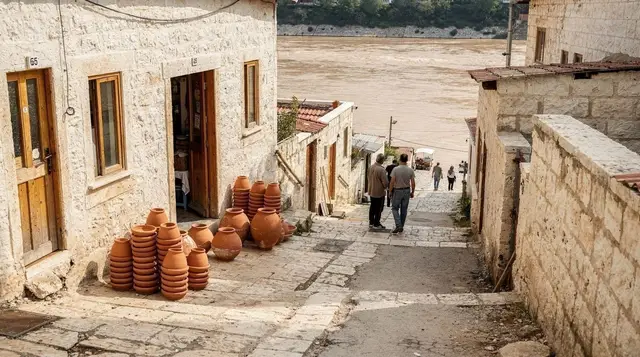
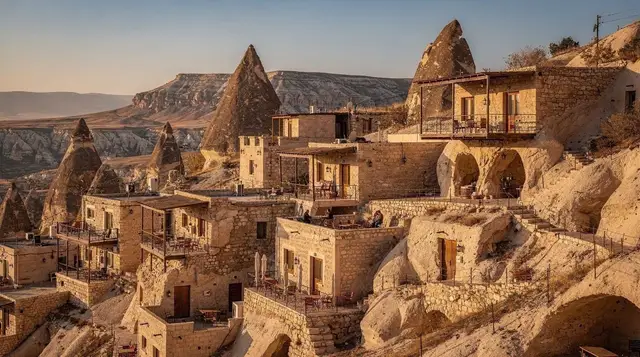
Ortahisar is a village of stone houses and tuff caves about ten minutes by road from Göreme and roughly the same distance from Ürgüp. It sits slightly off the main tourist through-road, which is the first thing you notice: fewer buses, fewer group hotels, and a village square that still functions as a village square rather than a strip of souvenir shops. The rock-cut castle that gives the village its name and its skyline is the reason most people come here for an hour, but that castle and its viewing platform have their own page — this one is about staying in Ortahisar, not climbing it.
As a base, the appeal is straightforward. You’re close enough to Göreme’s museum, cafés and tour agencies, and to Ürgüp’s wine cellars and restaurants, that neither feels far away. At the same time, you sleep somewhere quieter, without a balloon-viewing crowd gathering under your window at dawn or minibuses idling outside a neighbouring hotel until midnight. Whether that trade-off suits you depends entirely on what you want from your evenings, and that’s worth being honest about before you book.
The storage caves: what Ortahisar is actually known for locally
Long before Cappadocia had a tourist industry, Ortahisar had a reputation among people who grew and sold fruit. The tuff rock that the whole region is carved from holds a near-constant cool temperature year-round, and Ortahisar’s caves — carved deep and kept dark — turned out to be unusually good at it. Traders used to bring citrus fruit up from the Mediterranean coast, hundreds of kilometres south, and ripen it slowly in these caves rather than let it spoil in the heat of transport. That trade shaped the village for generations: warehouse caves, not show caves, cut for volume rather than display.
The same caves are still used today, on a smaller and more domestic scale, by local families storing apples and potatoes through the winter months. It isn’t a tourist attraction in the way the open-air museum is — there’s no ticket booth and no fixed opening hours for most of them — but it’s the detail that explains why Ortahisar looks and feels different from a village built around cave hotels alone.
Walk the back lanes below the castle and you’ll pass doorways cut into the rock that are still doing exactly the job they were cut for a century or more ago, stacked crates and all. If you’re curious about how the storage system actually works, ask at your guesthouse; many owners have family who used the caves themselves and will talk about it more readily than any information board would.
Getting there and getting around
From Göreme, a taxi to Ortahisar takes about ten minutes and costs a modest, fairly fixed fare that your hotel can confirm before you leave. Dolmuş minibuses also run this route through the day, connecting Ortahisar with Nevşehir, Göreme and Ürgüp, though services thin out after early evening — the same pattern that holds across the region. If you’re driving yourself, Ortahisar sits just off the road between Göreme and Ürgüp, and parking in the village is easier than in either of those two.
Within the village, everything is walkable. The centre is small enough that most guesthouses are a five-to-ten-minute walk from the square, and the streets are steep stone lanes rather than a grid, so a car is more useful for day trips out than for getting around once you’ve arrived.
Walking to the valleys from here
One of the more practical reasons to base yourself in Ortahisar is that two of the region’s valley trails start close enough to reach on foot. Meskendir Valley and the White Valley both connect through to Ortahisar, and walking one or both from the village avoids the need to arrange transport to a trailhead first.
Neither is a long or difficult route by Cappadocia standards — a couple of hours each at an easy pace — but they follow the same rules as every valley walk here: wear closed shoes, carry water, and expect little to no shade once you’re past the first stretch. Paths through soft tuff can be slippery after rain and dusty in dry weather, and phone signal drops away once you’re down inside the canyon walls.
Walking out from your accommodation rather than driving to a trail car park is a genuine advantage of staying here, particularly if you’re planning an early start before the heat builds in summer.
What the village doesn’t have — and who that suits
This is the part worth being direct about. Ortahisar has noticeably fewer restaurants than Göreme or Ürgüp, and almost nothing in the way of bars, rooftop terraces with music, or late-opening cafés. A handful of places around the main square serve straightforward Turkish food — pide, gözleme, grilled dishes — and a few cave hotels run their own restaurants for guests, but you won’t find the density of options that lines Göreme’s main street or fills Ürgüp’s old town in the evening. After dinner, the village is quiet; shops close early and the streets empty out.
That’s neither a flaw nor a selling point on its own — it depends on what you’re after. If your idea of a good evening in Cappadocia involves trying several restaurants, browsing shops after dark, or finding a terrace with live music, you’ll get more of that staying in Göreme or Ürgüp and treating Ortahisar as a stop rather than a base. If you’d rather have a quiet cave room, a short walk to dinner, and an early night before a valley walk or a balloon flight, the same limited choice reads as exactly what you came for. Many visitors split the difference: they stay in Ortahisar and drive the short distance into Ürgüp or Göreme for dinner a couple of nights during their stay, which works well given how close all three villages are.
Ortahisar compared with Göreme and Ürgüp as a base
| Göreme | Ürgüp | Ortahisar | |
|---|---|---|---|
| Restaurants and cafés | Dense, aimed at travellers | Wide range, more local mix | Limited, a handful in the centre |
| Evening atmosphere | Busy, tour-agency strip | Lively but calmer than Göreme | Quiet, most shops close early |
| Balloon-viewing crowds at dawn | Heavy, right in the village | Lighter | Light |
| Distance to open-air museum | Walkable | ~15 minutes by road | ~10 minutes by road |
| Distance to valley trailheads | Several within walking distance | Short drive to most | Meskendir and White Valley reachable on foot |
| Cave hotel character | Wide range, from budget to luxury | Mostly mid-range and up | Smaller properties, often family-run |
None of these is objectively the right choice — it’s a question of what kind of few days you want. Travellers weighing this exact decision in more depth can read the fuller comparison in the Göreme, Ürgüp or Uçhisar guide, which covers a third option this table leaves out.
What a day based in Ortahisar looks like
A typical stay here isn’t built around Ortahisar itself so much as around what it lets you reach easily. A common pattern: an early balloon flight if the weather cooperates, breakfast back at the guesthouse rather than joining the queue for a viewpoint café, a walk down through Meskendir or the White Valley while the morning is still cool, then a drive into Ürgüp or Göreme for lunch and the afternoon’s main sight. Evenings are spent back in the village, often with dinner at the hotel or one of the few places on the square, before an early night — useful if the next morning’s balloon call time is another 4am wake-up.
For a full day out from Ortahisar rather than a half-day, the Green Tour is the one that makes most geographic sense, since it runs south towards the underground cities and Ihlara valley, a direction that suits Ortahisar’s position better than the northern Red Tour circuit.
a full-day Green Tour covering an underground city, Ihlara valley and Selime is a reasonable way to see the southern sights without driving yourself, and it can be picked up from hotels across the Ürgüp-Ortahisar area, not just from Göreme.
If you’d rather not join a group and are staying centrally, a private sightseeing day with your own guide and vehicle lets you set the pace and skip the parts of a fixed itinerary you don’t need — useful if you’ve already done some of the standard stops on a previous visit.
Where to eat, and where to go when you want more choice
Ortahisar’s own options are enough for a night or two without a car: expect straightforward pide and grilled meat places around the square, priced a little below what the same dish costs in Göreme’s main tourist strip, and one or two hotel restaurants that welcome outside diners if booked ahead. For a wider range — meze, wine-focused menus, or anything more ambitious — Ürgüp is the short drive most guesthouses will recommend, and its restaurant scene is covered in more detail in the where to eat in Ürgüp guide.
One local option worth knowing about is a set-menu evening built specifically around Ortahisar’s cave setting.
a traditional dinner and folk show held in one of Ortahisar’s cave venues bundles a meal with music and dance in a way that solves the “nothing’s open” evening problem in one booking, and it’s held in the village itself rather than requiring a drive out.
Cave hotels here versus elsewhere
Ortahisar’s cave hotels tend to be smaller and more often family-run than the larger properties clustered in Göreme, which suits the village’s general pace. Rooms genuinely cut into the rock stay noticeably cooler in summer and can run cold in winter without good heating, so ask specifically whether a room is a true cave or a stone-built “cave style” room before booking — the difference matters more for comfort than the photos usually show.
The general trade-offs of sleeping in a cave room, including ventilation, natural light and stairs, are covered fully in the cave hotels explained guide; Ortahisar doesn’t differ from the regional pattern, it just offers it on a smaller scale with fewer properties to choose between.
Combining Ortahisar with an underground city day
Given the village’s position, a day trip south to one of the underground cities pairs naturally with a stay here, since you’re already oriented towards the Green Tour’s direction rather than the northern valleys.
a guided tour of Derinkuyu’s underground city covers the deepest of the publicly open sites, with a guide explaining the ventilation shafts, stables and stone doors as you go — worth having someone narrate it rather than working through the tunnels alone on a first visit. Full detail on choosing between Derinkuyu and Kaymaklı, including which suits people uneasy in tight spaces, is in the underground cities guide.
Practical notes for staying in Ortahisar
Cash is more useful here than in Göreme or Ürgüp, since some of the smaller family-run guesthouses and the handful of village shops don’t reliably take cards — carry a modest amount of Turkish lira for incidentals. Mobile signal in the village itself is fine; it’s only once you drop into the valley trails that it disappears. If you’re staying two or three nights, ask your host about the storage caves near your accommodation — many properties have one on-site, sometimes still in occasional use, and owners are usually happy to show it if asked rather than presenting it as a formal feature of the stay.
Frequently asked questions about staying in Ortahisar
Is Ortahisar too quiet for a first visit to Cappadocia?
Not necessarily, but it changes the shape of your evenings. If seeing the main sights by day and having a relaxed, low-key evening suits you, Ortahisar works well even on a first trip. If you want restaurant choice and evening activity within walking distance, Göreme or Ürgüp fit a first visit more comfortably, with Ortahisar better suited to a return trip or a couple of nights within a longer stay.
How far is Ortahisar from Göreme’s open-air museum?
About ten minutes by road. It’s an easy add-on to a museum visit rather than a separate excursion, and several tours that stop at the museum also pass through or near Ortahisar.
Can I walk from Ortahisar into the valleys without a guide?
Yes — Meskendir Valley and the White Valley both connect to Ortahisar and are walked independently by many visitors. Paths aren’t always obviously marked, footing on tuff can be loose or slippery, and there’s little shade, so go prepared with water and check the general direction before you set off, particularly outside the cooler months.
Is there anywhere to eat dinner in Ortahisar itself?
A small number of places around the main square serve Turkish staples, and some cave hotels run their own restaurants for guests. Choice is limited compared with Göreme or Ürgüp, so many visitors staying here plan on driving the short distance to Ürgüp for one or two dinners during a longer stay.
Should I stay in Ortahisar or Ürgüp?
It comes down to what you want in the evening. Ürgüp has more restaurants, wine cellars and general activity after dark; Ortahisar has less noise, fewer crowds and a quieter pace, at the cost of restaurant choice. Both are similarly placed for reaching Göreme’s sights and the wider region.
Are the storage caves in Ortahisar open to visitors as an attraction?
Not in a formal, ticketed sense — they’re working or formerly working storage spaces rather than a museum exhibit. Some cave hotels have one on-site and will show guests on request; otherwise, they’re best appreciated by noticing the doorways cut into the rock around the village rather than by seeking out a specific site to visit.
Does Ortahisar have its own cave hotels, or do I need to book in Göreme?
Ortahisar has its own selection of cave hotels, generally smaller and more often family-run than the larger properties in Göreme. There’s no need to base yourself elsewhere and commute in — booking directly in the village is straightforward and often better value than a comparable room in Göreme’s busiest streets.
Is Ortahisar a good base for an underground city day trip?
Yes — its position slightly south of Göreme puts it on a sensible route towards Derinkuyu, Kaymaklı and the Green Tour circuit, which runs south rather than through the northern valleys near Göreme.