Cave hotels in Cappadocia, explained
What's the difference between a cave hotel and a cave-style hotel in Cappadocia?
A genuine cave room is cut directly into the tuff rock, which keeps it cool in summer, mild in winter, and often without an exterior window or mobile signal. A cave-style room is built with stone or plaster to look the same but sits in an ordinary structure, so it doesn't hold the same temperature or silence. Listings rarely make the distinction clear, so it's worth checking with the hotel directly before you book.
“Cave hotel” is the single most misleading phrase in Cappadocia’s accommodation listings, not because it’s dishonest exactly, but because it covers two genuinely different products: a room cut directly out of the volcanic rock, and a room built to resemble one. Both get called a cave hotel. Only one of them behaves like a cave. If you’ve booked in Göreme expecting the cool, silent, slightly odd experience people describe, it’s worth knowing which one you’re actually getting before you arrive.
What a genuine cave room is
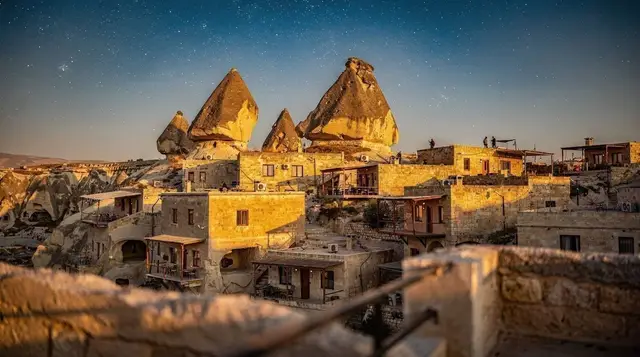
A real cave room in Göreme, Ürgüp, or Uçhisar is carved out of the same soft volcanic tuff that shapes the fairy chimneys and underground cities across the region. Builders and hoteliers have been cutting living space into this rock for centuries, long before tourism gave it a name. The technique is straightforward in principle: the tuff is soft enough to carve with hand tools when freshly exposed, then hardens slightly on contact with air, which is the same property that lets the fairy chimneys stand for centuries once their harder capstone protects them from rain.
A room cut this way has no cavity wall, no plasterboard, and usually no exterior window, because the whole point of the technique was shelter rather than a view. What it has instead is mass: a metre or more of solid rock between you and the outside air in most directions. That mass is what does the work. It absorbs heat slowly during the day and releases it slowly at night, which is why a cave room in August stays noticeably cooler than a standard building without air conditioning, and why the same room in January can feel raw without decent heating.
The other kind: cave-style, built to match
A cave-style room is a normal built structure, usually stone, brick, or concrete, finished with curved plaster ceilings, rounded doorways, and stone-effect walls to evoke the same look. Some are finished very convincingly. What they don’t have is the rock mass that makes a real cave room behave the way it does. A cave-style room heats up and cools down more or less the way any other hotel room does, because it’s built the same way any other hotel room is built, just with a different interior finish.
Neither option is inherently the better choice; they suit different travellers. The problem is that hotel listings, and even some hotel staff, use the word cave for both, and photographs of a barrel-vaulted ceiling look identical whether it was carved from rock or poured and shaped. The only reliable way to know which you’ve booked is to ask the hotel directly which specific room type you’ve been assigned and whether it’s cut into the hillside or built on top of it.
What a cut cave room gives you
The most consistent benefit is temperature. Cappadocia’s climate is dry and continental, with afternoons regularly reaching 30 to 35 degrees in July and August and nights dropping to near 0 degrees in January. A room with a metre of rock around it dampens both extremes far more effectively than standard insulation, which is a genuine, measurable advantage in the hottest weeks of summer.
The second benefit is quiet. Thick rock walls block sound almost completely, so a cave room set back from a courtyard is usually the quietest option a hotel offers, useful if you’re trying to sleep off a pre-dawn balloon pickup or simply want silence after a day of walking Rose Valley or Red Valley.
The third is atmosphere, which is harder to quantify but real: an irregular stone ceiling, a niche carved into the wall instead of a shelf, a doorway that curves rather than squares off. It’s a genuinely different way to sleep, and for many visitors that’s the entire reason to choose Cappadocia over a conventional city break.
What it costs you
The trade-offs are just as real. Many cave rooms have no exterior window at all, relying instead on a skylight, a vent, or simply the open door for daylight and air. Mobile signal drops noticeably once you’re behind a metre of tuff, which matters if you need to make calls or rely on mobile data rather than the hotel’s wifi. Walls are irregular by nature, which means picture hooks, standard furniture, and even some plumbing fixtures don’t sit the way they would against a flat surface, and some rooms carry a faint mineral smell or slightly higher humidity depending on ventilation and the season.
Stone floors and steps are common throughout cave properties, not just inside the rooms, and they’re rarely level. That’s a minor inconvenience for most guests and a real obstacle for anyone using a wheelchair, a walking frame, or travelling with a pushchair; see Cappadocia with limited mobility if that applies to your trip.
Cut cave versus cave-style, side by side
| Genuine cut cave room | Cave-style built room | |
|---|---|---|
| Structure | Carved into volcanic tuff | Built with stone, brick, or concrete |
| Summer temperature | Noticeably cooler without air conditioning | Similar to a standard hotel room |
| Winter temperature | Mild but needs active heating | Similar to a standard hotel room |
| Exterior window | Often none, sometimes a small one | Usually a standard window |
| Mobile signal | Frequently weak or absent | Usually normal |
| Wall surfaces | Irregular, curved, hard to hang items on | Flat or lightly textured, easier to furnish |
| Typical price position | Higher end of the local market | Closer to standard hotel pricing |
| Noise from outside | Very low | Low to moderate, depending on build |
Who a cave room doesn’t suit
Anyone with claustrophobia should think carefully before booking a windowless cave room; a low ceiling and thick walls with no view out is close to a worst-case scenario for that particular fear, however attractive the room looks in photographs. People sensitive to humidity, mould, or musty air should also ask specifically about ventilation, since it varies enormously between properties and even between rooms in the same hotel.
Families travelling with toddlers or very young children are a genuine grey area. Some children sleep better in a dark, quiet cave room than they would anywhere else; others become distressed by the lack of a window and the strange acoustics, particularly if they’re used to seeing outside from their bedroom. See Cappadocia with toddlers and family-friendly cave hotels for properties that specifically address this by offering windowed cave rooms or a mix of room types.
Light sleepers who rely on natural light to wake up should also be cautious, since a windowless room with blackout-level darkness can make it easy to sleep through a balloon-watching sunrise or a scheduled tour pickup. If your trip is built around an early hot air balloon flight, ask for a room with a working alarm clock or confirm the hotel’s wake-up call service rather than relying on daylight.
Comfort varies more than the word “cave” suggests
Two hotels can both advertise cave rooms and deliver very different experiences. Ventilation, heating and cooling equipment, humidity control, and even the quality of the original carving all vary by property and sometimes by individual room within the same building. A cave room finished to a high standard, with proper climate control and good lighting, bears little resemblance to a damp, poorly ventilated one at a budget property, even though both use the same word in their listing.
This is the single most important thing to establish before you book: don’t treat “cave” as a fixed specification. Treat it as a starting point for questions. Ask what heating and cooling the room has, whether there’s an exterior window, how the hotel handles humidity, and whether the room you’re being shown in photographs is the exact room type you’d be assigned. A good hotel will answer these questions specifically; a vague answer is itself useful information.
What to check before you book
| Question to ask the hotel | Why it matters |
|---|---|
| Is this specific room type cut into rock or built? | ”Cave hotel” as a name doesn’t guarantee a cut room |
| Does the room have an exterior window? | Many cave rooms have none; affects light, air, and claustrophobia |
| How is the room heated in winter and cooled in summer? | Rock mass helps but isn’t a substitute for working equipment |
| Is there mobile signal in the room, or only wifi? | Thick rock walls often block mobile data |
| How many steps or uneven surfaces lead to the room? | Cave properties are rarely level or accessible |
| Is there a musty smell or noticeable humidity? | Varies by ventilation quality, not by price alone |
For a broader look at how cave hotels compare with conventional buildings across price, comfort, and location, see cave hotel versus regular hotel and where to stay in Cappadocia.
Building a day around a dark, quiet room
Because a genuine cave room offers little natural light and often no view, it works best as a base for a trip that’s spent mostly outside it rather than a room you’ll want to linger in during the day. Most visitors are out from early morning for a balloon flight or a valley walk and back only for the evening, which suits the format well.
A day trip such as a jeep safari through the valleys around Göreme gets you outdoors and covers ground a windowless room can’t offer any sense of, and a morning at a guided walk through the rock-cut churches of the open-air museum pairs naturally with an afternoon back at a cool cave room once the midday heat and crowds build up at the site itself.
If you’re spending a full day beyond Göreme, a full-day tour with a stop for local wine tasting covers a wider loop and returns you in the evening, which is when a quiet cave room earns its keep.
Evenings are where a cave setting adds something a standard hotel room can’t: a whirling dervish ceremony held inside a historic cave venue uses the same acoustic properties that make cave bedrooms so quiet, and it’s a fitting way to end a day before returning to a room that offers the same rock-cut hush for sleeping. For more on filling an evening in Göreme, see Göreme after dark and stargazing in Cappadocia, both of which work well from a base near the village centre.
Deciding what actually matters to you
The word cave sells a fantasy that a real cut room only partly delivers and a cave-style room doesn’t deliver at all. Before booking, be honest about what you actually want: if it’s the cool, silent, slightly strange experience of sleeping inside rock, ask direct questions until a hotel confirms your specific room is genuinely cut, not just decorated to look that way. If natural light, mobile signal, or easy access matter more to you than atmosphere, a cave-style room, or a standard hotel room in the same village, will very likely suit you better and probably cost less.
Whichever you choose, book the room type specifically rather than the hotel’s overall reputation. A property can run both cut and built rooms side by side under the same name, and only one of them is the experience you’re picturing. For planning the rest of the stay around it, see how many days in Cappadocia, Cappadocia packing list, and what a Cappadocia trip costs.
FAQ: cave hotels in Cappadocia
Is every hotel in Göreme calling itself a cave hotel actually cut into rock?
No. Many properties use cave-cut rooms only for part of the building and fill the rest with stone-built rooms designed to look similar. The word cave in a listing name or description isn’t a guarantee, so it’s worth asking the hotel which rooms are genuinely carved.
Do cave rooms have windows?
Some do, usually where the room faces an open courtyard cut into the hillside, but many cave rooms have no exterior window at all and rely on the door and a skylight or vent for light. If natural light matters to you, ask for a room with a window before booking rather than assuming one is included.
Is there mobile signal inside a cave room?
Often weak or absent, since thick volcanic rock blocks a phone signal the way it blocks heat and sound. Most hotels have working wifi in the room or nearby, but don’t count on a mobile data connection once the door is closed.
Are cave rooms cold in winter and cool in summer?
The rock keeps a fairly constant temperature year-round, which reads as pleasantly cool in the 30 to 35 degree afternoons of July and August. In January, when outside temperatures hover around 0 degrees, that same constant temperature can feel cold without good heating, so check what heating the room has for a winter stay.
Are cave hotels suitable for families with young children?
It depends on the child and the room. Uneven stone steps, low doorways, and a lack of natural light suit some families fine and unsettle others, particularly toddlers who rely on seeing outside. A family-oriented cave hotel with a window room and level access is a different booking from a boutique property built into a steep hillside.
Do cave rooms suit people with claustrophobia?
Not usually. A windowless, low-ceilinged room with poor mobile signal is close to a worst case for claustrophobia, even when the room is spacious by cave standards. Anyone who struggles in enclosed spaces is better off booking a room with a confirmed exterior window, or a cave-style room instead.
How do I check whether a room is a genuine cave before booking?
Message the hotel directly and ask whether the specific room type is cut into rock or built, whether it has an exterior window, and how it’s heated or cooled. Photos in a listing often show the hotel’s best cave room, not the one you’d actually be assigned, so a direct question is more reliable than the gallery.
Are cave hotels more expensive than standard hotels in Cappadocia?
Genuine cave rooms with good finishing tend to sit at the higher end of the local market because carving and maintaining rock is slower and costlier than standard building work. Cave-style rooms are usually priced closer to an ordinary hotel room, which is one more reason to confirm which type you’re actually booking.
Trip-planning essentials on GetYourGuide
Verified deep-linked GetYourGuide tours. Book through these links and we earn a small commission at no cost to you.
GetYourGuide does not provide a product photo for this activity — the image shows the meeting point, photographed by us.