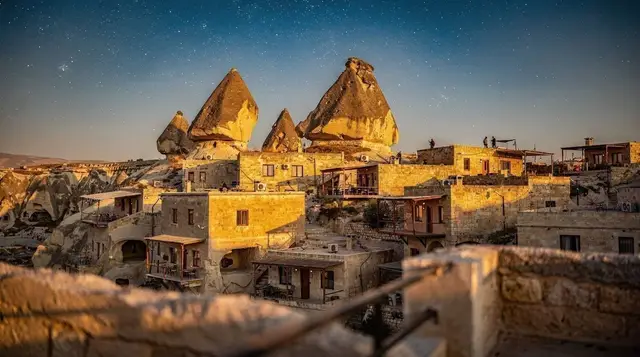
Choosing a family-friendly cave hotel in Cappadocia
Are cave hotels a good choice for families with young children in Cappadocia?
Cave hotels work well for families, but check what you are booking first. A genuine cave room is often carved with no exterior window, and stairs plus uneven stone floors are common on hillside properties. Many hotels sell newer stone-built rooms with windows alongside real cave rooms, so ask which one you are getting before you pay.
The room type matters more than the hotel’s star rating
“Cave hotel” is not one thing. Under that label you will find a room carved straight into the tuff with walls a metre thick and no exterior window, sitting next to a newly built stone room with a window, air conditioning and a balcony, sold at the same property under the same name. Both are marketed as “cave hotel” because both sit inside a cave-style building. For an adult on a romantic trip, the difference is atmosphere. For a family with a toddler who wakes at dawn or a baby who naps twice a day, it is the difference between a smooth week and a difficult one. Before you compare where to stay in Cappadocia by location, it is worth understanding what you are actually booking room by room.
This guide covers the practical side of choosing a room: windows, stairs, temperature, and how to ask a hotel the right question before you pay a deposit. It does not list specific hotels, because the same property can have both room types, and it does not cover what to do with children once you have checked in — that is covered separately in our guide to Cappadocia with kids and in Cappadocia with toddlers.
The window problem: what a real cave room is actually like
A genuine cave room is excavated into the rock face of a hillside, most often around Göreme, Uçhisar and parts of Ürgüp, where the local tuff is soft enough to carve and strong enough to hold its shape once shaped. Cutting a large window opening into that rock weakens the wall around it, so many original cave rooms were built with no exterior window at all — just a door, and sometimes a small vent or a shaft cut up toward the surface for air. Hotels have adapted some of these rooms with skylights or internal light wells, but a true cave room without any of that still exists in plenty of properties, and it is often the one photographed for the website because it looks the most dramatic.
For most adults, a night or two without a window is a novelty. For a young child, it removes the normal cues that help regulate a sleep routine: no daylight to wake up to, no sense of what time it is on a groggy 3am toilet trip, and in some rooms, no natural airflow beyond what the door lets in when opened. Some children sleep fine regardless; others find it genuinely unsettling, particularly on the first night or two of a trip when they are already off their usual rhythm. If your child struggles in unfamiliar dark rooms at home, assume a windowless cave room will be harder here, not easier.
The fix is simple but requires asking directly: request a room with an exterior window, by name, and ask the hotel to confirm it in writing rather than assuming “cave room” means the same thing at every property. Many hotels list a “deluxe cave room” or “cave suite” category specifically because it has a window that the standard cave room lacks.
Stairs, slopes and uneven stone floors
Cave hotels are built into hillsides, which means the site itself is rarely flat. A typical layout has reception at one level, a breakfast terrace a flight up or down, and guest rooms spread across several more levels connected by stone steps rather than a lift. Treads are often narrower than a standard staircase, worn smooth by decades of use, and uneven in height from one step to the next because they follow the original rock rather than a poured concrete mould. Handrails exist in most places but are not universal, especially on older sections of a property.
None of this is dangerous for a careful adult. It is a real consideration for a family travelling with a pushchair, a new walker who is still unsteady, or a child who runs ahead without looking at the ground. A few practical points:
- Ask for a ground-floor room, or one reachable without steps from reception — many hotels can place you there if you ask when booking, not on arrival.
- A full-size pram will not manage most cave hotel layouts; a lightweight, foldable stroller or a soft carrier copes far better with steps and narrow doorways.
- Courtyards and terraces are frequently unfenced at the edge, since the original buildings were not designed with young children in mind. Worth a five-minute walk-through on arrival before you let a toddler explore alone.
- If mobility is a bigger concern than a young child underfoot, our guide to Cappadocia with limited mobility goes into more detail on which building styles to avoid entirely.
Temperature and damp, season by season
Rock is a natural insulator, and that cuts both ways depending on when you travel. In July and August, when afternoon temperatures in the region regularly reach 30 to 35 degrees, a carved room stays noticeably cooler than the outside air without needing air conditioning at full blast — most families find this the single best feature of a cave room in summer, and it is genuinely pleasant for a child struggling with the heat.
In winter, the same thermal mass works against you. Rock is slow to warm up and slow to release heat once the day’s warmth has gone, so a cave room in December or January can feel cool and slightly damp even with the heating running, particularly on the first evening after a period of vacancy. Cappadocia’s winters bring temperatures around freezing and occasional snow that settles on the fairy chimneys for several days at a time — see Cappadocia in winter for the wider picture. A young child loses body heat faster than an adult and will feel a cool, damp room more acutely.
Two questions worth asking a hotel directly if you are travelling outside summer: what heating the specific room has (not just the hotel in general), and whether that room is regularly used through winter rather than closed off in the low season. A room that has sat empty and unheated for weeks takes longer to warm through than one in daily use.
Real cave versus stone-built: telling the two apart before you book
Because both styles are marketed under the same “cave hotel” heading, the only reliable way to know what you are booking is to ask. Photos are not enough — both room types are dressed with similar rugs, stone-look furniture and warm lighting, and a skilfully lit photograph of a stone-built room can look just as cave-like as a genuine one.
| Genuine cave room | Stone-built room | |
|---|---|---|
| Walls | Carved from solid rock, thick and curved | Cut stone blocks, straighter lines |
| Window | Often none, sometimes a skylight or vent | Usually a standard window |
| Summer temperature | Naturally cool | Cool with air conditioning |
| Winter temperature | Slow to heat, can feel damp | Heats more predictably |
| Airflow | Limited to the doorway in many rooms | Normal window ventilation |
| Sound | Echoes more in stairwells and corridors | Closer to a standard hotel |
| Typical location in the property | Older or lower sections, built into the hillside | Newer wings, often added later |
The direct question that gets a useful answer is: “Is this specific room carved into the natural rock, or built from stone with a roof added, and does it have an exterior window?” A hotel that cannot answer that clearly on request is worth a second look before you book, particularly for a family stay.
Family rooms, connecting rooms and having enough space
A carved cave building limits how a hotel can reconfigure its rooms — walls that started as solid rock cannot easily be knocked through the way a plasterboard partition can, so connecting rooms and family suites exist in smaller numbers than at a standard hotel chain. Larger properties around Göreme and Ürgüp are more likely to have a genuine family layout, sometimes a stone-built family suite with two separate sleeping areas, but availability is limited and worth booking well ahead of a summer trip.
Before comparing towns for logistics, our guide to Göreme, Ürgüp or Uçhisar sets out how each base differs for a family, and cave hotels explained covers the category in general beyond the family-specific points here. If you would rather stay somewhere that behaves more predictably than a cave-style building, cave hotel versus regular hotel lays out the trade-off plainly.
When you contact a hotel about a family room, ask three things: the exact bed configuration, whether the two sleeping areas are truly separate rooms or one room divided by a curtain, and whether the layout involves internal steps. “Family room” is used loosely enough across the region that none of these should be assumed from the name alone.
Getting settled with a baby or toddler in tow
Beyond the room itself, a few small logistics make a cave hotel stay easier with young children. A cot is worth requesting at the time of booking rather than on arrival, since carved rooms have less spare floor space than a standard hotel room and a hotel may only hold a limited number of travel cots. Breakfast terraces are often up or down a flight of steps from the rooms, so factor that into how much you are carrying each morning. Wi-Fi signal can be weaker inside thick rock walls than in a stone-built wing, worth checking if you rely on a baby monitor app or need to stay reachable.
If your itinerary includes a full day out — the Göreme open-air museum in the morning, say, followed by an afternoon exploring Uçhisar castle — a private, unhurried pace tends to work better with young children than a fixed-departure group tour. A guided visit that lets you set the pace can help here:
a private tour of the Göreme open-air museum and an underground city, timed around your own schedule rather than a group’sFor an easier first full day that still covers the region’s highlights without excessive walking, a small-group option with lunch included takes the planning off your hands:
a Red Tour with lunch and a guide, covering the open-air museum, Pasabag and Avanos in one dayAnd for the open-air museum itself, which is the single busiest site in the region between 10am and 3pm, a guided visit that includes entry and a clear explanation of the frescoes saves a lot of standing around trying to make sense of it independently with children in tow:
a guided tour of the Göreme open-air museumIf the evening allows for a later activity with older children, the whirling dervishes ceremony held in a historical cave venue is calmer than it sounds and works well as a first cultural evening out:
an evening whirling dervishes ceremony held inside a historical cave venueRainy or cold days, and what a cave hotel changes
On a wet or unusually cold day, a cave hotel’s thick walls and small windows can make a room feel more closed-in than a standard hotel, which is worth knowing if you are planning downtime rather than sightseeing that day. Our guide to rainy day activities in Cappadocia covers indoor options nearby, and if you are travelling with children old enough for an active outing regardless of weather, a covered jeep safari keeps you out of the worst of it while still seeing the valleys.
A short checklist before you book
- Ask whether the specific room is carved into natural rock or built from stone, and whether it has an exterior window.
- Request a ground-floor room or one without steps between reception and the door if you have a pushchair or a new walker.
- Ask what heating the room has if travelling outside summer, and whether that room is in regular winter use.
- Request a cot at the time of booking, not on arrival.
- Confirm the exact bed configuration for a family or connecting room by name, not just the label “family room.”
- Walk the courtyard and terrace edges on arrival before letting a young child explore unsupervised.
- If daylight and airflow matter more to your family than atmosphere, choose the stone-built room over the carved one — you can visit a genuine cave room at the Göreme open-air museum or Zelve during the day instead of sleeping in one.
None of this makes a cave hotel a poor choice for families — plenty of parents stay in one happily every week of the year. It simply means the label covers two different products, and the right questions before you pay a deposit matter more here than at a standard hotel where every room is built the same way. For the wider question of how many nights and which towns to combine, how many days in Cappadocia and our three-day family itinerary are a reasonable next stop once your room type is settled.
Cave hotels and children: common questions
Does a cave hotel room have a window?
Not always. A room carved directly into the rock face often has no exterior window, since the opening would weaken the surrounding tuff. Some cave rooms get light and air through a shaft or a small vent instead. If your child needs to see daylight from bed, ask the hotel directly whether the specific room has a real window, not just whether the hotel has cave rooms.
Are cave hotels safe for toddlers and babies?
They can be, but the stone stairs and sloped courtyards common to hillside cave hotels are worth checking in advance. Treads are often narrower and less even than a standard hotel staircase, and railings vary a lot between properties. Ask for a ground-floor room if your child is a new walker.
Is a cave room too cold or damp for children?
In summer, no: the rock keeps rooms noticeably cooler than the outside air, which most families find pleasant. In winter and shoulder season, a cave room can feel damp and slow to heat, and young children lose warmth faster than adults. Ask what heating the room has and whether it was built to run in winter.
Can I bring a pushchair or stroller into a cave hotel?
Often only partway. Many cave hotels are built up a slope with steps between the reception, the courtyard and the rooms, so a pushchair may need to be carried rather than wheeled. A carrier or a lightweight, foldable stroller works better than a full-size pram for this terrain.
How do I tell a real cave room from a stone-built room?
Ask the hotel plainly: is this room carved into the natural rock, or built from cut stone with a roof added on. Photos alone will not tell you, because both styles are dressed to look similar. A genuine cave room usually has thick, curved walls and no exterior window; a stone-built room has straighter walls, a window, and behaves like a normal hotel room.
What is the best type of room for a family with a baby?
A stone-built room with a window, on the ground floor or ideally ground-floor-with-no-steps between reception and the room. It gives you daylight for naps, easier night wake-ups, and no stairs to negotiate with a cot or a stroller. Save the atmospheric carved room for a trip without a baby.
Do cave hotels have connecting or family rooms?
Some do, particularly larger properties in Göreme and Ürgüp, but the layout of a cave building limits how many rooms can connect, so availability is lower than at a standard hotel. If you need a connecting room or a family suite, book well ahead and confirm the layout by name, not just by the words family room.
Are cave hotels noisy or echoey with kids?
Rock and stone carry sound differently to plasterboard: footsteps and voices in a corridor can echo more than in a standard hotel, and a room next to a stairwell or courtyard picks up more of it. If a light sleeper is travelling with you, ask for a room away from the stairs and the breakfast terrace.
Family-friendly tours on GetYourGuide
Verified deep-linked GetYourGuide tours. Book through these links and we earn a small commission at no cost to you.
GetYourGuide does not provide a product photo for this activity — the image shows the meeting point, photographed by us.