Cave hotel or regular hotel in Cappadocia
Is a cave hotel actually better than a regular hotel in Cappadocia?
Neither is better outright. A genuine cave room is carved into the tuff rock, stays cool and dark with little natural light, and often has no window; a regular hotel in the same village gives you more daylight and a conventional layout while reaching the same valleys and tours. The choice comes down to whether you want the low-light, carved-rock experience or a brighter, more familiar room.
What a cave room actually is
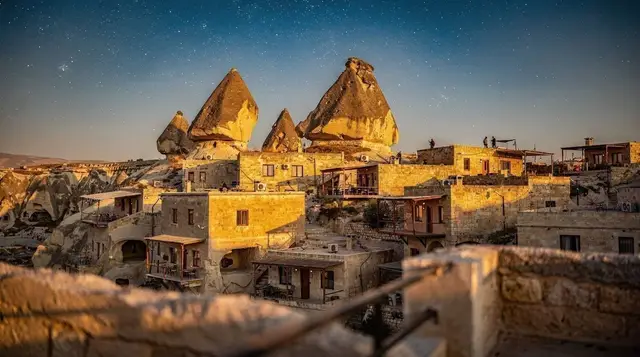
In Göreme and the villages around it, “cave hotel” gets used loosely enough that the phrase has stopped meaning much on its own. It is worth separating the two things people are actually choosing between, because the difference is about the room itself, not about which village or which valleys you can see from it. A genuine cave room is carved directly into the volcanic tuff rock that makes up the whole region — the same soft stone that erosion has shaped into the fairy chimneys outside. A regular hotel room in the same street is built the ordinary way, with blocks, plaster and a poured or timber floor, even when its exterior has stone cladding to match the neighbourhood.
Both types sit within the same small cluster of villages — Göreme, Ürgüp and Uçhisar — so this is a comparison of room type, not of where to base yourself. You can find carved rooms and built rooms a few doors apart from each other in all three.
Cave and cave-style rooms sell fast in high season precisely because Cappadocia is the one place most travellers will ever sleep inside solid rock. That novelty is real and worth having for at least a night. It is also worth being clear-eyed about what it costs in daily comfort, which is the part marketing photos rarely show.
Light, temperature and air: the three real differences
Set aside the branding and the three differences that matter day to day are light, temperature and airflow.
Light. A room cut into rock has, at most, one exterior wall — the one facing outward from the hillside — so window options are limited from the start, and many carved rooms have no window at all. Where a window exists it is often small, set into thick rock, and lets in less daylight than a standard window frame would. For someone who wakes with the light, likes to read by a window, or simply feels closed in without daylight, this is the detail that decides the question before anything else does. A regular hotel room, by contrast, is built with a normal window opening and gets daylight the way a hotel room anywhere does.
Temperature. This cuts the other way. Rock has enormous thermal mass, so a carved room barely tracks the outside temperature at all. Through a Cappadocia July or August afternoon, when outside temperatures often reach 30–35 degrees, a cave room commonly stays comfortably cool without any air conditioning running. A built room, however well insulated, swings closer to the outdoor temperature and more often needs a working air conditioning unit to stay comfortable. The same stability helps in winter: a cave room resists the cold longer than a thin-walled built room, though it still needs heating once temperatures drop toward 0 degrees.
Air and sound. Windowless or near-windowless rooms rely more on mechanical ventilation, and a room with no operable window means you cannot air it out by opening it. The upside is sound: rock walls block outside noise far better than built walls, so a cave room is usually the quieter option if the property sits near a road or a courtyard bar. A built room with a window you can open trades some of that quiet for the ability to control airflow yourself.
What stays the same either way
It is easy to assume the room type changes the whole trip. It mostly does not.
- Location and access. Cave and regular hotels sit in the same villages, often on the same street, so your walk to the open-air museum, a viewpoint café, or a dolmuş stop does not change based on room type.
- Tours and transfers. Both room types are equally easy for a tour company to collect you from. A two-day highlights tour with cave-hotel accommodation or a balloon flight pickup works the same whether your base for the rest of the stay is carved or built.
- Breakfast and terrace. Many properties of both types serve breakfast on a rooftop or terrace with a valley view, since the view is a feature of the site, not of the individual room.
- Price band overlap. Category, view and season move the price far more than whether the room is carved. A plain cave room in a modest guesthouse can cost less than a smart built hotel with a pool, and a cave suite with its own terrace can cost several times a simple built double.
Where a cave stay is the better fit
A carved room suits you if the reason you are in Cappadocia at all is to experience something you cannot get elsewhere: sleeping inside the rock the region is made of. It suits early risers heading out for a sunrise balloon flight, since you are leaving before daylight matters anyway. It suits travellers who value quiet over a view-filled window, and anyone who finds a cool, dim room genuinely restful rather than confining. If part of the appeal of the trip is telling people afterward that you slept in a cave, this is also, honestly, the version that delivers that.
a two-day Cappadocia highlights tour that starts from a cave hotel is a straightforward way to pair one or two carved nights with a full day covering the main sights, without having to separately arrange transfers between hotel and tour pickup.
Where a regular hotel is the better fit
A built room suits you if daylight in the room matters to you — working from the room, getting ready by a window, or simply not wanting a windowless space for several nights running. It suits travellers with mobility limitations, since carved properties are built into sloped, historic ground with irregular stone stairs and few lifts, while a standard hotel is more likely to offer level access and a conventional bathroom.
It also suits anyone travelling with young children who need a room easy to move around in, or who would find a rock-walled, low-light room unsettling at night. See family-friendly cave hotels and Cappadocia with limited mobility for more on both cases specifically.
A middle option: one or two cave nights, not the whole trip
You do not have to choose one type for the entire stay. A common and sensible approach is to book a cave room for one or two nights — enough to have the experience and to be well placed for an early balloon pickup — and a regular hotel for the remainder if the low light or the stairs did not suit you. It works just as well the other way round, ending the trip on a cave night once you know you like it. Because both room types sit within the same villages, switching hotels partway through does not mean changing your base or your access to the valleys.
a one-night cave hotel stay paired with a guided valley tour is built for exactly this: a single carved night bracketed by a day of sightseeing, rather than a multi-night commitment to a room you have not tried.
Checking before you book
Because “cave hotel” is used loosely in listings, the only reliable way to know what you are getting is to ask directly or check recent photos and reviews that show the room’s walls and ceiling, not just the terrace view. A few points worth confirming:
| Question to ask | Why it matters |
|---|---|
| Is the room carved into rock, or built with a cave-style finish? | Determines whether you get the temperature and light effects described above |
| Does the room have a window, and how large? | Cave rooms range from none to a small opening; built rooms have standard windows |
| Is there air conditioning or a fan? | Cave rooms often do not need it in summer; built rooms usually do |
| How many stairs, and are they level or carved stone? | Relevant for anyone with mobility limitations or heavy luggage |
| Is there a lift? | Rare in either type but worth checking on multi-storey properties |
If none of this is available in the listing, a short message to the property before booking clears it up faster than reading between the lines of a photo gallery.
Combining a cave stay with the rest of the trip
However you split your nights, the room type does not limit what else fits into a Cappadocia stay based in Göreme. A cave or built base works equally well as the starting point for an Ihlara Valley half day, an underground city visit, or a multi-day loop covering the main valleys — see a three-day itinerary for how those pieces usually fit together.
a package pairing a cave hotel stay with a balloon flight, ATV ride and Ihlara Valley visit bundles several of the region’s set-piece activities around a carved-room base, which suits travellers who have already decided the cave experience is what they want and would rather book the rest around it than separately.
For a broader look at where to stay before narrowing down room type, see where to stay in Cappadocia and the village-by-village comparison in Göreme, Ürgüp or Uçhisar. Season also affects the calculus slightly: a windowless cave room reads as a relief in the heat of Cappadocia in summer and as a cosy retreat in Cappadocia in winter, while shoulder-season travellers checking the best time to visit may find the temperature difference between room types barely noticeable either way.
Whichever you choose, the packing list and a look at hamam culture are worth a glance regardless of room type, since neither changes with where you sleep. For one traveller’s account of what a carved room is actually like night to night, see a reality check on cave hotels.
Cave room and regular room compared
| Cave room | Regular room | |
|---|---|---|
| Natural light | Little to none | Standard window |
| Summer temperature | Naturally cool | Often needs AC |
| Winter temperature | Retains warmth well | Needs heating |
| Noise from outside | Well insulated | More audible |
| Access and stairs | Often irregular stone steps, few lifts | More often level, conventional |
| Typical ceiling | Curved or domed rock | Flat, standard |
| Best suited to | Short stays, early risers, quiet-seekers | Longer stays, daylight-dependent routines, limited mobility |
| Access to valleys and tours | Same as regular hotel | Same as cave hotel |
Frequently asked questions about cave hotels versus regular hotels
What actually makes a room a cave room?
The core of the room is carved directly into the volcanic tuff rock, not built with blocks or plaster. It usually has thick rock walls, a curved or domed ceiling, little or no window, and a noticeably cooler, quieter interior than a built room.
Are all hotels advertised as cave hotels actually carved into rock?
No. Many properties in Göreme, Ürgüp and Uçhisar sell stone-built rooms styled to look like caves, with vaulted ceilings and rough stone finishes but no rock carving behind the walls. Ask directly whether the room is oyma (carved) or yığma (built) before booking if this matters to you.
Is a cave room too dark to spend the day in?
Many cave rooms have no window at all, or a small one, because the room is cut into solid rock. That is fine for sleeping and for a base you leave early for a balloon flight, but it can feel confining for anyone who wants daylight while dressing, reading or working from the room.
Do cave rooms get uncomfortably hot in summer?
The opposite. Rock retains a stable temperature, so cave rooms stay noticeably cooler than built rooms through July and August afternoons, often without needing air conditioning. In winter the same rock mass keeps the room from getting as cold as a thin-walled built room, though some properties still add heating.
Which is better for someone with mobility limitations?
Regular hotels are generally the safer choice. Cave hotels are built into sloped, historic sites with irregular stone steps, narrow carved stairwells and few lifts, while a standard hotel is more likely to offer flat access and a conventional bathroom.
Does staying in a cave hotel change which tours or valleys I can reach?
No. Cave and regular hotels in Göreme, Ürgüp and Uçhisar sit within the same small area, so both put you within a short drive or dolmuş ride of the same valleys, underground cities and balloon launch sites.
Are cave hotels more expensive than regular hotels?
It varies more by category and view than by whether the room is carved. A basic cave room can cost less than a mid-range built hotel, while a cave suite with a valley-view terrace can cost several times a plain regular room; compare specific properties rather than assuming either type is pricier.
Can I try a cave room without committing my whole trip to one?
Yes. A common approach is one or two nights in a cave room for the experience, then a regular hotel for the rest of the stay if the low light or the stairs did not suit you, or the reverse if you want the cave night to end the trip.
Popular Cappadocia experiences on GetYourGuide
Verified deep-linked GetYourGuide tours. Book through these links and we earn a small commission at no cost to you.
GetYourGuide does not provide a product photo for this activity — the image shows the meeting point, photographed by us.