What sleeping in a Cappadocia cave hotel is actually like
The photo and the pillow are not the same room
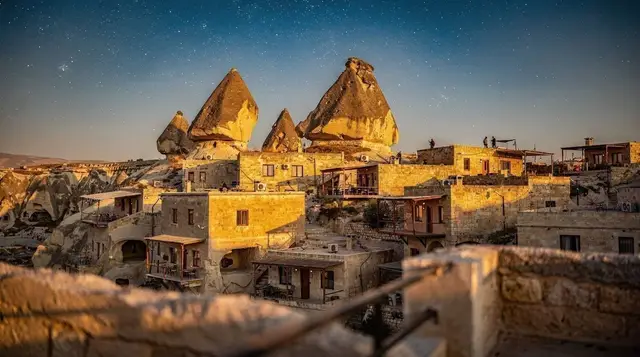
Every cave hotel listing in Göreme uses roughly the same set of images: bare stone walls, a rounded arch over the bed, warm lamplight, maybe a fireplace. It photographs beautifully, and it is one of the reasons people choose Cappadocia over almost anywhere else in Turkey. What those photos don’t show is what the room does to you at two in the morning — the temperature, the total dark, the particular way the stone carries sound. I’ve now slept in half a dozen of these rooms across different price points, and the gap between the marketing image and the lived experience is bigger than I expected the first time.
Carved into the rock, or just built to look like it
This is the distinction that matters most and the one that’s hardest to check from a booking site. Some rooms are genuinely tunnelled into the tuff hillside — the walls, ceiling and sometimes the floor are the same continuous rock the region is famous for. Others are ordinary stone-built rooms, constructed rather than carved, finished with an arched doorway and rough plaster to read as “cave” in photographs. Both get marketed under the same word, and the difference isn’t always visible in a listing.
| Carved cave room | Stone-built, cave-style | |
|---|---|---|
| Walls and ceiling | Solid rock, no seams | Built stone or block, plastered |
| Temperature | Naturally cool year-round | Closer to a normal room |
| Windows | Sometimes none | Usually at least one |
| Sound | Very deadened | Normal hotel-level quiet |
| Damp risk | Higher if poorly vented | Lower |
If the distinction matters to you, the only reliable move is to ask the hotel directly, room by room, before you book — a guide on cave hotels explained goes into the construction side in more detail, and where to stay in Cappadocia covers how this plays out across neighbourhoods.
What actually happens after midnight
In a genuinely carved room, tuff behaves like a very effective natural insulator. In August that’s a gift — the room stays cool without air conditioning while the terrace outside is still warm at midnight. From late autumn through spring it works against you: the same rock that resists heat resists warming up again, and a room that hasn’t had its heating running for a while can feel properly cold, with a faint mineral damp smell that no amount of the featured throw blanket disguises. I now ask, every time, what heating the specific room has and whether it’s been on.
Darkness is the other surprise. A room carved deep into the hillside for privacy can have no exterior window at all — no glow under the curtain, no sense of morning arriving. It’s restful for some people and disorientating for others, especially if you’re used to natural light waking you. And the stone does something to sound that’s hard to predict in advance: outside noise all but disappears, which is genuinely one of the best things about staying in one of these rooms, but voices and footsteps inside the room can carry a slightly flatter, more contained quality than in a plaster-walled room. None of this is a defect. It’s just not what the photograph tells you.
The maintenance nobody photographs
Damp and ventilation are the real, structural weak points of this kind of building, not a one-off problem with an unlucky hotel. Rock holds moisture, airflow in a room with no window is limited by design, and a carved room that isn’t actively managed — dehumidified, aired out, checked for condensation — will develop a damp smell faster than an equivalent built room would. A well-run property manages this routinely; a tired one doesn’t, and you can sometimes tell within the first hour of arriving. It’s a fair, specific question to put to a hotel before you book, not a complaint to raise only after the fact.
Who this actually suits
I’ve stayed with people who loved it immediately — the quiet, the coolness in summer, the sense of sleeping inside the landscape rather than beside it — and with people who tapped out after one night and asked to move to a normal room. Both reactions are completely reasonable. If you like total dark and total quiet, a deep carved room with no window can be the best sleep of the trip.
If you get uneasy in enclosed spaces, or you simply want to see daylight without getting up, that same room is the wrong choice, and there’s no shame in booking a stone-built cave-style room with a window and a door to the outside instead — see cave hotel versus regular hotel for a fuller comparison. This isn’t a hierarchy of correct or superior room types. It’s a personal preference, and it’s worth being honest with yourself about which side of it you’re on before you commit two or three nights of your trip to it.
Booking around it, not just booking it
None of this is a reason to skip cave hotels — for most travellers they’re still the right call in Göreme, Ürgüp or Uçhisar, and comparing the three is its own decision covered in Göreme versus Ürgüp and Göreme, Ürgüp or Uçhisar. It’s a reason to book with your eyes open: ask whether the room is carved or built, ask what heating and ventilation it has, and if you’re travelling in winter, check the best time to visit and Cappadocia in winter guides so the cold doesn’t come as a surprise on top of everything else.
In summer the calculation flips almost entirely in the cave room’s favour — see Cappadocia in summer for why. If you have mobility concerns, note that carved rooms often come with uneven stone steps and low doorways; Cappadocia with limited mobility has more on what to check. And whichever room you end up in, a proper packing list with warm layers earns its place even in what looks, in every photo, like a warm stone room.
A cave stay pairs naturally with the rest of a first visit. If you’re combining it with the valleys and an underground city, a one-night cave hotel stay bundled with a guided Red Tour saves you booking the two separately. For a longer trip that also reaches Ihlara, a package pairing a cave hotel night with the Ihlara valley, a balloon flight and an ATV outing covers most of the region’s highlights around your stay.
And if you’d rather have someone else handle the logistics entirely for a short trip, a two-day highlights tour departing from your cave hotel is a straightforward way to see the essentials without renting a car. However you book it, go in knowing what the rock actually does at night — solo travellers weighing up a cave stay alone might also want solo travel in Cappadocia for more on that side of it.
tours.Where to stay
Verified deep-linked GetYourGuide tours. Book through these links and we earn a small commission at no cost to you.
GetYourGuide does not provide a product photo for this activity — the image shows the meeting point, photographed by us.