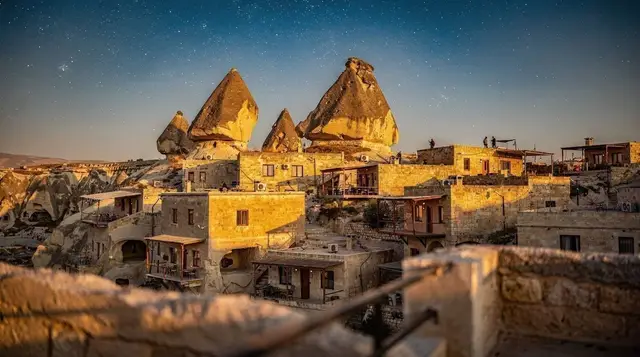
Cappadocia with toddlers
Can you visit Cappadocia with a toddler?
Yes, but plan around a baby carrier rather than a stroller — the valleys and most old-town streets are dusty, uneven tuf that wheels can't cope with. Build the day around nap times rather than a tour itinerary, and think carefully before signing up for the pre-dawn balloon wake-up with a very young child.
What actually changes when the child is under three
Cappadocia is a doable family destination, but a toddler changes the practical shape of a trip more than most parents expect before arriving. This isn’t a general guide to Cappadocia with kids — for the wider age range, see our Cappadocia with kids guide and the Cappadocia with teenagers page if you’re travelling with a mixed-age group. Here, the focus is narrower: children roughly one to three years old, still napping, not yet walking long distances on their own, and usually carried rather than led by the hand.
Three things drive almost every decision below. First, the terrain: the region is a plateau of volcanic tuf, and the valley floors and much of the old town streets are dusty, uneven and occasionally stepped, which rules out a stroller for anything beyond a short paved stretch. Second, the climate: summer afternoons regularly reach 30–35 degrees with almost no shade in the valleys, which is a real constraint for a small child rather than a mild inconvenience.
Third, the pace: Cappadocia’s best-known activity, the sunrise hot air balloon flight, runs on a schedule built around dawn and a fixed pickup window, which sits awkwardly against a toddler’s nap and sleep needs. None of this rules the destination out — it just means the itinerary has to bend around the child rather than the other way round.
Strollers don’t work here — plan for a carrier instead
If there’s one piece of advice worth acting on before you land, it’s this: leave the expectation of a stroller-based trip behind. Göreme itself has a walkable centre, but step off the main street and you’re on gravel, tuf dust or stone steps within a couple of minutes. Uçhisar, Ortahisar and Avanos are similar — some flat stretches, then stairs or slopes with no ramp. The valley trails, from Rose Valley to Ihlara, are dirt and rock paths with no surface a wheeled stroller can handle for more than a few metres.
A soft-structured baby carrier or, for a slightly older toddler, a hiking-style backpack carrier with a sun canopy is the piece of kit that actually gets used every day. It works on stairs, uneven tuf, in underground passages and in the back of a tour vehicle in a way a stroller never will. If you’re travelling with both a stroller and a carrier, expect the stroller to stay folded in the hotel room for most of the trip and bring it only if you also plan time in flatter towns like Ürgüp or Nevşehir where a short stretch of level pavement makes it briefly useful.
Build the day around the nap, not the itinerary
Organised day tours — the Red, Green and Blue circuits sold out of every agency in Göreme — are built for adults on a fixed schedule: pickup, several stops, a set lunch time, drop-off in the evening. That structure works against a toddler’s nap. A missed nap tends to cost you the rest of the day, not just the missed hour, so the more useful approach with a very young child is usually to treat organised tours as optional rather than the backbone of the trip.
A private, flexible tour can be worth the extra cost specifically because the schedule bends to you rather than a busload of other travellers — you can call the driver back early if a nap is overdue, or push lunch by half an hour. A private highlights tour with a flexible schedule covers several of the main sights in one day without locking you into someone else’s timetable.
If you’d rather skip organised tours altogether, a self-paced day works well with a toddler precisely because you control the stopping points. One short walk in the morning — the Göreme open-air museum takes 1.5–2 hours and is manageable in a carrier, though the site gets crowded between 10am and 3pm — followed by lunch and a nap back at the hotel, then a second short outing in the late afternoon once the heat has eased, covers more comfortable ground than trying to fit a Red Tour’s six stops into one day.
The heat and shade problem
Cappadocia’s valleys offer almost no shade. The trails run between exposed rock walls and open fields, and there is rarely a tree line or a covered rest stop along the way. In July and August, afternoon temperatures commonly reach 30–35 degrees, and a toddler in a carrier feels that heat more acutely than an adult walking freely, since body heat from the carrier itself adds to the ambient temperature. Mornings, by contrast, are noticeably cooler, and this is the window worth protecting for outdoor time rather than lie-ins.
Practically, that means: valley walks and outdoor sightseeing before around 11am or after 5pm in summer; the hottest hours reserved for indoor stops, hotel pool time if your accommodation has one, or the nap itself; a wide-brimmed hat and high-factor sun cream applied before you leave, not on the trail; and considerably more water carried than feels necessary — for the adult carrying the child as much as for the child.
Spring (April–June) and autumn (September–October) remove most of this pressure, with milder daytime temperatures and cooler mornings, and are worth weighting your travel dates toward if your schedule allows it — see our best time to visit Cappadocia guide for a season-by-season breakdown.
Should you do the balloon flight with a toddler?
This is the question most families ask, and it deserves a direct answer: it’s not advisable, though it isn’t impossible either. A standard flight means a hotel pickup roughly one to one and a half hours before sunrise, waiting in a cold, dark field while the balloon inflates, and then 45 minutes to an hour and a half airborne in a crowded wicker basket with no seating and no easy way to step out if a toddler becomes distressed mid-flight.
Balloon operators don’t generally set a strict minimum age, but the practical case against it — the wake-up time, the cold wait, the enclosed basket, the length of the flight — applies whether or not a company will sell you the ticket. Our balloon flight with kids and fear of heights guide covers the considerations for older children in more detail.
The alternative many families land on is watching rather than flying. A dawn walk or short drive to one of the balloon launch sites or a viewpoint hotel terrace gives you the same view of more than a hundred balloons lifting off at sunrise, without committing a toddler to a multi-hour dawn schedule or a locked-in flight booking that weather might cancel anyway — balloon flights are grounded for wind on several days most months, more in winter and spring.
A sunrise balloon-viewing trip by SUV gets you to a good vantage point for the spectacle on your own schedule rather than the flight operator’s. For more on the experience from the ground, see watching the balloons without flying and balloon sunrise timing by season, since the exact pickup time shifts through the year with sunrise itself.
Underground cities with a toddler
Derinkuyu and Kaymaklı are two of the region’s genuine highlights, but they come with real physical constraints worth knowing before you go with a small child. Derinkuyu descends roughly 85 metres across eight levels open to the public, with stone stairways, low-ceilinged connecting tunnels and stretches where airflow is limited; Kaymaklı is shallower but its corridors run lower, meaning more of the route is walked stooped. In a carrier, a stooped adult effectively lowers the child further into a tight passage, and taller adults in particular find some sections genuinely awkward to pass through with a child on their back or front.
None of this makes the underground cities off-limits — many families do visit with toddlers — but it’s worth going in with realistic expectations: a shorter loop rather than the full circuit, a front-carry rather than a tall backpack carrier in the lowest sections, and a readiness to turn back if the child becomes unsettled in the enclosed space.
Our Derinkuyu underground city guide and Kaymaklı underground city guide break down each level, and underground cities with kids and Derinkuyu or Kaymaklı go further into which suits a family better. If the idea of a confined, low-ceilinged space with a toddler doesn’t appeal, the open-air Göreme museum or a valley walk delivers a comparable sense of the region’s carved history in daylight and open air instead.
Walking the valleys with a toddler in a carrier
The fairy chimney valleys — Rose, Red, Love, Pigeon and the shorter, flatter Devrent — are walkable with a toddler in a carrier, and for many families they’re the highlight of the trip precisely because there’s no ticket, no schedule and no crowd to navigate. That said, the same rules apply as everywhere else here: no shade, uneven and sometimes loose underfoot, and paths that split and rejoin without clear signposting in places. A short, well-defined route beats an ambitious multi-valley traverse with a small child on your back.
Devrent valley is the easiest starting point — flat, short, no churches or stairs to navigate, just eroded rock formations, and a 30-minute loop is enough to see it properly. Rose Valley and Red Valley offer more dramatic scenery but longer, less even paths; going a short way in and back, rather than committing to the full through-route to Çavuşin, keeps the outing within a toddler’s tolerance and your own. Our full best hikes in Cappadocia and hiking safety in the valleys guides cover distances and terrain in more detail, and are worth reading before you commit to a route with a child on your back.
Where to stay: cave hotels and toddlers
Sleeping in a genuine cave room is one of the reasons families choose Cappadocia in the first place, and most cave hotels are perfectly workable with a toddler — but two things are worth checking before booking rather than assuming from the photos. First, stairs: cave hotels are built into slopes, and internal and courtyard staircases are often stone, uneven and without a handrail at a height that helps a toddler-carrying adult.
Second, windows: a room genuinely carved into the rock can be windowless or have only a small opening, which some parents of light sleepers or very young children prefer to avoid, opting instead for one of the many hotels that build a stone-fronted room in cave style with a proper window. Ask directly when booking rather than relying on marketing photos, which rarely distinguish the two. Our family-friendly cave hotels guide lists which properties handle this well, and cave hotels explained covers the room-type distinction in full.
A sample day
| Time | Activity | Notes |
|---|---|---|
| 7:00–8:30am | Breakfast, optional balloon-watching from a terrace or nearby viewpoint | Skip the flight itself; watch from the ground |
| 9:00–10:30am | Short valley walk or Göreme open-air museum | Before the heat and the 10am–3pm crowd peak |
| 11:00am–12:30pm | Return to hotel, lunch | Buffer time built in, not rushed |
| 1:00–3:00pm | Nap / downtime | Hottest hours; skip outdoor plans entirely |
| 4:00–6:00pm | Second short outing — a village like Uçhisar or Ortahisar, or a pottery workshop in Avanos | Cooler, good light, shorter attention span by now |
| Evening | Dinner, early night | Long carrier days are tiring for the adult too |
What to pack
- A soft-structured or hiking-style backpack carrier — the single most-used item on the trip
- Sun protection: wide-brimmed hat, high-factor cream, and a carrier sunshade if available
- More water than feels necessary, for both of you
- Sturdy closed shoes for the adult carrying the child; the tuf is loose and can be slippery after rain
- A change of clothes and snacks that don’t need refrigeration for outings away from the hotel
- A basic first-aid kit; pharmacies exist in Göreme and Ürgüp but are easiest to reach in daylight hours
A fuller checklist, including what’s easy to buy locally versus worth bringing, is in our Cappadocia packing list. If your trip coincides with a rainy or unusually hot stretch, rainy day activities in Cappadocia covers indoor options that still work with a toddler, from pottery workshops to museum visits.
Frequently asked questions about visiting Cappadocia with a toddler
Can you take a stroller to Cappadocia?
Not usefully outside the newer parts of Göreme, Ürgüp and Nevşehir. The valley trails and much of Uçhisar, Ortahisar and Avanos run over loose or compacted tuf, cobbles and steps, and hotel courtyards are often stone stairs rather than ramps. A stroller works for a flat stretch of main street but stays in the room for everything else; a soft-structured carrier or hiking-style backpack carrier is the only piece of kit that goes everywhere with you.
What age is too young for the underground cities?
There’s no official age limit, but Derinkuyu and Kaymaklı involve stooped passages, stone steps and stretches with limited air movement, and a carrier that fits under a low tuf ceiling matters more than the child’s age. Many parents of children under about two find a shorter visit, or one of the underground cities with wider corridors, more manageable than a full multi-level circuit.
Should a toddler do the sunrise hot air balloon flight?
It’s not banned, but it means a hotel pickup around an hour to an hour and a half before sunrise, standing in a cold field in the dark, and then up to 90 minutes in a crowded basket — a hard sequence for most toddlers and the adults carrying them. Watching from the ground, or from a viewpoint, gives the same skyline of a hundred-plus balloons without the pre-dawn wake-up.
Are cave hotels safe for toddlers?
Most are, with the usual toddler-proofing you’d do anywhere — but the stone stairs are often steep, uneven and without handrails at toddler height, and a genuinely carved room can be windowless, which some parents prefer to avoid for a very young sleeper. Ask specifically about window, floor level and stair layout when booking rather than assuming from photos.
How much walking is realistic with a toddler each day?
Plan one valley walk or one town in a morning, not both, and treat the afternoon as flexible rather than scheduled. A carrier means distance itself isn’t the limit — heat, nap timing and your own stamina on uneven ground usually are.
What should go in a day bag for the valleys?
Water well beyond what feels necessary, a hat and sun cream, snacks that don’t need refrigeration, a change of clothes, and a carrier rain cover or sunshade if yours has one — shade is scarce on the trails. Mobile signal drops in the canyons, so tell someone your rough route and expected return time.
Is Göreme or Ürgüp better as a base with a toddler?
Göreme puts you closest to the open-air museum, several valley trailheads and the balloon launch fields, all useful if you’re doing short outings around nap times. Ürgüp has a flatter, more walkable town centre and a slightly wider choice of restaurants within stroller-friendly range, which some families with a toddler still in a buggy for around-town use find easier.
If you want a wider structure for the trip beyond the toddler-specific concerns above, our Cappadocia in three days itinerary and general Cappadocia with kids guide are the next places to look, and a Göreme Red Tour with a private guide and set lunch stop can work well on a day when you’d rather someone else handled the logistics — just confirm in advance that the pace and stops suit a toddler in a carrier.
Family-friendly tours on GetYourGuide
Verified deep-linked GetYourGuide tours. Book through these links and we earn a small commission at no cost to you.
GetYourGuide does not provide a product photo for this activity — the image shows the meeting point, photographed by us.