Underground cities with kids: what actually works
Are the Cappadocia underground cities suitable for young children?
Kaymaklı works reasonably well for most children over about six, since its rooms are wider and the route stays shallower than Derinkuyu. Below that age, or with any child uneasy in tight, dark spaces, treat it as a maybe rather than a plan, and be ready to turn back.
Deciding whether to go at all
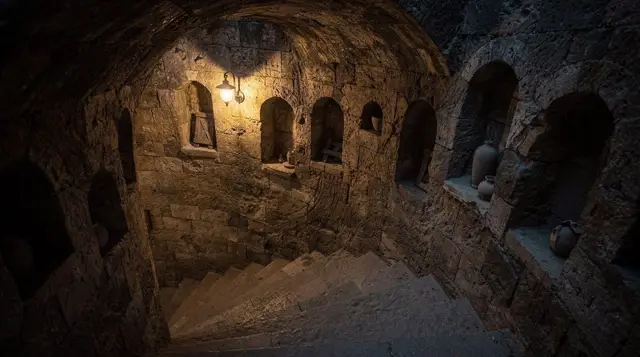
Every Cappadocia itinerary with children eventually reaches the same fork: everyone else is doing an underground city, so should you. The short answer is that it depends less on the destination than on the specific child standing in front of you. These are not show caves with handrails and even lighting. They are working storage and shelter complexes cut by hand into soft rock, with passages sized for people moving in a hurry a thousand years ago, not for a family of four walking two abreast with a stroller bag.
That does not mean skip it. Most children who have never had trouble with tunnels, lifts, or crowded rooms cope fine, and the ones who do go often remember it as the strangest, most physical part of the whole trip. But this guide will not tell you it suits every age, because it does not, and pretending otherwise sets a family up for a bad half hour underground with nowhere comfortable to stop.
If your child is anxious about tight or dark spaces at home, read Underground cities and claustrophobia before you book anything, and consider substituting a surface-level day instead: Cappadocia with kids covers alternatives that skip the tunnels entirely.
The age question, honestly
There is no official minimum age, and no ticket office will turn a family away. In practice, most guides and long-time residents converge on a rough pattern rather than a hard number.
Under about five, the visit is usually more physically demanding than rewarding. Small children cannot always judge ceiling height for themselves and tend to hit their heads on the frequent low lintels even when warned. They also tire quickly from walking stooped, which adults barely notice doing for thirty seconds but which is a real effort for a four-year-old sustained over several minutes.
From around six to eight, most children manage a shortened visit well, particularly at Kaymaklı, provided the pace stays unhurried and an adult is willing to turn back at the first sign of real distress rather than pushing on to see the whole thing.
From eight or nine upward, the underground cities generally read as an adventure rather than an ordeal, and this is often the age where children start asking the more interesting questions about how the ventilation shafts worked or why the rolling stone doors were shaped the way they were. How the underground cities worked is a good primer to read together before you go, so the visit has some context beyond a dim corridor.
Treat all of this as a starting point, not a rule. A cautious ten-year-old can struggle more than a confident five-year-old. You know which one you have.
Why Kaymaklı over Derinkuyu for a first family visit
Cappadocia has two underground cities set up for regular visitors, and they are not equivalent for a family group.
a guided walk through Kaymaklı’s rooms and storage levels is the better starting point. Kaymaklı has four levels open to the public, and its rooms are noticeably wider than Derinkuyu’s, because the settlement expanded sideways rather than digging as deep. The stooping sections are shorter, and there are more points where the family can pause together in a room rather than a corridor.
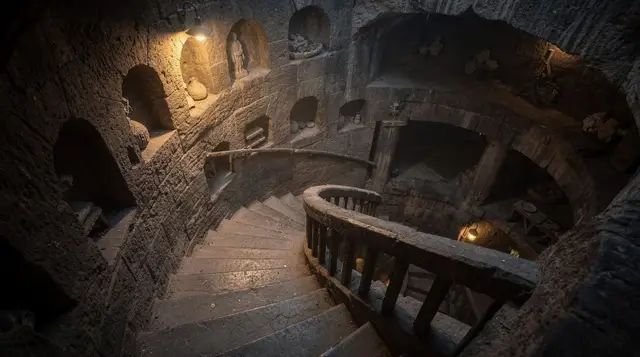
Derinkuyu, by contrast, descends roughly 85 metres over eight open levels. It is the more dramatic of the two, and worth returning to on a later trip or with older children, but its connecting passages run narrower and the sense of depth is more pronounced. First-time visitors who are already slightly nervous about the idea of an underground city tend to find Derinkuyu the more intense of the two, which is the opposite of what you want on a trial run with a six-year-old.
If you are weighing the two properly, Derinkuyu or Kaymaklı sets out the differences beyond the family angle — crowd patterns, what each site actually shows, and which suits a second visit once children already know what to expect.
For a family that wants to see both without doing two separate long drives, a combined day covering Kaymaklı and Derinkuyu together exists, but think carefully before booking it with young children. Two underground cities in one day is a lot of stooped walking and cool, dim air for a small body to absorb, even if the adults find it easy. A single site done properly, with breaks, usually beats two sites done at a rush.
What the guided tours are actually like with children
Both Green Tour itineraries and dedicated underground-city tours move in a group, on a schedule, with a guide who has a set amount of time allotted to the site. That is fine for most families, but it means you cannot always dictate the pace, and a group of twenty adults moving through a narrow passage is not an easy place for a toddler to stop and cry.
a private guided underground visit set to your own pace solves this directly. A private guide can stop where you need to stop, skip a section the child finds difficult, and explain things at whatever level suits the age in the group, rather than pitching commentary at a mixed adult crowd. It costs more than a shared coach tour, but for a family with a genuinely young or nervous child, the flexibility is usually worth more than the saving.
If the underground city is one stop on a longer day rather than the whole plan, a Green Tour combining an underground city with the Ihlara Valley walk and a Red Tour that folds in an underground lunch stop are both worth knowing about, though be aware these pack a full day of sightseeing around the underground portion, which is a lot for a small child on top of the tunnels themselves. Read the stop order before booking and judge whether your child will still be in good shape for the underground section, wherever it falls in the day.
Five things that make the difference underground
No pushchair, no exceptions. The steps are uneven stone, ceiling height drops without warning, and several sections only work in one direction. A pushchair cannot be turned around partway through a narrow passage, and there is no lift or ramp anywhere in the complex. Carry a baby or toddler in a soft structured carrier instead, and leave the pushchair at the hotel.
Pack a layer nobody thinks they need. Both underground cities hold a steady, cool temperature all year, which comes as a genuine surprise in the middle of a 35-degree Cappadocia August afternoon. Children in shorts and t-shirts get cold faster than adults expect, and a cold, uncomfortable child is a fractious one. A light jumper or fleece per child, carried rather than worn on the way in, solves this without overpacking the day bag.
Decide in advance that turning back is a normal outcome, not a failure. Both sites have shorter loop routes near the entrance that do not require finishing the whole circuit. If a child stalls, cries, or simply says no partway through a low passage, the right response is to turn around calmly, not to coax them further into a space they are already unhappy in. Nobody underground will think less of you for it, and pushing through rarely produces a good memory on either side.
Go early or go late, not at midday. Both Kaymaklı and Derinkuyu see their heaviest crowds between roughly ten and three, when coach groups converge in the same narrow passages your family is trying to move through. A crowded, queuing tunnel is worse for a nervous child than an empty one, quite apart from the extra waiting. An early slot, ideally the first hour after opening, gives you room to move at a child’s pace without a queue building behind you.
Skip it entirely if today is not the day. Some mornings a child is simply not in the mood for tight, dim spaces, whatever the plan said. Cappadocia with toddlers and Cappadocia with kids both list surface alternatives — pottery workshops in Avanos, open-air valley walks, a slow morning at a family-friendly cave hotel — that keep the day enjoyable without forcing an underground visit that will not go well.
Quieter alternatives once children have done one
Once a child has managed a visit to Kaymaklı without distress, Özkonak and Mazı are worth considering on a later trip. Both sit well outside the main tour circuit, which means none of the crowd pressure that makes Kaymaklı and Derinkuyu tense at midday, but also patchier lighting and no fixed one-way route, which suits a calmer, more experienced child better than a first attempt.
The quiet underground cities and Mazı and Gaziemir off the tour route cover what to expect at each, including the practical point that neither always has a guard or working lights, so bring a torch and do not plan on a polished visitor experience.
Fitting it into a family itinerary
An underground city visit sits naturally as a single stop rather than the anchor of a whole day, particularly with younger children who will need calmer activities either side of it. Cappadocia family, 3 days places Kaymaklı on a day with a lighter afternoon rather than stacking it against another demanding site, which is the pattern worth copying if you are building your own schedule. Pair the underground visit with something outdoors and unhurried afterwards — a walk at ground level, lunch somewhere with a view — rather than another enclosed or crowded stop straight after.
Preparing children before you arrive
A child who knows what to expect copes far better than one who is surprised by the first low doorway. In the days before the visit, explain in plain words what the place is: a village that went underground when people needed to hide, with rooms for animals, food and sleeping, and corridors that were never meant to be comfortable. Children tend to like the idea of a secret hiding place, and framing the visit as exploring one gives them a role rather than just a corridor to endure. The background in How the underground cities worked is easy to retell in a few sentences over breakfast.
It also helps to rehearse the physical part. Ask them to walk a few steps with knees bent and head low, and to pretend the ceiling is close. It sounds silly, but a child who has already done the stooped walk once in the hotel garden is less startled when it happens for real. Agree on a simple signal, a squeezed hand or a single word, that means “I want to stop”, and promise that it will always be respected. That promise is what lets a hesitant child keep going, because they know the exit is one signal away.
What to carry and how to dress
Keep the kit small. Both hands should stay free, because stone steps and uneven floors are no place to juggle bags, and an adult carrying a tired child needs to be able to steady themselves on the wall. A small torch per older child is a good idea: it turns the dim passages into something they control rather than something that happens to them, and it is handy if a section is darker than expected. Check first that the batteries work, since a torch that fails halfway down is worse than none.
Shoes matter more than anything else. Closed shoes with a decent grip suit the worn, sometimes polished stone, and sandals invite stubbed toes on the low thresholds. Dress in layers that come off and go back on easily, and bring a small bottle of water for the walk back up, since children often feel thirsty and slightly dizzy after the stooped walking and the change in air. A snack waiting in the car or at the nearest café gives everyone something to look forward to when the visit ends.
Keeping the visit fun rather than endured
Turn the walk into a game. Ask older children to spot the ventilation shafts, the stone doors, the grain stores and the kitchen areas, and to count how many levels they have gone down. Younger ones can hunt for particular shapes in the rock or try to guess which room was for animals and which was for people. A child with a small job to do notices the dark far less than one simply being led along.
Let them set the pace, and stop often. A pause in a wider room, with a drink and a look around, resets a child who was beginning to tense up. If you are visiting with a guide, say at the start that you may need to linger or turn back, and a good one will adapt without fuss. Praise the effort, not the distance covered: a child who went further than they expected, or who made a calm decision to turn around, has done something worth acknowledging either way.
After the visit
Come back up slowly and give children a few minutes in the open air before asking for anything else. Bright light and warmth after the cool dimness can be overwhelming, and a short sit in the shade often helps more than a rushed move to the next stop. Ask what they thought, and listen to the answer without defending the plan. A child who says it was scary may still want to talk about the funniest room or the strangest door, and those memories are usually what stay.
If the morning went well, an easy afternoon is the right reward. A long, quiet lunch, a swim at the hotel or a gentle walk in the valleys, such as the options in Cappadocia with toddlers and Cappadocia with kids, lets everyone settle. If the visit was hard, do not schedule a second challenge for the same day. Let it be over, and treat the rest of the day as a fresh start. For the following days, Cappadocia in three days and the family itinerary show how to space the demanding stops between easier ones.
The honest summary
An underground city is one of the more physically unusual things a child will do in Cappadocia, and for many families it becomes the story they tell first when they get home. But it is not universally suitable, the two main sites are not interchangeable, and the difference between a good visit and a bad one usually comes down to choosing Kaymaklı over Derinkuyu for a first attempt, going early rather than at midday, and being genuinely willing to turn back. Plan for that, rather than for a guaranteed success, and the odds shift firmly in your favour.
Underground city tours on GetYourGuide
Verified deep-linked GetYourGuide tours. Book through these links and we earn a small commission at no cost to you.
GetYourGuide does not provide a product photo for this activity — the image shows the meeting point, photographed by us.