Mazı and Gaziemir: Cappadocia's underground cities off the tour route
What are Mazı and Gaziemir underground cities, and are they worth visiting?
Mazı and Gaziemir are two underground cities south of Göreme that see almost no visitors because they sit outside the Red, Green and Blue Tour routes. They are worth a detour if you want an underground city with nobody else in it, not if you are looking for the scale or polish of Derinkuyu or Kaymaklı.
Two underground cities that no tour stops at
Cappadocia has dozens of underground cities carved into the volcanic tuf, but only a handful are set up to receive visitors. Derinkuyu and Kaymaklı get the tour buses. Özkonak gets a trickle of independent travellers who have read about its rolling stone door. Mazı and Gaziemir get almost nobody, because neither one sits on the Red, Green or Blue Tour routes sold along the main street in Göreme. If you want to stand alone in a genuine underground city rather than share a passage with fifty other people, these two are where that actually happens — but go in knowing that “quiet” and “spectacular” are not the same promise.
This guide covers Mazı and Gaziemir only. For Özkonak, which has its own access arrangement and its own history as a defensive stronghold, see the guide to the quiet underground cities.
Mazı underground city
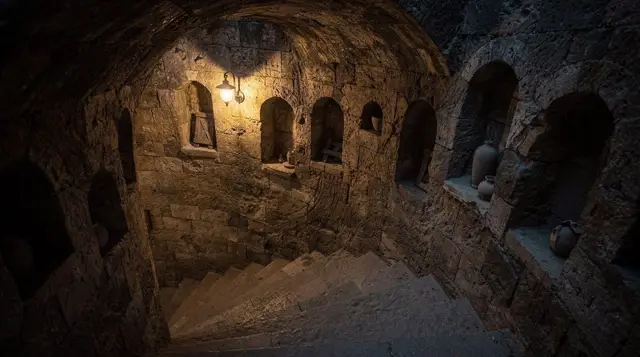
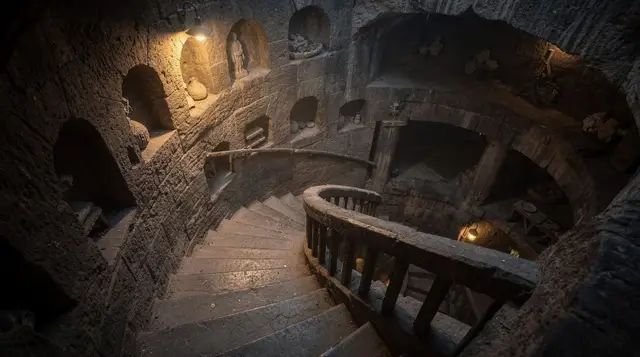
Mazı sits in a small village of the same name south of Nevşehir, on the way toward the Ihlara side of the region rather than directly on the Derinkuyu–Kaymaklı road. It is the larger and more developed of the two sites covered here: more chambers are open to visitors, the route through the tunnels is easier to follow, and the passages are a little more consistently lit than at Gaziemir. It still falls well short of Derinkuyu’s eight open levels or Kaymaklı’s wide chambers — Mazı is a fraction of the scale, and that is exactly why it stays off the tour circuit.
What makes Mazı worth the detour is less the underground chamber itself and more the setting above ground: a working village with its own rock-cut storage caves and dovecotes carved into the surrounding cliffs, largely untouched by tourism. Mazı is unusual among the region’s lesser-known underground cities in that one version of the Blue Tour does include it, swapping it in for Soğanlı or an underground city stop depending on the operator — so it is possible to see Mazı on an organised day out, unlike Gaziemir. Operators change their exact stop list from season to season, so confirm before booking if Mazı is the reason you are choosing that tour.
a Blue Tour itinerary that includes a stop at Mazı underground city is currently the only packaged way to see it without arranging your own transport.
Gaziemir underground city
Gaziemir is smaller again, and rawer. It does not appear on any organised itinerary — Red, Green, Blue or otherwise — which means every visitor arrives independently, by rental car, taxi or private driver. The passages are lower and less signed than Mazı’s, lighting is less reliable, and the caretaker arrangement can mean waiting at the entrance for someone to come and unlock the site, or finding nobody available at all on a quiet day. This is not a complaint about the site so much as a description of what “off the tour route” actually means in practice: no fixed hours, no ticket booth, no guarantee.
Go to Gaziemir expecting a bare, unpolished underground city with almost no other visitors, not a hidden rival to Derinkuyu. The appeal is the emptiness and the sense of finding something that most guidebooks skip entirely, not the scale of what is carved into the rock.
Mazı versus Gaziemir at a glance
| Mazı | Gaziemir | |
|---|---|---|
| Development for visitors | More developed; clearer route, more consistent lighting | Less developed; low passages, patchy or no lighting |
| Size | Larger of the two, still small next to Derinkuyu or Kaymaklı | Smaller and more compact |
| On any organised tour | Some Blue Tour departures include it | No — independent access only |
| Getting there | By car; roughly 1 hour from Göreme | By car; roughly 1 hour from Göreme, no dolmuş |
| Caretaker access | Usually available, occasional wait | Less predictable; may require asking in the village |
| Best for | A quieter alternative to Derinkuyu with some structure | Travellers who specifically want the emptiest option |
Getting there without a tour
Both villages lie south of the main Göreme–Nevşehir–Derinkuyu corridor, roughly an hour’s drive from Göreme depending on which village you start from and how direct the road is that day. Neither is served by a regular dolmuş, so realistically you need one of three things: your own rental car, a taxi booked for a return trip with waiting time included, or a private driver arranged through your hotel. If you are not comfortable with driving in Cappadocia — unmarked turnings, gravel village lanes, the odd stray dog — build in extra time and consider a driver instead.
Because neither site keeps fixed, published opening hours, arriving mid-morning on a weekday gives the best odds of finding a caretaker on site without a long wait. Do not plan a same-day combination with a full Green Tour itinerary; between the driving and the uncertainty of access, trying to fit both into one day alongside Ihlara Valley or Derinkuyu is unrealistic.
Treat a Mazı-and-Gaziemir day as its own half-day, ideally paired with nearby villages rather than squeezed after a packaged tour. For travellers without a car at all, see getting around without a car and the itinerary for a Cappadocia trip without a car, both of which are honest about the limits independent underground-city visits like these run into.
What to expect when you arrive
Neither city has the infrastructure of Derinkuyu or Kaymaklı: no ticket booth staffed all day, no printed floor plan handed out at the entrance, and in Gaziemir’s case sometimes no fixed lighting at all. Bring a torch or a phone light regardless of what you are told is provided — caretakers vary in how much equipment they keep on hand. Passages are low, the tuf floor is uneven, and there are no handrails or barriers of the kind you find on the main tourist circuit. Anyone who found Derinkuyu or Kaymaklı’s lower levels uncomfortable should read underground cities and claustrophobia before adding a less-developed site on top.
There is usually a small entrance fee paid directly to the caretaker rather than a formal ticket office, and it is worth having small notes in Turkish lira on hand since card payment is not something to count on in a village setting like this.
How this compares to Derinkuyu and Kaymaklı
If your main goal is to understand how an underground city actually worked — ventilation shafts, rolling stone doors, stables, wine presses, a chapel — that story is told far better at Derinkuyu and Kaymaklı, both of which have eight and four open levels respectively and proper interpretation. The guide to how the underground cities worked and the comparison of Derinkuyu or Kaymaklı are the right starting points if this is your first underground city.
Mazı and Gaziemir make more sense as a second underground-city visit, once you already know what you are looking at and want to see it without the queues.
Anyone weighing up which underground city to build a day around should also look at what else groups nearby: the Green Tour covering the south of Cappadocia takes in one of the two developed underground cities alongside Ihlara Valley, while a guided tour of Kaymaklı underground city is the simplest way to get the full underground-city experience with none of the access uncertainty that Mazı and Gaziemir carry. Neither Mazı nor Gaziemir replaces that first visit — they add to it.
For a wider view of how the region’s underground sites differ in mood as well as scale, the guide to the quiet underground cities sets Mazı, Gaziemir and Özkonak side by side. Families weighing an underground visit against how their children will cope should read underground cities with kids first, since low, unlit passages with a waiting caretaker are a harder introduction than a staffed site with clear walkways.
Who these two sites suit, and who should skip them
The honest test is what you want from an underground city. If you want a clear story told chamber by chamber, with a route that is obvious and a staffed entrance, spend your time at Derinkuyu or Kaymaklı and do not feel guilty about it. If you have already done one of those and found yourself wishing the passages were empty, Mazı and Gaziemir answer exactly that wish. Travellers who enjoy a little improvisation, asking a villager where the caretaker lives and taking a slow look at a place few people write about, usually come away happy. Travellers on a tight schedule, with a long list of sights for the day, tend to find the uncertainty frustrating, and for them a guided day is the safer choice.
A sensible way to build the day
Start from the idea that the underground visit is the shortest part of the day. The driving, the wait for a keyholder and the time you spend wandering the village above ground are what fill the hours. Leave Göreme in the morning, visit the larger of the two sites first while you have the most patience, and treat Gaziemir as a bonus rather than a promise. If the caretaker cannot be found, a village walk and a tea in a local café is not a wasted stop, it is part of what off-the-route travel looks like.
It also helps to decide in advance what you will do if a door stays shut. Having a fallback within reach, such as another quiet valley or a slow day around Göreme, means a locked gate costs you a detour rather than a whole day. Readers who like to plan around these gaps will find more ideas in seeing Cappadocia without a tour and in the blog piece on the valleys nobody walks.
For a full day that mixes the headline sights with a long drive south, a private route tour with lunch included takes the navigation off your hands, though it will follow the established stops rather than these two villages.
Etiquette with a caretaker
The person who opens the gate is usually a neighbour doing a favour rather than an employee in uniform. Greet them, be patient, and follow their lead about where you may walk. Ask before taking photographs of people, and keep to the passages you are shown rather than squeezing into side tunnels that look inviting but have not been checked. A small tip or a purchase from a village shop is a gracious way to say thank you, and it is part of why these places stay open at all.
Practical notes
- Wear closed shoes. The floor is bare tuf, uneven and occasionally damp near the entrance.
- Bring your own light source. Do not assume either site has working electric lighting throughout.
- Carry small cash. Entrance fees are typically paid to the caretaker directly, not through a card machine.
- Confirm which underground city a Blue Tour includes. Operators vary the stop, and Mazı is not guaranteed on every departure even when “underground city” appears on the itinerary.
- Don’t count on a set schedule. Both sites depend on a local caretaker being available; build slack into your plan rather than a fixed arrival time.
- Pair the visit with the village above ground. Mazı in particular has rock-cut storage caves and dovecotes worth a slow look once you are back at the surface.
If your plan for the day also includes other quiet stops south of the main circuit, the Soğanlı Valley makes a natural addition — it shares the same “almost nobody comes here” character and sits on the Blue Tour route that sometimes also takes in Mazı.
FAQ about Mazı and Gaziemir underground cities
Are Mazı and Gaziemir on any organised tour?
No. Neither appears on the Red, Green or Blue Tour itineraries sold in Göreme. The only underground city that does turn up on a set-route tour is Mazı, and only on some versions of the Blue Tour that swap it in instead of Derinkuyu or Kaymaklı. Gaziemir does not feature on any packaged itinerary at all.
Do I need a car to get to Mazı and Gaziemir?
Effectively yes. There is no reliable dolmuş service to either village, so you need a rental car, a taxi arranged for the return trip, or a private driver. Public transport gaps are exactly why these sites stay quiet.
Is there always someone to let you in?
Not guaranteed. Both sites are looked after by a local caretaker who lives nearby rather than staffed continuously like Derinkuyu or Kaymaklı. On a quiet weekday, particularly outside the summer months, you may need to wait, ask around the village, or find the site closed.
Which is better, Mazı or Gaziemir?
Mazı is the larger and more developed of the two, with more passages open and a somewhat clearer route through the tunnels. Gaziemir is smaller and rawer, with less lighting and less signage. Neither is developed to the standard of Derinkuyu or Kaymaklı, and that is the point of going.
How does this compare to Özkonak?
Özkonak is covered separately because it has its own access road, its own caretaker arrangement and a distinct history as a defensive site with a rolling stone door still in place. Mazı and Gaziemir are quieter again, and less visited even than Özkonak.
How long should I set aside for both sites?
Budget half a day from Göreme once driving time, waiting for a keyholder and the underground visits themselves are all added up. Trying to combine both with a full Green Tour itinerary on the same day is unrealistic.
Is it safe to explore an underground city with no fixed lighting?
Bring your own torch or a phone light regardless of what the site provides. Passages are low, uneven and occasionally damp, and a caretaker showing you round is not the same as a guided safety briefing. Anyone prone to claustrophobia should read up before committing to either site.
Are Mazı and Gaziemir suitable for children?
Both involve stooping through low passages with no handrails and inconsistent lighting, so they suit families who are already comfortable with Derinkuyu or Kaymaklı rather than a first underground-city visit with young children.
Underground city tours on GetYourGuide
Verified deep-linked GetYourGuide tours. Book through these links and we earn a small commission at no cost to you.
GetYourGuide does not provide a product photo for this activity — the image shows the meeting point, photographed by us.