Soğanlı Valley: Cappadocia's quietest church valley
What is Soğanlı Valley and is it worth the detour from Göreme?
Soğanlı is a pair of twin valleys around an hour south of Göreme, walkable in two to three hours, with Byzantine rock-cut churches and old pigeon houses cut into both cliff faces. It sees a fraction of the traffic of the valleys near Göreme, which is the main reason to go.
What makes Soğanlı different
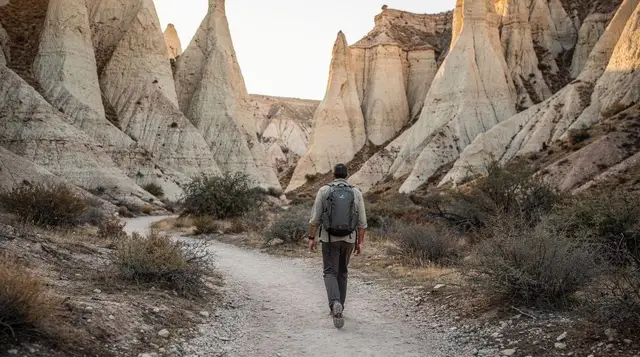
Most first-time visitors to Cappadocia spend their walking hours in the valleys within fifteen minutes of Göreme: Rose, Red, Love, Pigeon. Those valleys are shaped by wind and water into fairy chimneys and not much else — there is barely a chapel between them. Soğanlı is a different kind of valley. It is actually two valleys, running roughly parallel and joined by a low saddle, and its cliffs are honeycombed with Byzantine rock-cut churches from roughly the ninth to the thirteenth centuries, several still holding painted frescoes. Above and around the churches, both valley walls carry rows of carved and plastered pigeon houses, some with painted facades, built to attract nesting pigeons whose droppings fertilised the valley’s orchards.
The combination — churches on one register, pigeon houses on another, spread across two valleys instead of concentrated in one open-air museum — is what sets Soğanlı apart. It rewards slow walking and a bit of looking up, rather than a single showpiece stop.
Getting there
Soğanlı sits about an hour’s drive south of Göreme, past Ürgüp and Mustafapaşa, on minor roads that see little other traffic. There is no dolmuş service this far south, so the realistic options are a rental car, a private driver, or the Blue Tour, which is built around Soğanlı as its main stop. A short guided visit built specifically around the valley is worth comparing against the full Blue Tour if churches and pigeon houses are your priority rather than a broader day out — the full-day tour to Soğanlı Valley spends the bulk of the day here rather than splitting time across Keslik and Mustafapaşa as well.
Self-driving travellers should budget the same hour each way and expect the last stretch to narrow into a village road before the car park. There is a small ticketed entrance at the main car park; bring cash in Turkish lira, since the booth does not reliably take cards.
Walking the two valleys
The two valleys — sometimes called Aşağı (lower) and Yukarı (upper) Soğanlı locally — run side by side and are linked by a path that climbs over a low saddle between them, so a there-and-out walk in one valley and a return through the other is the natural loop rather than backtracking the same ground twice.
| Detail | |
|---|---|
| Walkable distance | Around 3 to 4 kilometres if you cover both valleys |
| Elevation change | Moderate — one climb of roughly 60 to 80 metres over the connecting saddle |
| Walking time | 2 to 3 hours at a church-stopping pace |
| Surface | Packed earth and tuf, loose gravel on the saddle climb |
| Entry points | Main car park at the valley mouth; a second, quieter access track at the far end near Karabaş church |
| Signage | Present at the car park and main churches; side paths to some churches are unmarked |
Because the two valleys are joined, it is possible to enter from one end, walk through both, and exit near where you started, or to arrange a driver to meet you at the far end if you would rather walk in a single direction. Most day visits from Göreme use the main car park as both entry and exit point and treat the saddle crossing as a there-and-back detour rather than a through-walk.
The rock-cut churches
Around a dozen churches are cut into the two cliff faces, though not all are easy to find or currently accessible — some have collapsed facades, others sit up short unmarked paths. The best-known include Karabaş Kilise (Black Head Church), which keeps some of the clearest fresco fragments in the valley and takes its name from a blackened image of a saint near the entrance, and Kubbeli Kilise (Domed Church), notable for its carved dome — an unusual feature this far from Göreme’s more famous rock-cut architecture.
The frescoes here are generally in rougher condition than the best-preserved examples at the Göreme Open-Air Museum, having had far less conservation investment over the decades. That is part of what keeps Soğanlı quiet: there is no single, polished highlight to draw a coach park’s worth of visitors, only a scattered set of modest, genuinely old churches that reward unhurried exploring rather than a fifteen-minute circuit.
Pigeon houses on the cliffs
Look up rather than only ahead and the second theme of Soğanlı becomes clear: both valley walls are pocked with carved pigeon houses, some plastered and painted white or ochre, framing small entrance holes cut for the birds. Pigeon droppings were the region’s main fertiliser before chemical alternatives arrived, and valleys across Cappadocia carved out lofts for this reason — Pigeon Valley near Uçhisar is named for exactly the same practice. Soğanlı’s pigeon houses are less visited but no less extensive, and because the valley is narrower than Pigeon Valley, the carved facades on the opposite wall are often close enough to make out clearly without binoculars.
The practice has mostly died out today, and most of the lofts here are no longer maintained or used, but the carved openings and painted surfaces remain, layered in among the church facades on the same cliffs.
Why it stays quiet
The comparison that matters is with the valleys covered by the Red and Green Tours. The Göreme Open-Air Museum, Uçhisar Castle, Pigeon Valley and the underground cities at Derinkuyu or Kaymaklı all sit within a tight cluster around Göreme, are served by every travel agency in town, and fill up between roughly ten and three.
Soğanlı is the anchor stop of the Blue Tour, which is consistently the least sold of the three colour-coded tours — a smaller share of visitors book it, agencies run fewer departures, and the extra hour of driving each way discourages the rental-car crowd from adding it to a packed Red-and-Green day. The result is a valley that, even in July and August, rarely feels crowded: you can stand at a church entrance without waiting, and the path itself is often empty.
| Soğanlı Valley | Red Valley / Green Tour valleys | |
|---|---|---|
| Distance from Göreme | About 1 hour | 5 to 45 minutes |
| Typical crowd level, midday | Low, even in peak season | High, especially 10:00 to 15:00 |
| Main draw | Rock-cut churches and pigeon houses | Rock formations, fairy chimneys, viewpoints |
| Reached by dolmuş | No | Partially |
| Usual tour package | Blue Tour | Red Tour / Green Tour |
If avoiding crowds matters more to you than ticking off the best-known viewpoints, Soğanlı is one of the more reliable ways to get a valley to yourself for part of a morning.
Nearby stops: Keslik and Taşkınpaşa
Soğanlı is rarely visited in isolation. Keslik Monastery, a short drive away, is a smaller rock-cut monastic complex with its own chapel and refectory, usually bundled into the same half-day as Soğanlı on the Blue Tour. Travellers who want the churches and the monastery together without the wider Blue Tour itinerary can book a more focused visit, such as the private tour covering Soğanlı Valley and Keslik Monastery, which spends its time on these two sites rather than adding Mustafapaşa or other Blue Tour stops.
Taşkınpaşa, a nearby village with a ruined Seljuk mosque and tombs, is another common pairing for travellers with a car and a free afternoon. For those who want the fuller circuit — Soğanlı, Keslik, and lunch worked into a single organised day with transfers included — the Blue Tour with Soğanlı Valley, lunch and transfers follows the traditional route rather than a Soğanlı-only itinerary.
Practical notes specific to Soğanlı
There are no cafés or shops inside the valley itself, only a small stand or two near the car park depending on the season, so bring water before setting out — there is nowhere to refill once you are past the entrance. Mobile signal is patchy on the valley floor and unreliable past the saddle, which matters more here than in the valleys around Göreme simply because there are far fewer other visitors around if you need help.
The ticket booth at the main entrance keeps standard daytime hours and is not always staffed early or late in the day outside peak season, so a self-driving visit is more reliable in the late morning to mid-afternoon window than at opening or closing time. Because several churches sit up unmarked side paths, a first visit benefits from either a guide or a printed map picked up at the entrance — it is easy to walk the main valley floor and miss two or three of the more interesting churches entirely.
Combining Soğanlı with the rest of a Cappadocia trip
Soğanly fits most naturally into an itinerary that already has a day set aside for the Blue Tour, or into a multi-day self-drive trip that has covered the Red and Green Tour valleys and has a spare half day left for something quieter. It pairs poorly with an already packed day — the drive alone takes up the best part of two hours round trip, and rushing the churches defeats the point of coming this far south in the first place.
Travellers weighing up how to structure the wider trip, including where Soğanlı and the rest of the Blue Tour stops fit against the more heavily marketed Red and Green routes, may find it useful to read how the three colour-coded tours differ before booking, and to look at the underground cities and Ihlara Valley separately, since both are sometimes confused with Soğanlı’s rock-cut sites despite being different kinds of excavation entirely.
For travellers who would rather see the valley from above before walking it on the ground, a small number of balloon operators now fly routes over Soğanlı and the surrounding countryside rather than the standard Göreme circuit, such as the sunrise balloon flight over Soğanlı Valley — a genuinely different view of the same terrain, and one that very few visitors add to their trip.
Planning the rest of your visit
Soğanlı works well as a half-day addition to a longer Cappadocia stay rather than a headline stop on a first, short visit — it rewards travellers who have already covered the essentials and have time to spare for something quieter. Below are the guides worth reading alongside this one.
- Soğanlı Valley destination overview
- Göreme, the base for most visits
- Ürgüp, the nearest town with services
- Mustafapaşa, the former Greek village of Sinasos
- Ihlara Valley, for comparison
- Taşkınpaşa, the nearby Seljuk village
- How the Red, Green and Blue Tours differ
- Walking Ihlara Valley
- Cappadocia’s cave churches and frescoes explained
- Mustafapaşa and the Greek-Orthodox history of Sinasos
- The best valley hikes in Cappadocia
- General hiking safety in the valleys
- Seeing Cappadocia without a tour
- Renting a car in Cappadocia
- A four-day hiking-focused Cappadocia itinerary
Frequently asked questions about Soğanlı Valley
How long does it take to walk Soğanlı Valley?
Plan on two to three hours for the walk itself, longer if you stop at several churches. Including the drive from Göreme and a look at Keslik Monastery on the way, most visitors give the outing a half day.
Can I visit Soğanlı Valley without a tour?
Yes, if you have a rental car — there is no useful public transport this far south. Without a car, the Blue Tour or a private driver is the practical option, since dolmuş services do not reach the village.
How difficult is the walk?
The path is gentle to moderate: mostly flat valley floor with one climb over the saddle between the two valleys. Trainers are fine; there is no scrambling or exposure, though the ground is loose tuf in places.
Do I need a guide to find the churches?
Not strictly, but several of the more interesting churches sit up short side paths without clear signage. A guide or a well-reviewed tour, such as the guided tour of Cappadocia’s hidden valleys and villages, saves time and means you do not walk past the best frescoes without knowing they are there.
Is there an entrance fee for Soğanlı Valley?
Yes, there is a small ticketed entrance at the main car park, separate from the Göreme Open-Air Museum ticket and from the Museum Pass Cappadocia in some seasons. Carry cash in Turkish lira, since the booth does not reliably take cards.
What is the difference between Soğanlı and the valleys around Göreme?
Soğanlı’s churches are Byzantine cave churches with domes and frescoes spread along two valley walls, closer in character to Ihlara than to Rose or Red Valley, which have almost no religious sites. The main difference visitors notice is simply how few other people are there.
Are the pigeon houses still in use?
No. The carved and painted pigeon houses on both cliff faces date from when pigeon droppings were collected as fertiliser for the valley’s orchards and vineyards. The practice has largely died out, but the openings and painted facades are still visible from the path.
What else is nearby worth combining with Soğanlı?
Keslik Monastery and the village of Taşkınpaşa, both a short drive away, are the standard pairing and are usually included on the Blue Tour. Mustafapaşa is a further stop on the same route for travellers with more time.
Hiking & nature tours on GetYourGuide
Verified deep-linked GetYourGuide tours. Book through these links and we earn a small commission at no cost to you.
GetYourGuide does not provide a product photo for this activity — the image shows the meeting point, photographed by us.