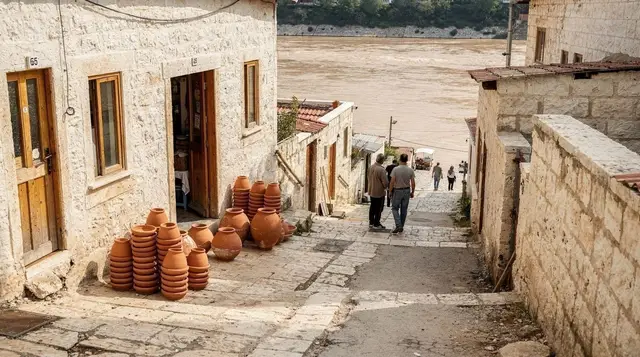
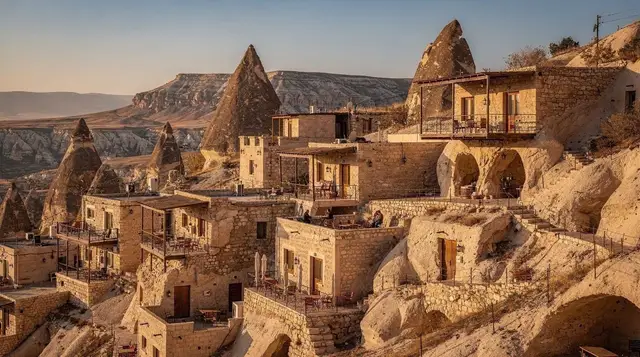
A Seljuk stop on the road south of Ürgüp
Most of what draws visitors to the Ürgüp area is rock: churches cut into tuff, cave hotels, chimneys standing in rows. Taşkınpaşa is the exception. It’s a modest village on the quieter road south of Ürgüp, on the way towards Soğanlı, and the reason it appears on any map at all is a cluster of freestanding Seljuk-era stone buildings — a medrese (theological college), a mosque and a türbe (tomb) — grouped together at the edge of the village. Nothing about them is rock-cut or Byzantine. They’re built, not carved, and that single distinction is what makes Taşkınpaşa worth the detour for the right traveller and entirely skippable for everyone else.
This isn’t a criticism. Taşkınpaşa was never meant to be a headline stop, and it doesn’t pretend to be one. There’s no visitor centre, no ticket booth with fixed hours, no row of tea houses waiting outside. What you get is a genuinely different layer of Cappadocian history — Seljuk rather than Byzantine, masonry rather than tuff — seen for the price of a short walk around a quiet square, usually with nobody else there.
Seljuk stone, not Byzantine rock — why that matters here
Almost everything else covered on this site sits inside the Byzantine, rock-cut tradition: the painted chapels of the Göreme Open-Air Museum, the frescoed churches strung along the Ihlara Valley, the hermit’s cell cut into a fairy chimney at Paşabağ. Those buildings were dug out of the volcanic tuff by monastic communities between roughly the ninth and eleventh centuries, and their defining material is the rock itself.
Taşkınpaşa belongs to a different world. The medrese, mosque and türbe here are dressed stone construction from the Seljuk period, the Turkic dynasty that controlled Anatolia in the centuries after the Byzantine hold on the interior weakened. Seljuk builders worked in cut stone rather than excavated rock, and their signature is visible in the doorway of the medrese: a carved portal with geometric and script ornament, the kind of stonework you’d associate more readily with Konya, the Seljuk capital a few hours south, than with the cave villages further north. The complex also includes a mosque still standing beside it and a türbe — a domed tomb structure — a short walk away, both built in the same stone tradition.
None of this is presented with much fanfare on the ground. There’s no interpretive signage explaining the political history of the period, and this guide won’t invent one either — what’s certain is the type of building you’re looking at: Seljuk civic and religious architecture, not a Byzantine chapel with a different paint scheme. If you’ve already spent a day or two inside cave churches and underground cities, Taşkınpaşa is useful precisely because it doesn’t repeat them.
What you’ll actually see
The complex sits at the edge of the village, an easy walk from wherever you park. Expect:
- The medrese — the most visually complete of the three structures, built around a courtyard with a carved stone entrance portal. Some sections have collapsed or are fenced off, so this is viewed from outside and around rather than walked through room by room.
- The mosque — still in occasional local use, plain from the outside, built in the same stone as the medrese.
- The türbe — a domed tomb structure a short distance from the other two, smaller and easy to miss if you don’t know it’s there.
That’s the full inventory. There’s no museum, no ticket window, and no guided route — you look, you read what’s posted (if anything is), and you move on. Twenty to thirty minutes covers it comfortably, even for someone who wants to walk the full perimeter and take photographs from a few angles. This is not a site to build a morning around; it’s a stop to fold into a longer day.
Taşkınpaşa versus Ayvalı and Cemil
Taşkınpaşa sits in the same general stretch south and east of Ürgüp as Ayvalı and Cemil, two other small villages that occasionally show up on the same maps. The comparison is worth making because it explains why Taşkınpaşa gets a dedicated stop and the other two mostly don’t.
| Village | What it has | Why visit |
|---|---|---|
| Taşkınpaşa | Seljuk medrese, mosque, türbe (built stone) | The only Seljuk architectural complex in this area — different period and style from the rest of Cappadocia |
| Ayvalı | Quiet rural village, valley walking, local guesthouses | Slow, low-key village life and walking, not monuments |
| Cemil | Small village, scattered rock-cut chapels nearby | Minor rock-cut heritage, low visitor numbers |
Ayvalı and Cemil are pleasant if you want a quiet village to wander through, but neither has a built monument of Taşkınpaşa’s scale or period. If the reason you’re heading south of Ürgüp is specifically to see something that isn’t another rock-cut church, Taşkınpaşa is the one that delivers it.
Getting there from Göreme
Taşkınpaşa isn’t served by regular dolmuş routes, so this is realistically a stop for self-drivers or for a private or tailored tour rather than a public-transport day out.
| From | Approximate time |
|---|---|
| Göreme | 45–55 minutes by car |
| Ürgüp | 25–30 minutes |
| Soğanlı | 15–20 minutes onward |
| Mustafapaşa | 25–30 minutes |
The most efficient way to see it is as a waypoint rather than a destination: heading south from Ürgüp towards Soğanlı, Taşkınpaşa sits more or less on the route, so a short detour off the main road adds relatively little driving time to a day that was already going that way. Trying to justify a standalone round trip from Göreme just for Taşkınpaşa is harder to argue for — the drive alone eats close to two hours round trip for a twenty-minute stop.
If you don’t have a car, this is one of the villages where a private tour earns its cost. A custom private tour of Cappadocia can be routed to include Taşkınpaşa alongside Soğanlı and Mustafapaşa, which is difficult to arrange with a fixed-itinerary group tour that doesn’t already stop here.
Combining Taşkınpaşa with Soğanlı and the south loop
Taşkınpaşa works best as one stop inside a longer loop through the quieter south side of the region, rather than a trip in its own right. A sensible day looks like:
- Leave Göreme or Ürgüp in the morning, before the midday heat.
- Stop in Mustafapaşa to see the old Greek stone houses and churches from its time as Sinasos.
- Continue to Taşkınpaşa for the Seljuk complex — twenty to thirty minutes.
- Finish at Soğanlı for the domed rock-cut churches and the twin valleys, allowing an hour or more for walking.
This is essentially the route the locally sold Blue Tour covers, minus a formal stop at Taşkınpaşa on most fixed itineraries. If you’re booking rather than self-driving, a Blue Tour taking in Soğanlı and Kaymaklı gets you through the same corner of the region, though you’d want to confirm with the operator whether Taşkınpaşa itself is included, since it’s treated as optional by some companies given the short amount of time it takes. A private Cappadocia sightseeing experience is the more reliable way to guarantee the stop if seeing the medrese specifically matters to you.
Don’t try to fold Taşkınpaşa and Soğanlı into the same day as the north-side Red Tour sites — the geography doesn’t cooperate, and stacking a full south loop onto a morning at the Göreme Open-Air Museum or Pigeon Valley makes for a rushed, backtracking day rather than an efficient one.
What Taşkınpaşa doesn’t have
Setting expectations before you go saves a wasted stop:
- No ticket booth or fixed opening hours in the way that Göreme Open-Air Museum or the underground cities have them. The complex is an open site.
- No restaurant or café built for visitors. The village is residential and modest; bring water and don’t plan a meal stop here.
- No shade to speak of around the stonework itself, so this is a hot midday stop in summer if you time it badly.
- No English-language signage guaranteed. What’s posted, if anything, may be in Turkish only.
- No parking infrastructure beyond informal roadside space near the complex.
None of this makes it a bad stop — it just means Taşkınpaşa rewards travellers who come with realistic expectations about a minor, unstaffed heritage site rather than those expecting a polished museum experience.
A note on nearby underground cities
If your south-side day already includes Taşkınpaşa and Soğanlı, it’s a reasonably short further drive to Kaymaklı or Derinkuyu, the region’s two underground cities, if you haven’t seen one yet and want to fold it into the same route. A Derinkuyu underground city tour pairs reasonably with a morning spent above ground at Taşkınpaşa and Soğanlı, spreading the day between built stone, rock-cut valleys and a below-ground complex rather than repeating one type of site all day.
How to look at the stonework
Because nothing is labelled, it helps to arrive with a few things to look for. Start with the portal of the medrese: walk up close, then step back, and notice how the carved ornament sits against plain walls around it. Seljuk builders concentrated their decoration on the entrance and left the rest comparatively austere, which is the opposite of a rock-cut church, where the plain tuff exterior hides a painted interior. Here the richest part is the face the builders wanted passers-by to see.
Then compare the three structures with one another. The mosque and the türbe share the stone of the medrese, and seeing them side by side shows how one building tradition served a school, a place of prayer and a tomb. Walk the full perimeter rather than stopping at the front; the way the masonry courses meet, and where later repairs differ from the original work, tell you more than any plaque would.
Light matters as well. Early morning and late afternoon bring out the carving on the portal, while a flat midday sun washes it out and makes the stop hotter than it needs to be. If you care about photographs, plan the south loop so that you reach the complex outside the middle of the day, and leave Soğanlı for the hours when the sun is high.
Pairing it with other quiet corners
Readers who enjoy the unhurried feel of Taşkınpaşa often like the same atmosphere elsewhere. The guide to Mustafapaşa and Sinasos covers another village where the architecture, rather than a famous attraction, is the point. For a full account of the valley at the end of the loop, see the Soğanlı Valley guide. And if the idea of visiting places without a tour group appeals, seeing Cappadocia without a tour explains how to link small stops like this one into a day of your own.
It also helps to think about what the rest of your trip has already shown you. After several mornings among painted chapels and balloon-filled skies, a short pause in front of dressed stone gives the region some historical depth: Cappadocia was not only a Byzantine monastic landscape, and the Seljuk presence is part of the story. Taking twenty minutes to register that, without any crowd or commentary, is a good reason to include the stop on a south-side day.
Taşkınpaşa: frequently asked questions
What period is the Taşkınpaşa complex from?
The medrese, mosque and türbe at Taşkınpaşa are Seljuk-era structures, built in dressed stone. This guide doesn’t assign them a specific date, but the architectural style — carved stone portals, geometric ornament — is distinctly Seljuk rather than the Byzantine, rock-cut style found at most other Cappadocian heritage sites.
Is Taşkınpaşa the same kind of site as the Göreme Open-Air Museum?
No. The Göreme Open-Air Museum is a cluster of Byzantine rock-cut churches carved directly into the tuff, with painted frescoes inside. Taşkınpaşa is built, freestanding stone architecture from the later Seljuk period. They’re worth seeing precisely because they’re different, not because one is a smaller version of the other.
How long should I spend at Taşkınpaşa?
Twenty to thirty minutes is enough to walk around the medrese, mosque and türbe and take photographs. It’s a stop, not a half-day site, and it’s best treated as one leg of a longer route rather than a destination on its own.
Can I get to Taşkınpaşa by dolmuş or public transport?
Not reliably. There’s no regular dolmuş service to Taşkınpaşa from Göreme or Ürgüp. A self-driven car or a private tour that agrees in advance to include the stop are the two practical options.
Is there an entrance fee at Taşkınpaşa?
There’s no staffed ticket booth at the site, unlike the Göreme Open-Air Museum or the underground cities. Treat it as an open, unstaffed heritage site rather than a ticketed museum, and don’t expect fixed opening hours.
Should I visit Taşkınpaşa instead of Ayvalı or Cemil?
If you specifically want to see a built monument rather than a quiet village or scattered minor chapels, Taşkınpaşa is the stronger choice of the three — it’s the only one with a substantial Seljuk architectural complex. Ayvalı and Cemil are better suited to travellers who want slow village walking rather than a specific monument to see.
What should I combine Taşkınpaşa with?
Soğanlı and Mustafapaşa are the natural pairing, since all three sit in the quieter south sector towards the Blue Tour route. Trying to combine Taşkınpaşa with north-side sites like the Göreme Open-Air Museum or Pasabağ in a single day means a lot of backtracking for little gain.
Is Taşkınpaşa worth the detour if I’m short on time?
Only if you’re already passing nearby on the way to Soğanlı. As a standalone trip from Göreme, the driving time outweighs the twenty minutes you’ll spend at the site. As an add-on to a south loop you were already doing, it costs very little extra time for a genuinely different piece of Cappadocian history.