A flat corridor between two villages
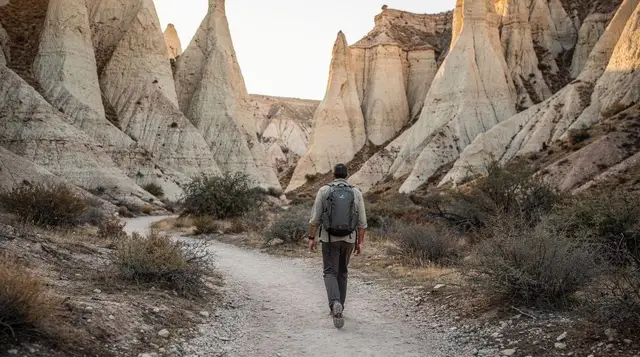
Pigeon Valley, known locally as Güvercinlik, is the path that most people who stay in Göreme or Uçhisar end up walking sooner or later, often without planning to. It runs between the two villages along a wide, mostly flat corridor cut into the tuf, and it is the one valley walk in the area that genuinely suits anyone who can manage a level, unpaved path for an hour or so.
Set it against Sword Valley or Rose Valley, both of which involve scrambling over rock steps and picking a route through narrower side-canyons, and the difference is immediate: Pigeon Valley has almost no elevation change, no exposed edges, and no sections that require hands-on-rock climbing.
That makes it a genuinely useful piece of the region’s geography rather than just another pretty walk. If you are staying in Göreme and want to see Uçhisar castle, or staying in Uçhisar and want to reach Göreme’s open-air museum, walking Pigeon Valley is a realistic way to cover the ground on foot instead of taking a taxi or waiting for a dolmuş.
It will not deliver the dramatic colour of Red Valley at sunset or the frescoed churches scattered through Rose Valley, and it is worth being upfront about that from the start. What it offers instead is an easy, direct route with a specific and slightly unusual visual feature running along both cliff walls for most of its length.
Why it’s called Pigeon Valley
The name comes from the hundreds of small, roughly square niches cut into the soft rock faces on either side of the path. These are old dovecotes: openings carved by hand into the cliff so that pigeons would nest inside, sheltered from birds of prey and the weather. For generations, farmers around Göreme and Uçhisar kept pigeons specifically for their droppings, which were collected and spread on the vineyards and fruit orchards on the plateau above as fertiliser, at a time when the tuf-based soil needed all the help it could get. Some dovecotes were fronted with small painted panels or simple decorative borders around the entrance holes, a handful of which are still faintly visible if you know to look for them.
This is the main visual marker to watch for as you walk: cliff faces that look, from a distance, almost pockmarked or peppered with small dark squares, in clusters that sometimes run for tens of metres along a single wall. It is worth knowing before you arrive that Pigeon Valley is not a site built around a historical mystery or a monument with a story to tell, in the way that Göreme’s rock-cut churches or Selime’s monastery are.
Its appeal is more straightforward: an unusual, human-made feature of the landscape, combined with an easy, pleasant walk between two places you probably need to get between anyway. Treat any framing of Pigeon Valley as a place of deep historical intrigue with some scepticism; the real story here is agricultural, practical, and fairly well understood.
Walking the trail: what to expect
The Uçhisar end
Starting from Uçhisar, the trailhead sits below the castle, reachable in a few minutes on foot from the village centre. The path drops gently into the valley floor and immediately opens into the wide, pale corridor that defines the whole walk. Underfoot it is compacted dust and loose stone rather than rock steps, which is part of why the route is manageable for most walkers, but also why footing needs a little care after rain, when the same surface turns slick.
The Göreme end
At the Göreme end, the path emerges near the road towards the open-air museum, a short walk or taxi ride from the village centre. Most visitors choose to start in Uçhisar and finish in Göreme, partly because the elevation drop makes for slightly easier walking in that direction, and partly because Göreme has more restaurants and cafés to end the day in. Either direction is perfectly workable, and neither end requires a car.
Along the way, the valley narrows and widens a few times but never closes into anything resembling a proper canyon. There are no forks that lead nowhere in the way some of the smaller side valleys near Zemi Valley or Meskendir Valley can catch out unprepared walkers. Signage is inconsistent in places, as it is across most of the valley network, but the path itself is wide and obvious enough that getting lost for any length of time is unlikely if you simply keep walking in one direction.
How it compares to Cappadocia’s other valleys
| Valley | Terrain | Typical time | Shade | Difficulty |
|---|---|---|---|---|
| Pigeon Valley | Flat, wide corridor | 1-1.5 hours one-way | Minimal | Easy |
| Rose Valley | Rock steps, narrow sections | 2-3 hours | Patchy | Moderate |
| Red Valley | Rock steps, steep in places | 1.5-2.5 hours | Patchy | Moderate |
| Sword Valley | Narrow, some scrambling | 1.5-2 hours | Minimal | Moderate to hard |
| Love Valley | Uneven, some incline | 1-2 hours | Minimal | Moderate |
| White Valley | Gravel and rock | 1-1.5 hours | Minimal | Moderate |
The comparison is useful for planning rather than ranking. If your priority is an easy morning walk with a clear start and end point, Pigeon Valley is the obvious pick. If you want dramatic rock colour and are comfortable on uneven ground, Red Valley or Rose Valley will suit you better, particularly around sunset.
Timing, shade and what to bring
There is very little tree cover on Pigeon Valley’s trail. For long stretches the walk runs through open ground flanked by cliffs rather than under any canopy, so the shade you do get comes from the valley walls themselves, and only when the sun angle happens to fall the right way. In July and August this matters: an easy, flat walk still becomes uncomfortable at midday when temperatures push into the low-to-mid thirties. Aim for the first couple of hours after sunrise or the last two before sunset, both for comfort and because the light on the cliff faces is better for photographs of the dovecotes at those times.
Despite the easy terrain, closed shoes are worth the effort. The path is dusty and dry most of the year, but the same tuf surface turns genuinely slippery after rain, and loose gravel sections can catch a sandal at an awkward angle. Bring at least a litre of water per person even for a walk this short, since there is nowhere to refill along the route itself. A hat and sun cream matter more here than in some of the deeper, narrower valleys precisely because there is less natural shade to rely on.
Mobile signal is patchy in the deeper sections but not absent the way it can be in narrower canyons, since the corridor stays relatively open throughout.
Doing it self-guided vs joining a tour
Because the trail is flat, well used and hard to lose, most people walk Pigeon Valley entirely on their own, without booking anything. It suits self-guided walking better than almost any other valley in the region: pick a direction, start walking, and follow the obvious path for an hour to ninety minutes.
That said, a guided option makes sense in a couple of specific situations. If you would rather combine Pigeon Valley with sites further out on the same day without arranging your own transport, a guided outing bundles the walk with a wider itinerary. A guided Pigeon Valley walk with hotel pickup and drop-off removes the logistics of getting to one end and back from the other, which is the only real friction point in an otherwise simple walk.
For visitors who want to pair the valley with one of the underground cities on the same day, a combined underground city visit and Pigeon Valley hike covers two very different sides of the region in a single outing: cool, enclosed tunnels followed by an open-air walk.
There is also a broader option worth knowing about if your day trip is heading south towards Ihlara Valley: a day tour covering Derinkuyu, Ihlara Valley and Pigeon Valley stacks a longer canyon walk and an underground city alongside this shorter one, which suits travellers without a car trying to cover more ground in a single day.
If you would rather stay closer to the shorter valleys, a half-day hike linking Love Valley and Pigeon Valley pairs this route with one of the more distinctive rock-formation valleys nearby, giving a fuller morning without committing to a full-day itinerary.
None of these are necessary purely to walk Pigeon Valley itself. They earn their price mainly through transport and pairing with other sites, not through any need for a guide to interpret the trail.
Combining Pigeon Valley with the rest of your day
Because it links Uçhisar and Göreme directly, Pigeon Valley works well as a connector rather than a destination to build a whole day around. A common pattern is to start in Uçhisar, visit the castle for the view over the valleys, then walk down into Pigeon Valley and finish in Göreme in time for the open-air museum or lunch in the village. Travellers following a one-day itinerary around Göreme and Uçhisar often fold this walk in without adding it as a separate stop.
It also pairs sensibly with a quieter afternoon, since the walk itself rarely takes more than ninety minutes. Some visitors combine it with a shorter loop through Zemi Valley or extend their day with sunset views from Uçhisar castle once the walking is done. For general planning on which valleys suit which fitness levels and time budgets, the wider guide to Cappadocia’s best hikes sets Pigeon Valley alongside the harder options, and the hiking safety guide covers the water, footwear and heat precautions that apply across all of them, Pigeon Valley included even at its easier grade.
Pigeon Valley walking FAQs
How long does the Pigeon Valley walk take?
Budget 1 to 1.5 hours to walk it one-way at a relaxed pace, longer if you stop often for photographs. It is a short outing compared with a half-day in Ihlara Valley or Rose Valley.
Where does the Pigeon Valley trail start and end?
The two ends sit below Uçhisar castle and on the edge of Göreme, near the road that runs towards the open-air museum. Either end works as a start; most people finish in Göreme, where there is more choice for lunch.
Is Pigeon Valley difficult?
No. It is one of the flattest, most straightforward walks in the region, with none of the scrambling or steep drops found in Sword Valley or Rose Valley. Ordinary fitness is enough.
Why is it called Pigeon Valley?
Local families carved small square openings into the soft cliff faces to house pigeons, then collected the droppings as fertiliser for the vineyards and orchards on the plateau above. The practice has mostly stopped, but hundreds of the niches remain visible along the walls.
Is there shade on the Pigeon Valley trail?
Very little for much of the route. The path runs through an open corridor with low scrub rather than trees, so midsummer midday walks are uncomfortably hot. Early morning or the last couple of hours before sunset are more sensible.
Can I walk Pigeon Valley without a guide?
Yes. The path is well trodden, mostly flat, and hard to lose for its full length, which is exactly why it suits people who would rather not join an organised tour. A guided option exists mainly for those combining it with sites further afield on the same day.
What should I wear for Pigeon Valley?
Closed, flat-soled shoes rather than sandals. The terrain is easy, but it is still dusty volcanic tuf that turns slippery underfoot after rain and where a stumble is more likely in open sandals.
Is Pigeon Valley worth it if I’ve already walked Rose Valley or Red Valley?
It is a different kind of walk rather than a repeat: flatter, quicker, and built around the dovecotes rather than rock colour or church frescoes. Treat it as a practical link between Uçhisar and Göreme rather than a second scenic hike on the same day.