Uçhisar Castle: the climb, the steps and the view
Is the climb to Uçhisar Castle difficult?
The path from Uçhisar village involves rock-cut steps and several narrow, low passages carved into the tuf, so it takes more effort than it looks like in photos. Allow 20 to 30 minutes each way at a steady pace, and expect some crouching and single-file sections near the top.
Uçhisar Castle is a single piton of rock rising out of the village that shares its name, and it is the highest point in Cappadocia’s tourist area. This page is only about the rock itself: the walk up to it, what the climb actually involves, what you see once you are on top, and the short loop of the village around its base. For a broader look at Uçhisar as a place to stay or eat, that is covered elsewhere.
What the castle actually is
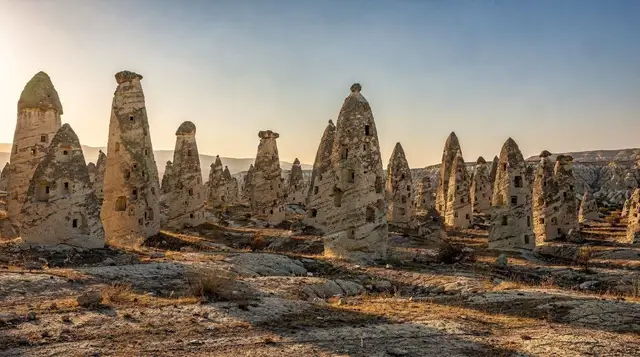
Despite the name, there is no fortress here in the usual sense — no walls, no gate, no towers built from cut stone. Uçhisar Castle is a natural cone of tuf, the same volcanic rock that forms the fairy chimneys across the region, hollowed out over centuries into room after room, corridor after corridor, connected by carved stairs. People used the rock as a refuge and a lookout for a very long time, digging deeper and higher as needed, which is why the inside now looks like a honeycomb when you see it in cross-section from certain angles in the village below.
At roughly the region’s high point, the rock is visible from a long way off, and it works the other way too: once you are up there, you can see most of the valleys and villages that make up the tourist heart of Cappadocia laid out at once. That combination — one climb, one 360-degree view — is the entire reason to come, and it is worth being clear-eyed about that before you buy a ticket: this is a viewpoint with a climb attached, not a museum with exhibits inside.
Getting to the base
Uçhisar sits about 10 minutes from Göreme by road, and dolmus minibuses run between the two frequently during the day. If you are staying in Göreme, a taxi or dolmus to the village square, followed by a short walk up through the lanes to the ticket kiosk at the base of the rock, is the normal route. Drivers can also get closer, though parking near the base fills up around midday when tour buses pass through.
The ticket kiosk sits at the foot of the rock. Buy your ticket in Turkish lira, and keep the fluctuating exchange rate in mind rather than expecting round numbers — cards are not always reliable at small kiosks like this one, so carrying some cash is the safer plan.
The climb: what the steps and passages actually involve
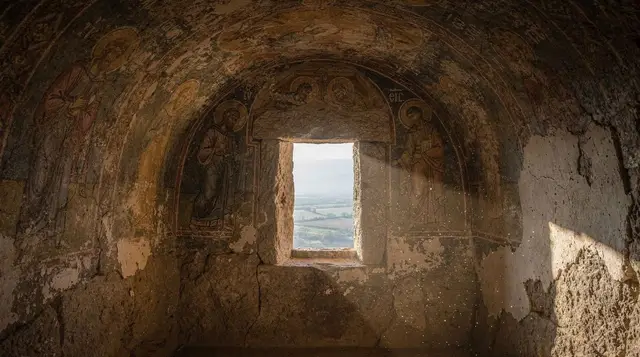
This is the part worth being honest about, because photographs of Uçhisar Castle tend to flatten it into a scenic backdrop rather than showing the route up. The path is a mix of rock-cut stairs, some of them shallow and worn smooth by decades of feet, others steeper and uneven, connected by tunnels and passages carved directly into the tuf. Several of these passages are narrow enough that two people cannot pass side by side, and a few require ducking or crouching, particularly on the upper sections closer to the summit.
There is no single straightforward staircase from bottom to top. The route weaves through openings in the rock, along ledges with metal railings in the more exposed spots, and up short flights that change direction as the tuf allows. None of it requires technical skill, but it does require steady footing, a reasonable level of fitness, and a tolerance for tight spaces — this is not a stroll, whatever a quick glance at a photo of the summit might suggest. Anyone with mobility limitations, a fear of enclosed spaces, or discomfort with unguarded drops should think carefully before starting the climb, since there is no shortcut once you are partway up and no accessible alternative route.
Give yourself 20 to 30 minutes to reach the top at a steady pace, more if you stop often to look back at the view opening up behind you, which most people do. Good closed shoes matter here more than almost anywhere else in the region, since the rock is dusty and can be slippery, especially after rain.
At the top: the view and how to read it
The summit is a series of platforms and outcrops rather than one single flat top, so there is some scrambling involved even once you have finished the main climb. From here, on a clear day, you can pick out Göreme below and to the northeast, the folds of Love Valley running out toward Göreme, and the wider patchwork of villages and valleys that make up central Cappadocia. It is genuinely the best single vantage point in the region for understanding how the villages relate to each other geographically, which flat maps do not convey nearly as well.
Wind picks up noticeably at the top, even on days that feel still in the village below, so a layer is worth having regardless of season. There is little shade, so in summer the midday sun on bare rock is intense; an earlier or later visit is more comfortable than a midday one, and it also means fewer people sharing the summit platforms with you.
Uçhisar Castle at sunrise, for the balloons
Because of its height, Uçhisar Castle’s summit is one of the recognised spots in the region for watching hot air balloons rise at first light, alongside the village of Uçhisar’s other high points. Rather than repeat the full detail on timing, ticket access at that hour, and how it compares with other balloon-watching spots, that is covered in a dedicated guide on watching the balloons without flying — worth checking before you plan a pre-dawn climb, since opening times for the ticketed site can differ from what free viewpoints around the village offer at that hour.
If balloons are the priority and the ticketed climb is not, several free vantage points lower down in the village give a similar angle without the stairs. For a wider comparison of the region’s best lookout points, including this one, see the Cappadocia viewpoints guide.
Walking the village around the castle
Uçhisar village wraps around the base of the rock in a loop of narrow stone lanes, small workshops, and a handful of cafés with terraces angled toward the view. It is compact: the whole loop, combined with the climb itself, fits comfortably into a single morning without feeling rushed. Houses here are built from the same cut stone as elsewhere in the region, and a number of them still have cave rooms behind more conventional stone façades, a pattern repeated across Göreme and beyond.
There is no need for a plan beyond wandering — the lanes are short and loop back on themselves near the ticket kiosk, so getting turned around is not a real risk. A slow circuit before or after the climb, with a stop for tea at one of the terrace cafés, is the natural way to spend the rest of the morning here.
Pacing the climb and the summit
The best way to approach the rock is to treat it as two separate efforts: the ascent, and the time you spend wandering the platforms once you arrive. On the way up, stop at the wider landings rather than in the narrow passages, because someone is nearly always right behind you and the tunnels are not made for pausing. The landings are also where the view starts to open, so you lose nothing by waiting for them.
At the top, take a few minutes before you start photographing. Turn a full circle and let your eye sort the landscape into pieces: the pale ridges, the dark patches of orchard, the clusters of rooftops. Only then pick a direction to shoot. Most people point the camera at the first thing they see and miss the better angle two platforms along. If the summit feels crowded, a short scramble to a neighbouring outcrop usually gives you the same view with more elbow room.
The descent deserves as much care as the climb. Tired legs and loose dust make the steps slippery going down, and the low passages that were easy to duck on the way up feel different when you are looking at your feet. Take it slowly, use the railings where there are any, and let faster walkers pass at the wide points.
Photography from the rock
Light changes everything here. Early in the day the valleys below sit in soft shadow and the stone glows warm, while late in the day the same rock turns golden and the long shadows give the landscape depth that midday simply flattens. If you only have one chance, choose either end of the day over the middle of it. For more spots where the light behaves well, the balloon photography spots guide and the Cappadocia photography itinerary over three days lay out how to build a plan around it.
A few practical habits help. Keep a hand on your phone or camera strap when you lean against a ledge, since a dropped lens does not come back up the rock. Bring a cloth for the dust, and wipe the lens before you shoot rather than after you notice the haze. Wide shots work best from the higher platforms, while the lower landings give you frames of the village roofs and the lanes you will walk afterwards.
Who the climb suits and who should skip it
The climb suits anyone who enjoys a little scrambling, is comfortable in tight stone passages, and does not mind heights. Teenagers and active adults usually find it a highlight, and it is a good short outing for a first morning in the region when you want to understand the geography before heading out to the valleys. If you are travelling as a family, the guides on Cappadocia with kids and Cappadocia with teenagers say how this kind of outing fits with the rest of a trip.
It is a poorer choice for anyone who struggles with narrow spaces or who has limited mobility. In that case the village lanes and a terrace café still give you a fine view of the rock itself, and the guide to Cappadocia with limited mobility points to alternatives elsewhere. Seeing the castle from below, from the lanes or from a distant viewpoint, is a perfectly good way to enjoy it without climbing.
Uçhisar Castle at a glance
| What | Detail |
|---|---|
| Distance from Göreme | About 10 minutes by road or dolmus |
| Time for the climb | 20 to 30 minutes up, similar down |
| Time at the summit | 15 to 20 minutes to take in the view |
| Village walk | Fits into the rest of a single morning |
| Fitness needed | Moderate — uneven steps, narrow passages, some crouching |
| Also good for | Sunrise balloon watching from the top |
| Payment | Turkish lira; cash safest at the kiosk |
What to know before you go
The Red Tour, one of the three colour-coded circuits sold across Göreme, typically includes a photo stop below Uçhisar Castle rather than the climb itself — worth checking with whichever agency you book through, since the wording can be vague. For a full breakdown of what each colour-coded tour actually covers, see the Red, Green and Blue Tour guide.
Midday brings the most visitors and the most tour buses idling near the base, so an early morning or late afternoon visit is more comfortable on the stairs, which narrow enough in places that congestion matters. If Uçhisar Castle is your only stop of the day, it pairs naturally with a walk through the Göreme Open-Air Museum or a longer loop through Göreme itself, both a short dolmus ride away. For a sense of how a single day in the region fits together, including a stop here, see the one-day Cappadocia guide or the matching one-day itinerary.
Timing your visit around the wider region’s weather also helps: the best months for comfortable walking and clear views from the summit are covered in the best time to visit Cappadocia guide, and where to base yourself for easy access to Uçhisar and the rest of the region is covered in the where to stay guide. For more on what else Uçhisar and the castle rock offer beyond this specific climb, see the things to do in Uçhisar Castle page and the wider Uçhisar Castle destination page.
Combining the castle with the rest of your day
Because the climb and the village loop fit into a morning, the afternoon is free for something different in character. Valleys are the obvious pairing: the Love Valley walk starts close by and gives you the same landscape from the inside rather than from above, and the Pigeon Valley trail links the village with the area below the rock on foot. Seeing the region from the summit first makes the walk easier to follow, because you already know which ridge leads where.
If you would rather spend the afternoon sitting down, the viewpoint cafés in Göreme are a gentle way to end a physical morning. And if you are still deciding where to sleep, the comparison of Göreme, Ürgüp or Uçhisar explains how each base feels, including what it is like to wake up with the castle rock outside your window.
Booking a guided visit
Several operators combine Uçhisar Castle with nearby stops rather than selling it alone, which suits travellers who would rather not manage transport and timing themselves. The guided half-day tour that pairs Uçhisar Castle with Love Valley and lunch covers the climb with a guide on hand to explain what you are looking at.
For a faster, more active way to see the castle rock alongside Avanos, the Avanos and Uçhisar sunset ATV tour swaps walking for riding on the approach. And for those who would rather end the day on foot with sunset views rather than a balloon at dawn, the sunset hiking tour with a local guide often takes in high points around Uçhisar as the light drops.
None of these require booking weeks ahead in most seasons, but summer evenings and the best sunrise slots do fill up, so booking a day or two out is a reasonable habit rather than a strict necessity.
Museum & art tours on GetYourGuide
Verified deep-linked GetYourGuide tours. Book through these links and we earn a small commission at no cost to you.
GetYourGuide does not provide a product photo for this activity — the image shows the meeting point, photographed by us.