Why Love Valley’s chimneys stand out
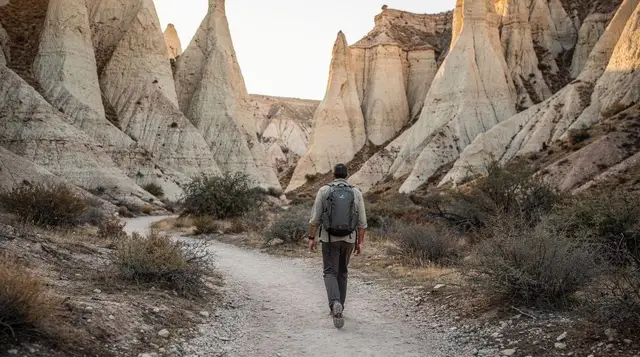
Most of Cappadocia’s fairy chimneys are a few metres tall, rounded, and scattered across gentler slopes. Love Valley’s are taller and noticeably more slender — some pass 30 metres — and cluster tightly enough in one stretch of the valley that a single roadside viewpoint above Göreme takes in dozens of them at once. That’s the reason the valley gets singled out rather than folded into a general “valleys” itinerary: the shape of the rock here really is different from what you’ll see on the Göreme Open-Air Museum side of town or in Pigeon Valley next door.
The name is a modern tourism coinage, not a historical one, and it refers plainly to the shape of the taller columns. It has stuck because it’s accurate enough to describe what you’re looking at, and because the valley genuinely photographs well from the viewpoint without any interpretation needed.
Like the rest of the region, this is tuf — compacted volcanic ash from eruptions of Erciyes and Hasan Dağı — carved by wind and water into columns that erode at different rates depending on the hardness of the caprock sitting on top of each one. Where that cap has held, you get the tall, narrow spires the valley is named for. Where it hasn’t, the chimney has already collapsed, which is worth remembering if you walk close to any of them: this is an active erosion landscape, not a finished sculpture.
Getting to the viewpoint
The Love Valley viewpoint sits on a road above the valley, about 10–15 minutes from central Göreme by car, taxi, or as a stop on an organised tour. There’s a car park and a short, flat walk to the railing — this part needs no fitness and no particular footwear, and it’s the version of Love Valley that most day visitors actually see.
There’s no scheduled dolmuş service out to the viewpoint, unlike the Göreme–Uçhisar–Ürgüp loop. Without your own car, the realistic options are a taxi there and back (agree the fare, including waiting time, before you go), or a half-day tour that includes the valley alongside walking, horseback riding or an electric-vehicle route. A number of local operators run exactly that combination:
a half-day guided walk through Love and Pigeon Valley covers both the viewpoint and a walking route with a guide who knows where the path actually goes, which matters given how easily the trail forks. For visitors who’d rather not walk at all, a self-drive electric Twizy tour that includes Love Valley reaches several viewpoints, including this one, without any hiking.
Walking down: what the trail is actually like
The viewpoint and the valley floor are two different visits, and it’s worth being clear-eyed about which one you’re signing up for. Walking down from the viewpoint into Love Valley is a moderate hike, not a paved lookout trail. The path isn’t waymarked to national-park standards; it splits repeatedly among the chimneys, and more than one branch leads nowhere useful. The surface is the same dry, dusty tuf as every other valley in the region — firm and manageable when dry, genuinely slippery on any incline after rain — and there’s a fair amount of up-and-down as the route threads between formations rather than following a flat valley floor throughout.
There is essentially no shade on this walk. In July and August, with afternoon temperatures regularly reaching 30–35°C, that’s a real constraint, not a minor inconvenience. Closed shoes with grip are necessary rather than optional, and carrying water is not a suggestion — plan on roughly a litre per person for a walk of this length in summer, more if you’re continuing on towards Uçhisar or linking up with Pigeon Valley rather than doubling back to the car park.
Mobile signal is unreliable once you’re down among the chimneys, so it’s worth telling someone your rough plan and expected return time, particularly if you’re walking alone or without a guide. None of this makes the walk dangerous in normal conditions — it’s a popular route and most visitors manage it without incident — but it’s a proper walk on uneven natural ground, not a groomed path, and it should be planned as one.
If you’d rather cover the ground on horseback than on foot, a horseback riding tour through Love Valley follows much of the same terrain at a different pace and with none of the walking effort, though it comes with its own learning curve if you haven’t ridden before.
| Way to see Love Valley | Time needed | Effort | Best for |
|---|---|---|---|
| Viewpoint only | 20–30 minutes | Minimal — flat, short walk from car park | Anyone with limited time or mobility |
| Guided valley walk | 2–3 hours | Moderate — loose surface, some elevation change, no shade | Fit walkers wanting to be among the chimneys |
| Horseback ride | 1.5–3 hours | Low physical effort, some riding skill helps | Riders wanting the valley floor without walking |
| Self-drive electric vehicle | 1–2 hours (multi-stop) | Minimal | Visitors combining several viewpoints without hiking |
When to go for the light
The best light for photographing the chimneys is early morning, roughly the first two hours after sunrise, or the last two hours before sunset — the same low, raking angle that makes the whole region’s rock formations look their sharpest and reduces the haze that tends to build up over the valley by midday. Midday visits aren’t wasted, but the light goes flat and the heat becomes the dominant factor, especially for anyone planning to walk rather than stop at the viewpoint.
Season matters as much as time of day. April–June and September–October give daytime temperatures that make the walk comfortable rather than gruelling, and skies that are more reliably clear than in the shoulder months either side. Winter visits are quieter and the light can be striking with a dusting of snow on the chimneys, but the descent into the valley becomes considerably harder to manage safely on wet or icy tuf, and it’s worth checking conditions locally before attempting the walk rather than the viewpoint alone. Deep summer is manageable at the viewpoint at any hour but genuinely uncomfortable for the full walk after mid-morning.
Love Valley versus Pigeon Valley, Rose Valley and Red Valley
It’s easy to blur these together when planning, since all four sit within a short drive of Göreme and all four involve walking among fairy chimneys. They’re not interchangeable, and picking the wrong one for what you actually want to do is a common source of disappointment.
Pigeon Valley, immediately south of Love Valley, is primarily a walking route connecting Göreme and Uçhisar, named for the dovecotes carved into its rock faces rather than for tall chimney formations. It’s the valley to pick if you want a point-to-point walk that ends somewhere useful — Uçhisar’s castle — rather than a there-and-back visit.
Rose Valley and Red Valley, east of Göreme, are known for the colour of their rock at sunset rather than for chimney height, and their trailheads sit on a different road entirely, closer to Çavuşin. If sunset colour is what you’re after specifically, those two valleys are the better target; Love Valley’s viewpoint works well at sunset too, but for the chimney shapes rather than rock colour.
The practical distinction worth remembering: Love Valley is the one you can appreciate fully from a viewpoint in half an hour, with the walk as an optional, more demanding extension. Pigeon Valley, Rose Valley and Red Valley are built around walking as the main event, with no equivalent single viewpoint that substitutes for it. Don’t plan Love Valley expecting a Rose Valley-style sunset walk, and don’t plan Pigeon Valley expecting a five-minute viewpoint stop.
Combining Love Valley with the rest of the day
Because the viewpoint takes so little time, most visitors pair it with something else rather than treating it as a standalone outing. A common combination is Love Valley in the early morning, followed by Uçhisar Castle or a walk through Pigeon Valley towards it, since the two trailheads sit close together geographically even though the valleys themselves are distinct.
For a longer, guided version of the same idea, a private tour covering Love Valley together with Kayaşehir and Avanos extends the day towards the Kızılırmak and Avanos, the pottery town on its banks, for visitors who’d rather have a full day planned around Love Valley than a standalone stop.
If your morning already starts with a hot air balloon flight, note that the two don’t combine directly — balloons launch before dawn from designated sites and land according to the wind, not to a fixed itinerary, though flights do sometimes drift over Love Valley’s chimneys, which are recognisable from the air. Treat the flight and the valley visit as two separate bookings on the same morning rather than one continuous activity; see our hot air balloon guide for how the timing of a flight actually works.
For walkers who enjoy Love Valley and want to see more of the region on foot, the same guided operators typically run similar routes through Rose Valley and Red Valley, and our hiking safety guide covers what applies across all of them — water, footwear, sun exposure and what to do if a trail forks unexpectedly, which happens in Love Valley as much as anywhere else.
Practical notes before you go
Wear closed, gripped shoes if you’re walking beyond the viewpoint — sandals and worn trainers are a genuine liability on loose tuf, particularly on the descent. Carry water rather than assuming you’ll buy it locally; there’s no reliable vendor at the viewpoint or along the trail. Sun protection matters more here than in valleys with any tree cover — hat, sunscreen and, in summer, avoiding the two or three hours either side of midday.
If you’re driving yourself, the viewpoint has parking but it fills up around sunrise and sunset in high season; arriving 15–20 minutes ahead of your target light window is a reasonable buffer. If you’re walking down, plan your return route in advance — the temptation to keep walking towards Pigeon Valley or Uçhisar is real, and it turns a 2-hour outing into a half-day one without a car waiting at the far end. For a wider look at how a Love Valley stop fits into a first visit to the region, see our guide to the best hikes in Cappadocia and our one-day itinerary, which places the viewpoint alongside the other stops most first-time visitors prioritise.
Love Valley frequently asked questions
Do I need to walk down into Love Valley, or is the viewpoint enough?
The viewpoint on the road above the valley shows the full cluster of tall fairy chimneys in a single view and needs no walking beyond the car park. Walking down adds a genuinely different experience — you’re among the columns rather than looking at them — but it’s a separate, longer commitment, not an extension of a five-minute stop.
How hard is the walk through Love Valley?
Moderate. The path isn’t waymarked in the way a national park trail would be, the surface is loose, dusty tuf that turns slippery after rain, and there’s a real amount of up-and-down as the route weaves between the chimneys. It isn’t technical, but it isn’t a stroll either, and there’s no shade for any of it.
Can I reach Love Valley without a car?
The viewpoint is reachable by taxi or as a stop on a Twizy or buggy tour out of Göreme. There’s no dolmuş service to the viewpoint itself, so without a car or a booked tour, the practical options are a taxi there and back, or joining a hiking, horseback or electric-car tour that includes it.
What’s the best time of day to visit?
Early morning, before the heat builds and while the low sun rakes across the chimneys, or the last two hours before sunset for the same light at the other end of the day. Midday sun is flat for photography and, in summer, genuinely uncomfortable on a shadeless trail.
How is Love Valley different from Pigeon Valley or Rose and Red Valley?
Love Valley’s fairy chimneys are taller and more slender than anything nearby, and the viewpoint sits above the valley rather than at trail level. Pigeon Valley, just south, is a walking route between Göreme and Uçhisar with dovecotes cut into the rock rather than tall chimneys. Rose and Red Valley, to the east, are known for coloured rock and sunset views rather than chimney formations, and their access points are separate roads entirely.
Is Love Valley suitable for children or anyone with limited mobility?
The viewpoint works for almost anyone who can get out of a car. The walk down does not: loose surfaces, uneven footing and no shade make it a poor fit for young children, anyone unsteady on their feet, or hot afternoons. Treat the viewpoint and the walk as two separate decisions.
Can I combine Love Valley with a hot air balloon flight?
Only by coincidence of timing, not by route. Balloon flights launch before dawn from designated sites and land wherever the wind takes them, not in Love Valley itself. Some flights do drift over the valley and its chimneys are a recognisable sight from the air, but a balloon booking and a Love Valley visit are planned as two separate parts of the same morning, not one activity.