Rose Valley hike: walking Güllüdere from Göreme
How long is the Rose Valley hike and when should I walk it?
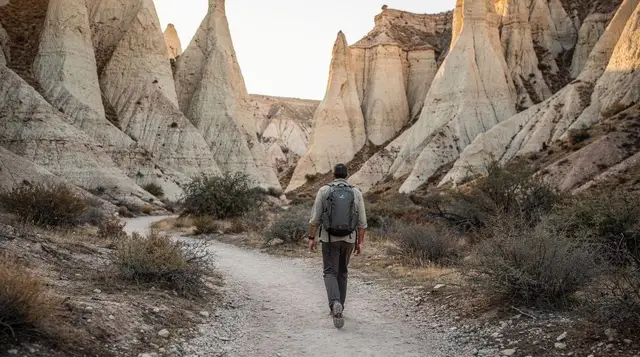
The main Rose Valley (Güllüdere) route runs roughly 6 to 7 kilometres one way and takes about two to two and a half hours at an easy pace, with gentle but uneven climbs on volcanic tuf. Late afternoon is the better window, since the low sun turns the rock a deeper pink than it shows at midday.
Rose Valley and Red Valley: not the same walk
Rose Valley, known locally as Güllüdere, runs alongside Red Valley and touches it at a few points along the way, which is why the two get confused before a trip and sometimes conflated once people are back home comparing photos. They are separate valleys with separate characters.
Red Valley has become the region’s set-piece sunset spot, with a fenced viewpoint that fills with tripods in the last half hour before dark — that route has its own dedicated page. Rose Valley is the quieter neighbour: fewer people on the path, a softer pink tone to the rock rather than Red Valley’s deeper rust, and a handful of rock-cut churches and tombs rather than the denser concentration found next door.
If you only have time for one valley walk near Göreme, which one you pick depends on what you want. Red Valley for the view at the end. Rose Valley for a longer, calmer walk with the light doing quieter work along the whole route rather than concentrated at a single viewpoint.
How long the trail actually is
The main Rose Valley route runs approximately 6 to 7 kilometres one way, and most walkers cover it in two to two and a half hours without stopping much. Add time for photographs, for the odd wrong turning where the path splits, and for a pause at any of the churches along the way, and a relaxed walk fills three hours comfortably.
The valley floor undulates rather than climbs in any sustained way — there’s no single steep ascent to plan around — but the path crosses several shallow ridges and dips, and the cumulative up and down adds more effort than the flat distance suggests. None of it is technical. It’s walking, not scrambling, though a short section or two asks for hands-on-rock balance where the tuf has eroded into a narrower cut.
A shorter option exists too: walking only the lower third or so of the valley from either trailhead gives a sense of the place in under an hour, which suits a late-arriving afternoon or a group with mixed fitness.
Terrain: what the ground is actually like
The valley floor is volcanic tuf, the same soft, pale rock that shapes every fairy chimney in the region, and it behaves the way it does everywhere else here: dry and dusty for most of the year, packed hard in places, loose and gravelly in others. Expect stretches of soft path that raise dust with every step, interspersed with rockier sections where the trail narrows between eroded walls. A few short scrambles over bare rock are unavoidable if you walk the full route, though none require equipment beyond decent shoes and a free hand.
The path is used often enough to stay visible, but it braids in places — a main trail with informal side tracks worn by people cutting towards a church, a viewpoint, or simply the shade of an overhang. Some of these side paths dead-end. It’s worth carrying a downloaded map or a GPS track rather than relying on signage, which is sparse to non-existent for long stretches.
Trailheads: where to start and where to finish
There is no single official start and end point, which is part of why Rose Valley suits an out-and-back or a one-way walk arranged with a taxi at the far end. The two most commonly used access points are:
- North end, near Çavuşin and Paşabağ. A marked junction off the road connecting Çavuşin to Paşabağ drops down into the upper valley. This is the usual starting point for walking south towards Red Valley.
- South end, near the Kızılçukur road. The valley meets the road that also serves the Red Valley viewpoint, making it straightforward to finish here and either walk the short distance to the viewpoint itself or arrange a pick-up.
Walking north to south puts the sun broadly at your back through the middle of the afternoon, which suits the late-light approach described below. Either direction works; the choice mostly comes down to where transport is easiest to arrange at the end of the day.
Why late afternoon suits this valley
Rose Valley earns its name from the colour the tuf takes on under low, angled sunlight — a warm pink that midday sun simply doesn’t produce. At noon, with the sun close to overhead, the same rock reads as pale beige, flattened by direct light with none of the depth that gives the valley its reputation among photographers. The transformation happens gradually through the last two to three hours before sunset, as the light angle drops and the colour deepens.
This is a different rhythm from Red Valley, where the draw is a single viewpoint at the very end of the day. In Rose Valley, the colour builds along the whole walk, which makes a late-afternoon start — leaving enough daylight to reach the far end before dark — the better plan than trying to time a single dramatic moment. Bring a torch or a phone light regardless, since the walk out from either trailhead can run past sunset if you’ve lingered.
What you’ll see along the way
Rose Valley’s churches and rock-cut tombs are real but modest compared with the concentration found in Red Valley or the formal complex at the Göreme Open-Air Museum. Expect to pass a handful of carved chambers cut into the valley walls — some are recognisably churches, with worn traces of decoration, and others are tombs, simpler and undecorated. Most are unsigned. Walking a little off the main path towards obvious openings in the rock face is the only way to find them; a straight walk down the valley centre will miss most of what there is to see.
Beyond the rock-cut sites, the appeal here is the formations themselves: eroded pinnacles, narrow side-channels, and the pink-toned walls that give the valley its name. It’s a quieter, more textured walk than the marquee stops elsewhere in the region, and that’s broadly the point of coming here rather than sticking to the more visited valleys.
Rose Valley or Red Valley: a quick comparison
| Rose Valley (Güllüdere) | Red Valley (Kızılçukur) | |
|---|---|---|
| Typical one-way distance | approx. 6–7 km | shorter, viewpoint-focused |
| Best time to walk | last 2–3 hours before sunset | last 30–60 minutes before sunset |
| Crowds | light to moderate | busy near the viewpoint at sunset |
| Rock-cut churches and tombs | a handful, mostly unsigned | more numerous |
| Main draw | colour along the whole walk | the sunset view itself |
| Combine with | can be linked to Red Valley | can be linked to Rose Valley |
For the full case on why Red Valley’s ending draws a crowd every evening, see the sunset guide.
Combining Rose Valley with a longer walk
Because the two valleys touch at several points, a combined route covering both Rose and Red Valley in one outing is common, and it’s sold locally as a half-day hike as well as offered as a guided option. Walking both independently takes longer than either alone — expect a half-day rather than a couple of hours — since the connecting stretches between them add distance and a little route-finding beyond what either valley needs on its own.
a half-day guided walk covering both Red and Rose Valley removes the guesswork around where the two valleys actually link up, which is the part independent walkers most often get wrong on a first attempt.
Rose Valley also sits within reach of other valley walks in the same cluster. Love Valley and Pigeon Valley lie nearby, and walkers building a multi-valley day often work through several of them, including Meskendir Valley and Zemi Valley, on consecutive afternoons rather than trying to cram more than one into a single walk.
Guided options if you’d rather not navigate
The braided path and sparse signage put some walkers off going independently, and a guided option removes that concern along with adding context on the churches and tombs that are easy to walk straight past.
a small-group hiking tour through Rose Valley covers the route with a local guide pointing out the rock-cut sites along the way, while a guided sunset walk timed for the late-afternoon light is built specifically around the colour change described above, finishing as the light drops rather than starting from it.
For a different pace through the same landscape, a jeep safari around the Red and Rose Valley area covers more ground with less walking, useful if a full hike doesn’t suit the day but the valleys themselves are still the draw.
Practical planning
| Detail | |
|---|---|
| Trail length (one way) | approx. 6–7 km |
| Walking time | 2–2.5 hours, plus stops |
| Terrain | dry tuf, dusty; some loose and rocky sections |
| Best time of day | last 2–3 hours before sunset |
| Signage | sparse; a downloaded map or GPS track helps |
| Access | near Çavuşin/Paşabağ (north) and the Kızılçukur road (south) |
| Suitable for | independent walkers and guided groups alike |
General valley safety, including footwear, water, and what to do about the lack of shade, is covered separately in the hiking safety guide rather than repeated here. For a broader shortlist of walks across the region, the best hikes in Cappadocia guide sets Rose Valley alongside the other main options, and the Göreme walking guide covers getting to and from trailheads without a car. If a valley walk is one piece of a wider two-day plan, the two-day Cappadocia itinerary shows where it fits.
Frequently asked questions about the Rose Valley hike
How long is the Rose Valley hike?
The full one-way route through Rose Valley covers approximately 6 to 7 kilometres and takes most walkers two to two and a half hours without stops. Shorter loops from either end can be done in under an hour if you only want a taste of the valley.
Is Rose Valley the same as Red Valley?
No, they are separate valleys that run roughly parallel and connect at a few points along the way. Rose Valley (Güllüdere) is quieter and has a softer pink cast to its rock, while Red Valley (Kızılçukur) is the one with the well-known sunset viewpoint.
What is the best time of day to walk Rose Valley?
Late afternoon, roughly the last two to three hours before sunset. The low, angled light brings out the pink and rose tones in the tuf that give the valley its name; at midday the same rock looks flat and pale.
Where does the Rose Valley trail start and end?
Most walkers start near the Çavuşin to Paşabağ road, where a marked junction drops into the valley, and finish either towards the Kızılçukur road on the Red Valley side or back up towards Göreme. Both ends are reachable on foot or by a short taxi hop, so the walk can be done in either direction.
Are there churches or rock-cut sites in Rose Valley?
Yes, a handful of rock-cut churches and carved tombs sit along the trail, though there are fewer of them here than in neighbouring Red Valley. Several are unsigned and easy to walk past, so it helps to go slowly near the valley walls rather than only on the main path.
Can Rose Valley and Red Valley be walked together in one trip?
Yes, the two valleys link up at a few points, and a combined loop or a guided route covering both is common, including as a half-day option. Doing them separately on two different afternoons gives more time in each, since the connecting sections add distance and route-finding.
Do I need a guide for the Rose Valley hike?
No, the main route is walkable independently with a downloaded map, since the path is used often enough to be reasonably clear in daylight. A guide is worth it if you want the churches and tombs pointed out, since several are easy to miss without local knowledge.
How difficult is the Rose Valley trail?
Moderate. The path undulates rather than climbs steeply, but the tuf surface is uneven, dusty, and occasionally rocky, so it takes longer than the distance alone suggests and firm footwear makes a real difference.
Hiking & nature tours on GetYourGuide
Verified deep-linked GetYourGuide tours. Book through these links and we earn a small commission at no cost to you.
GetYourGuide does not provide a product photo for this activity — the image shows the meeting point, photographed by us.