Turkey’s longest river, and why it matters here
The Kızılırmak — literally the “Red River” — rises in the Kızıldağ mountains of eastern Turkey and runs for around 1,355 km before it eventually empties into the Black Sea, making it the longest river entirely within Turkey. For most of that course it has nothing to do with Cappadocia. The stretch that matters to visitors is a single wide loop around the town of Avanos, about 15 minutes’ drive north of Göreme, where the river curls around three sides of the old town centre before continuing north.
In Cappadocia the Kızılırmak is not a destination with an entrance fee or a fixed itinerary. It is a landform: the reason Avanos sits where it does, the reason the town works clay for a living, and a useful line to orient yourself by when the streets tangle up near the old bridge. This page treats the river on those terms — as geography and as a place for a short walk — rather than as a boat trip or a swimming spot, because neither of those exists here in any organised form.
Where the river actually is
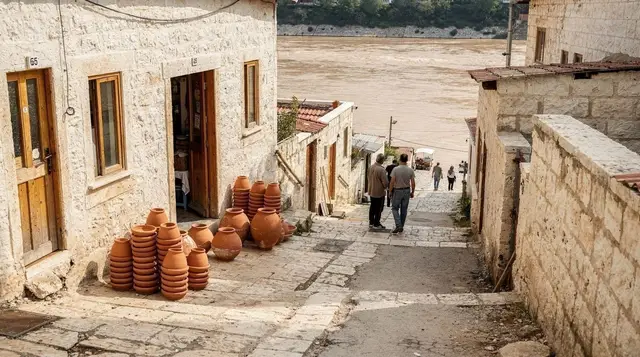
Avanos grew up on the river’s south bank, with the newer part of town, and most of the car parks used by day-trip minibuses, on the north side. A single road bridge connects the two, and this is the easiest fixed point to navigate from if you are exploring Avanos on foot rather than with a guide. Stand on the bridge and you can see, in one glance, the pottery workshops clustered on the south bank, the weekly market area, and the river itself moving past at a pace that is usually gentle rather than dramatic — it is a working river through a dry plateau, not a mountain torrent.
The water carries a faint reddish-brown tint that gives the river its name, most visible after rain has washed sediment down from higher ground. In the height of summer, after months without significant rainfall, the flow can drop noticeably and some of the gravel banks are exposed; in spring, after snowmelt further upstream, the river runs fuller and faster. Neither state is dangerous to look at from the bank, but the current is not something to wade into for a photo — the bed shifts and the water is colder and stronger than it looks from a café table.
The clay, briefly — and where that story is actually told
Avanos has worked the river’s red clay since at least the Hittite period, roughly the second millennium BC, and the trade has continued in some form ever since. The clay is dug from beds along the riverbank, worked on a foot-powered wheel much as it would have been centuries ago, then fired in workshops that still line the streets closest to the water. That continuity — a craft tied to a specific stretch of a specific river for over three thousand years — is the main reason the Kızılırmak is worth a mention on its own, rather than being folded silently into a general Avanos write-up.
This page is not the place to choose a workshop, watch a demonstration, or try the wheel yourself: that is covered in full on the Avanos pottery workshops guide, and the wider town — its streets, the hilltop viewpoint, and the market — is covered on the Avanos walking guide. What belongs here is simpler: the clay is red because the river is red, and the river is red because of the iron-rich sediment it carries down from the highlands. Everything downstream of that fact, literally and figuratively, is Avanos’s story rather than the river’s.
What there is to actually do at the river
Be direct with yourself about expectations: there is no boat trip, no kayak rental, no organised river cruise, and no supervised swimming area on the Kızılırmak in Cappadocia. Anyone selling you one of those as a “Cappadocia river experience” is either confused about geography or describing something that happens hundreds of kilometres away. What the river offers is quieter and cheaper.
- A riverside walk. A paved and packed-earth path runs along sections of both banks near the town centre, shaded in places by poplar and willow trees that are a genuine contrast to the bare valleys elsewhere in the region. Twenty to forty minutes covers the walkable stretch near the bridge at an easy pace.
- A café stop with a view of the water. Several cafés on the south bank have terraces that look directly onto the river; a tea or coffee here runs roughly 30–60 TRY, in the same range as anywhere else in the region.
- Photography. The combination of poplar trees, the old stone bridge, and pottery stalls along the bank is one of the more photogenic ordinary-life scenes in Cappadocia, distinct from the fairy chimney views everyone already has.
- Orientation. If you arrive in Avanos without a fixed plan, walking to the river and finding the bridge is the fastest way to work out which side of town you are on.
None of this needs a booking, a guide, or more than an hour, which is why the suggested time above is short. It pairs naturally with a longer Avanos visit rather than justifying a trip by itself.
Reading the landscape around the river
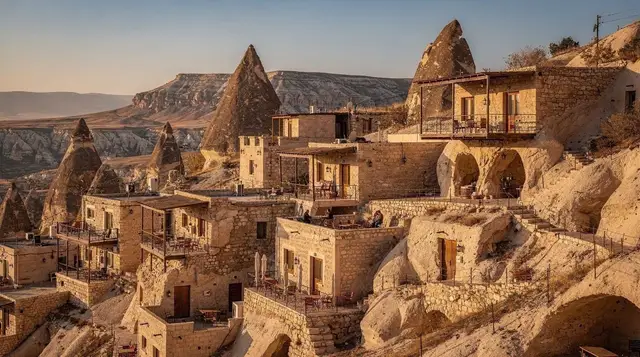
The river is easier to appreciate once you notice how different it feels from the rest of Cappadocia. Most of the region is pale tuff, bare ridges and dry valleys, shaped by the volcanic story told in the volcanoes that made Cappadocia. Here, a ribbon of green follows the water, and the colours shift from cream and pink rock to dark poplar leaves and reddish mud. That contrast is the real reason to slow down: you are looking at the one thing that keeps this part of the plateau alive and settled.
If you have just come from the rock formations of Göreme or the Göreme National Park, the river quarter feels like a change of scene rather than more of the same. It makes a good counterweight to a day of fairy chimneys and cave churches, and it suits people who want one quiet, ordinary hour in the middle of a busy itinerary.
How to pace a short riverside visit
Because the stop is brief, a little order helps. Start on the bridge to get the layout in your head, then choose one bank and follow it for as long as it stays pleasant. Turn back when the path loses interest rather than pushing on for the sake of distance; there is no famous viewpoint at the end of it, and the best moments are usually the small ones — a potter’s stall opening for the day, light through the willows, a pause on a terrace.
- Go early or late. The soft light of morning and the hour before sunset are kinder to both the water and your photographs, and the bank is calmer once the day-trip minibuses have moved on. For a broader picture of how the town fills and empties, see Cappadocia crowds, hour by hour.
- Bring little. A hat, water and comfortable shoes are enough; the path is not a hike. If your day continues into the valleys, the Cappadocia packing list covers what to carry.
- Keep it flexible. Weather in the region can change the feel of a river walk quickly, so it helps to read when the weather turns in Cappadocia before committing to an outdoor-only plan.
The river and the story of Avanos clay
For readers who want the human side of the river rather than the geography, the blog piece Avanos clay and the red river follows the clay from bank to wheel. Pair it with a visit to the Avanos hair museum if you want to see the town’s more eccentric side, or with a lesson at one of the studios described in the Avanos pottery workshops guide. None of these needs the river, but all of them make more sense once you have stood beside it and seen where the raw material comes from.
Getting there from Göreme
| From | Distance / time | Typical way to get there |
|---|---|---|
| Göreme | ~15 min by road | Dolmuş (minibus), taxi, rental car, or as a stop on the Red Tour |
| Ürgüp | ~20 min by road | Taxi or rental car; less frequent dolmuş service |
| Nevşehir | ~20 min by road | Dolmuş or taxi |
Dolmuş minibuses connect Göreme and Avanos frequently through the day but thin out by early evening, so plan a return before dark if you are relying on one rather than a rental car or taxi. Avanos is also one of the standard stops on the Red Tour, which is the easiest way to see the river and the pottery quarter together without arranging your own transport.
Combining a river visit with the rest of the day
A short riverside stop rarely fills a half-day on its own, so most visitors fold it into a longer stay in Avanos or the wider northern loop. Reasonable pairings:
- Avanos town + river walk. Cover the market streets, the hilltop viewpoint, and the riverbank on foot in half a day; see the Avanos walking guide for a suggested route.
- A pottery workshop + river walk. Watch or try the wheel, then walk the bank where the clay is dug; the Avanos pottery workshops guide covers what to expect and roughly what a piece costs.
- The Red Tour. Avanos, including a stretch by the river, is one stop among several on the standard Red Tour, alongside the Göreme Open-Air Museum, Paşabağ, and Devrent Valley.
For travellers booking the day rather than arranging it themselves, the Red Tour that stops in Avanos alongside the open-air museum and Paşabağ covers this loop in one organised day. Travellers who would rather explore the riverbank and back roads at their own pace, with stops wherever they like, can look at a private jeep tour through the valleys around Avanos instead.
What the river is not
Worth stating plainly, because marketing copy elsewhere sometimes blurs this: the Kızılırmak in Avanos is not a swimming destination, not a rafting river, and not a cruise route. Rafting does exist in Cappadocia, but on the Zamantı river near Kayseri, a separate river system roughly 1 hour 15 from Göreme — a different trip entirely, and not something to conflate with a stroll along the Kızılırmak in Avanos. If a “Kızılırmak boat trip” is advertised in Göreme, ask exactly where it departs from and what body of water it is actually on before booking anything.
For anyone who wants to see the river’s most photogenic sunrise light from above rather than from the bank, a sunrise balloon flight over the Avanos valley is the way to do it — though the balloon routes vary by wind direction and a flight over this specific stretch of river is never guaranteed. Travellers who want balloon views without flying can also see baskets pass overhead from a fixed viewing point with a balloon photo zone tour timed to sunrise.
Fitting the river into a longer trip
The river works best as a connecting piece, not an anchor. On a short stay, the Cappadocia in one day and Cappadocia in two days plans leave little room for it, so treat it as an optional pause if you pass through Avanos anyway. On a slower trip, such as the five-day slow itinerary, a leisurely morning by the water fits naturally. If you are weighing how much time the whole region deserves, how many days in Cappadocia helps set expectations, and seeing Cappadocia without a tour shows how independent travellers can link Avanos to the other stops.
Kızılırmak river: frequently asked questions
How long is the Kızılırmak river?
The Kızılırmak is approximately 1,355 km long, making it the longest river entirely within Turkey’s borders. It rises in the Kızıldağ mountains in the east and flows in a long arc before draining into the Black Sea. Only a short stretch, where it loops around Avanos, is relevant to a Cappadocia visit.
Can you swim in the Kızılırmak at Avanos?
There is no supervised swimming area, and it is not treated as a swimming river by locals or visitors. The current and depth vary with the season and are not signed or monitored, so it is best appreciated from the bank rather than in the water.
Is there a boat trip or river cruise on the Kızılırmak in Cappadocia?
No organised boat trip or cruise operates on the Kızılırmak in the Avanos area. If a tour is advertised under that description, confirm the actual body of water before booking, since it may be referring to a different activity or location entirely.
Why is the water in the Kızılırmak red?
The colour comes from iron-rich sediment the river picks up as it crosses the Anatolian plateau. That same reddish clay is what has been dug from the riverbank at Avanos and worked into pottery since Hittite times.
How much time should I spend at the river?
Thirty to sixty minutes covers a walk along the bank and a stop at a riverside café. Most visitors combine it with several hours in Avanos itself rather than visiting the river as a separate outing.
Is the Kızılırmak the same river used for rafting in Cappadocia?
No. Rafting in the region takes place on the Zamantı river near Kayseri, a separate river roughly 1 hour 15 from Göreme. The Kızılırmak at Avanos is not used for rafting.
What is the best time of year to see the river?
April to June and September to October offer comfortable walking temperatures and, in spring particularly, a fuller river fed by snowmelt. Midsummer afternoons are hot for a riverside walk, though the trees along the bank offer more shade than most valley trails in Cappadocia.
Do I need a guide to visit the river?
No. The riverside path near the bridge in Avanos is easy to find and walk independently, whether you arrive by dolmuş, rental car, or as part of an organised tour such as the Red Tour.