When the weather turns in Cappadocia
I did not expect the sky to be the thing I paid closest attention to on this trip. In most places I have travelled, weather is background noise — you check it once, pack accordingly, move on. In Cappadocia it sat at the front of my mind every evening, because it decided more of the next day than any itinerary I had written.
Living at 1,000 metres changes the rules
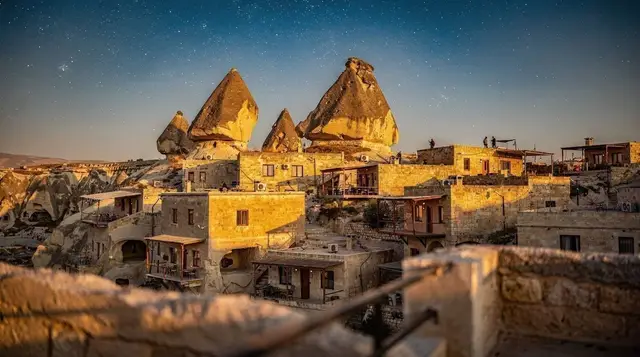
Göreme and the villages around it sit on a plateau at roughly 1,000m, with no coastline, no forest cover and very little to slow the wind down. That openness is part of what makes the landscape look the way it does, but it also means conditions shift faster than I was used to. A clear, still morning can turn breezy by mid-morning; a flat grey sky can clear within an hour. I stopped trusting the forecast I checked the night before and started checking again at breakfast.
The clearest example is the hot air balloons. Operators measure wind speed and direction at first light and decide, sometimes within the hour, whether flights go up at all. I am not going to repeat the full story of a cancelled flight here — that is its own piece, on balloon flight cancellations and wind — but the pattern is worth knowing before you land: on any given morning in Cappadocia, there is a real chance the balloons stay grounded, whatever the season.
Rain behaves differently here too. It rarely lasts long, but it does not need to. The paths through Rose Valley, Red Valley and Love Valley are cut into soft tuf, and a shower turns the dust into a thin slick within minutes. I watched a guide turn a small group back from a staircase section after ten minutes of drizzle, not because the rain itself was heavy but because the rock underfoot had already changed.
Summer heat sets the clock, not the calendar
July and August afternoons in Cappadocia routinely climb into the mid-30s, with almost no shade across the open valley floors or the terraces of Göreme Open-Air Museum. What surprised me was less the peak temperature than how early it arrives. By 11am on a summer day, walking Devrent Valley or the Pigeon Valley trail already felt like a mistake I was making on purpose. The people who seemed to be enjoying themselves were the ones who had started at 7 or 8am and were back at a shaded café by the time I was setting out.
Nights cool considerably even in high summer, which is worth remembering if you are booking a cave room without air conditioning — check before you assume the thick stone walls will be enough on their own.
Winter turns the chimneys white and closes some doors
I have not seen Cappadocia under snow myself, but everyone I spoke to in Göreme described it the same way: striking to look at, and genuinely disruptive to a loose itinerary. Snow settles on the fairy chimneys and can sit for several days at a stretch. Paths that are dusty and firm in summer become icy underfoot, some outdoor viewpoints close for safety, and balloon operators cancel far more often through the winter months than in spring or autumn.
This is where the two underground cities earn their keep. Derinkuyu and Kaymaklı do not care what the sky is doing — they sit below ground either way, which is exactly why I would build a winter day around one of them rather than a valley walk. If you are travelling in the colder months, it is worth reading up on Cappadocia in winter and, if snow is part of the appeal, Cappadocia in the snow before you commit to a fixed outdoor plan.
Spring and autumn are steadier, not immune
April to June and September to October get recommended as the best windows for a reason: temperatures sit in a comfortable range, and cancellations are less frequent than in the depths of winter or the gustier stretches of late winter and early spring. I would still not call either season immune. A friend flying into Kayseri in late April told me her balloon flight was pushed back a day by wind, on a trip that otherwise had textbook weather. Read the seasonal detail in best time to visit Cappadocia, or work through it month by month in Cappadocia month by month if your dates are flexible.
What actually changes on the ground
In practice, weather rewrites a Cappadocia day in a small number of predictable ways. A balloon flight moves to the following morning if your trip has a spare one, or it is simply missed if it does not — which is the strongest argument I heard locally for booking the first available morning of your stay rather than the last.
An outdoor valley walk gets swapped for Derinkuyu or Kaymaklı, or one of the quieter underground cities if you want to avoid the coach groups entirely. A hike that was meant to run the length of a valley gets shortened or postponed until the tuf underfoot has dried out — general hiking safety in the valleys is worth reading regardless of season, since footing is the real hazard here, not distance.
If you are planning a winter trip specifically, it is worth building slack into the schedule from the start rather than discovering the need for it on day two — a loosely structured plan like Cappadocia winter, three days leaves room to swap a day around without losing anything.
None of this means Cappadocia is an unreliable place to visit. It means the plateau has its own weather logic, tied closely to altitude and openness rather than to a fixed calendar, and a trip here goes more smoothly if you plan for a swap rather than assume every morning will look like the brochure photo. On my own first morning, low cloud kept the balloons down; by the second, at the same hour, more than a hundred of them were up over the valleys at once. Both mornings were in the same week.
Two ways to see the valleys that do not depend on a single clear sunrise: a guided pass through the northern sites on the Göreme Red Tour with lunch and a guide, or a fuller day covering the underground cities and Ihlara on the small-group Cappadocia Green Tour — both run regardless of what the sky is doing that morning.
For the balloons themselves, booking the Göreme sunrise hot air balloon flight on your first morning, rather than your last, is the closest thing to a hedge against a windy forecast. If Paşabağ is on your list either way, the Göreme Paşabağ Valley day tour runs comfortably in anything short of rain.
Questions about Cappadocia’s weather and your itinerary
Which season has the most stable weather in Cappadocia?
April to June and September to October are the steadiest windows, with fewer wind cancellations and comfortable daytime temperatures. Neither is guaranteed, though — I have had grounded balloon mornings in both.
Does rain ruin a day in the valleys?
A short shower is more of a hazard than a washout. The tuf paths in Rose, Red and Love Valley turn slick almost as soon as they get wet, so I would rather wait an hour and start late than walk down a wet staircase cut into soft rock.
What happens to my balloon flight if it is windy?
The flight is cancelled or postponed by the operator, not by you, based on wind readings at first light. If your trip has a spare morning built in, you get a second attempt; if it is your only morning, you may simply miss it.
Is Cappadocia too hot to visit in July and August?
It is manageable if you shift outdoor time to before 10am and after 5pm. Midday sun on the open paths of Göreme Open-Air Museum or Devrent Valley is genuinely draining, and there is almost no shade.
What do the underground cities have to do with bad weather?
Derinkuyu and Kaymaklı sit below ground regardless of what the sky is doing, which makes them the natural swap when snow, wind or rain rules out a valley walk or a balloon flight.
Does it snow enough to affect sightseeing?
Yes, in a normal winter the fairy chimneys carry snow for days at a stretch. It looks striking, but paths get slippery, some viewpoints close, and I plan looser days with an indoor or underground fallback built in.
How much warning do you get before the weather changes?
Not much. The plateau sits at roughly 1,000m with little to break the wind, so a clear morning can cloud over and a breeze can pick up within an hour or two, faster than I was used to at sea level.
Seasonal experiences on GetYourGuide
Verified deep-linked GetYourGuide tours. Book through these links and we earn a small commission at no cost to you.
GetYourGuide does not provide a product photo for this activity — the image shows the meeting point, photographed by us.