Why Kaymaklı is the wide one, not the deep one
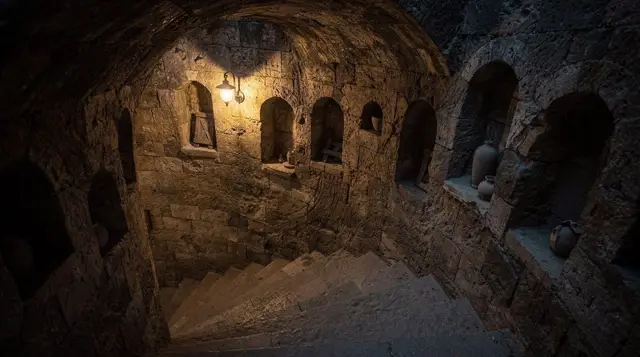
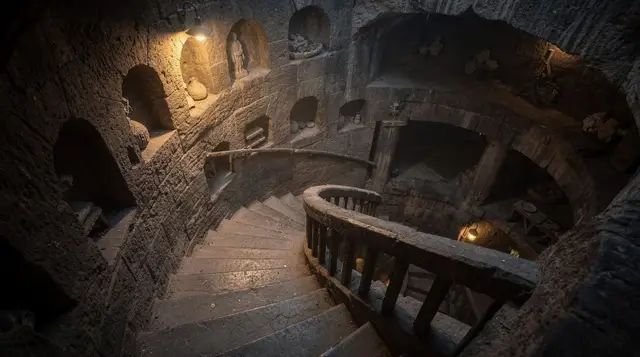
Cappadocia has five known underground cities, and only two are set up for regular visits: Derinkuyu and Kaymaklı. They get compared constantly, usually on the wrong measure. Derinkuyu is deeper — around 85 metres, eight levels open to the public — and that depth is what gets repeated in every brochure. Kaymaklı is shallower, reaching roughly 20 metres on its open levels, but it’s wider. The people who carved it favoured breadth over depth, cutting a denser cluster of side chambers off each corridor rather than stacking more levels straight down. The result is more rooms to look into per metre walked, and less headroom to walk through to reach them.
That trade-off is the whole story of a Kaymaklı visit. You’ll duck more often than at Derinkuyu, for longer stretches, and in exchange you’ll pass a stone wine press, a row of stables with carved feeding troughs, and cellars still marked by soot from cooking fires. Whether that’s a good trade depends on what you’re after — see our side-by-side breakdown in Derinkuyu or Kaymaklı if you’re deciding between the two rather than doing both.
Inside the four open levels
Kaymaklı’s public route runs through four levels, each built around a different function, though the boundaries blur in practice because families and animals shared space out of necessity rather than by tidy floor plan.
The first level, closest to the surface, holds stables. Livestock stayed near the entrance, partly for ease of access and partly because animals produced heat that helped warm the levels below in winter — a detail worth mentioning to anyone picturing a purely defensive bunker. Move down and the second level is largely domestic: living rooms, small chapels cut into the rock, and storage niches sized for grain and dried goods.
The third level is where Kaymaklı earns its reputation among the underground cities: a stone winery, complete with a press channel cut to run juice into waiting jars, sits alongside more storage and what’s generally read as a kitchen area, identified by soot staining on the ceiling. The fourth level, the deepest currently open, holds further storage and one of the site’s ventilation shafts, part of a system that also supplied water and let residents shut off flooding tunnels from sieges above.
Throughout, look for the stone disc doors — large circular slabs, cut to roll across a corridor and jam from the inside — the same defensive mechanism used at Derinkuyu, sized here for Kaymaklı’s narrower passages. Nobody has a firm date for when the tunnels were first dug; what’s better documented is that they were expanded and used for shelter repeatedly over centuries, most recently as a hiding place during regional conflicts in the early twentieth century.
The crowding problem, and how to dodge it
Kaymaklı’s real limiting factor isn’t its size or its depth — it’s timing. The site is the default underground stop on the Green Tour, the standard day itinerary sold by nearly every agency in Göreme and Ürgüp, which means multiple busloads arrive back-to-back through the late morning. Because Kaymaklı’s corridors are narrower than Derinkuyu’s, a crowd here bottlenecks harder: you end up queueing bent over in a low tunnel waiting for a group coming the other way, rather than simply walking around them.
The fix is scheduling, not site selection. Arrive at opening, or in the final hour before closing, and the same rooms that felt like a scrum at noon are close to empty. If you’re travelling independently rather than on a fixed tour departure, this is the single biggest lever you have. For a broader sense of how crowd levels shift through the day across Cappadocia’s main sites, see the quiet underground cities, which also covers quieter alternatives like Özkonak and Mazı if Kaymaklı’s queues put you off entirely.
Getting there from Göreme
| From | Distance/time | Typical transport |
|---|---|---|
| Göreme | ~35 minutes | Car, taxi, organised tour |
| Ürgüp | ~30 minutes | Car, taxi |
| Nevşehir | ~20 minutes | Car, taxi, some dolmuş routes |
| Derinkuyu | ~10 minutes | Car, taxi — often paired on the same day |
| Ihlara Valley | ~35 minutes | Car, taxi — common Green Tour pairing |
Kaymaklı sits just off the main Nevşehir–Niğde road, which is why it’s such a convenient tour stop: buses can pull in without a detour. Driving yourself is straightforward and parking is available at the site entrance. Without a car, a taxi from Göreme or a Green Tour booking are the realistic options; public dolmuş coverage this far south of Nevşehir is thin and not reliable for a same-day return.
What a visit actually costs
Entry to Kaymaklı is priced separately from Derinkuyu — there’s no combined The Underground Cities ticket, so seeing both means paying twice. Prices have moved up with Turkish lira inflation in recent years, so treat any specific number you’ve seen online as outdated; check the rate at the gate or through your tour operator rather than budgeting off an old figure. A basic day that includes Kaymaklı, transport, and lunch typically runs in the same range as any other Green Tour day — plan on the wider Cappadocia day-budget figures at the top of this page rather than a Kaymaklı-specific number, since the site fee itself is a small part of the total.
Who should think twice
Kaymaklı is not the place to bring anyone with real difficulty on stairs or uneven, worn stone underfoot — there’s no accessible route through the lower levels. It’s also a poor fit for anyone with even mild claustrophobia; the bent-double stretches here run longer than at Derinkuyu, and once you’re partway along a narrow corridor with people behind you, turning back isn’t always simple.
Guides can point out shorter loops that skip the tightest sections, but the site as a whole rewards visitors who are comfortable in low, enclosed spaces. Read underground cities and claustrophobia before booking if you’re unsure, and see underground cities with kids for advice on visiting with children, who generally manage the ducking better than adults do.
If low ceilings and crowds both put you off, Kaymaklı’s quieter, unrestored cousins — Özkonak and Mazı — are covered in Mazı and Gaziemir off the tour route; they trade polish and facilities for near-total silence.
How Kaymaklı fits into a Cappadocia day
Because it sits directly on the road south from Nevşehir, Kaymaklı rarely stands alone on an itinerary. The standard Green Tour pairs it with a run down to Ihlara Valley and Selime, while some operators route it alongside Soğanlı on quieter southern circuits. For the full breakdown of what each colour-coded circuit covers and how they differ, see Red Tour, Green Tour, Blue Tour explained.
If you’d rather understand how the tunnels themselves were engineered — the ventilation logic, the stone doors, the reasoning behind stabling animals near the surface — how the underground cities worked goes into more depth than fits on a single destination page.
For planning the rest of your trip around timing and weather, our best time to visit tool covers how crowd levels and site comfort shift month to month, which matters more at a cramped site like Kaymaklı than almost anywhere else in the region.
Walking the route: a few habits that help
Underground, the useful habits are small ones. Let the group ahead of you clear a low section before you enter it, so you aren’t pushed along by people behind you. Keep your hands free rather than carrying a bag in one of them, because you will steady yourself against the rock more often than you expect. Look up as well as ahead: the soot marks, the carved niches and the openings of the ventilation shafts are all at head height or above, and they are easy to miss while watching your footing.
It also helps to decide beforehand how you want to use the visit. Some people treat Kaymaklı as a quick look at one of the region’s best-known sights; others stay in each chamber long enough to work out what it was for. Neither is wrong, but the second approach works much better outside the busy hours, when you can stand in a stable or beside the winery without blocking a corridor. If you’re travelling with a guide, ask them to point out the room functions first and leave the history for the surface, where you can talk freely and stand upright.
Pairing Kaymaklı with other stops
Kaymaklı pairs well with sights that feel nothing like it. After a morning in cramped tunnels, an open landscape is a relief, which is one reason the Green Tour works as a format: Ihlara Valley and the walk described in the Ihlara Valley hike guide put you outdoors beside a river. If you prefer to stay near the underground theme, Derinkuyu shows the deeper design, and the Derinkuyu underground city guide explains what to expect there. For a quieter afternoon, Soğanlı Valley offers rock churches with far fewer visitors, and the Soğanlı Valley guide covers it in detail.
Whichever combination you choose, leave some slack in the day. Underground visits tend to run longer than planned once you stop to look into the side rooms, and a rushed schedule is what turns a good site into a tiring one.
Booking a visit
A guided visit adds real value at Kaymaklı specifically, because the rooms aren’t individually labelled — without an explanation, a wine press and a stable can look much the same. A dedicated small-group guided visit focused on Kaymaklı is the most direct option if you don’t need the rest of a Green Tour day. If you want both major underground cities covered in one trip with the comparison explained on the spot, an underground cities day combining Kaymaklı and Derinkuyu saves arranging transport twice.
Most visitors, though, see Kaymaklı as part of a wider day. The standard Green Tour that pairs Kaymaklı with Ihlara Valley and Selime is the version sold by nearly every agency in Göreme, and it’s the one responsible for the midday crowding described above — book the earliest departure time offered if crowd levels matter to you. For a quieter southern alternative that swaps the crowds for Soğanlı’s near-empty rock churches, the Blue Tour combining Soğanlı and Kaymaklı is worth checking against your dates.
Kaymaklı in context: things to do nearby
Underground cities are a category of their own within Cappadocia’s sights — see underground cities as a category for how Kaymaklı, Derinkuyu, Özkonak, Mazı and Gaziemir compare on crowd levels, accessibility and depth in one table. If you’re building out a longer stay rather than a single day trip, Kaymaklı slots naturally into a 3-day or hiking-focused itinerary alongside the surface valleys — pack accordingly using the packing checklist under our planning tools.
Frequently asked questions about Kaymaklı underground city
Is Kaymaklı or Derinkuyu better?
Neither is clearly better; they’re different shapes. Derinkuyu goes deeper, to around 85 metres over eight open levels, with more headroom on its main routes. Kaymaklı is wider, with four open levels and a denser network of side rooms — cellars, stables, wine presses — but its corridors are lower and narrower, so you spend more time stooped. If you can only see one, Derinkuyu is the easier walk; Kaymaklı has the denser room layout.
How deep is Kaymaklı underground city?
Kaymaklı’s open levels reach roughly 20 metres below the surface, shallower than Derinkuyu’s 85 metres, though the full complex is thought to extend further down through sections that are closed to visitors.
Is Kaymaklı suitable for claustrophobic visitors?
Be cautious. Several stretches require walking bent double for tens of metres at a time, and the tunnels narrow more than at Derinkuyu. If enclosed spaces trouble you, tell your guide before descending — there are shorter routes that skip the tightest sections — or consider a surface-level site such as Zelve or Çavuşin instead.
How long does a Kaymaklı visit take?
Budget 45 minutes to an hour for a self-guided walk through the open levels, or up to 1.5 hours with a guide who stops to explain the ventilation shafts, stone doors and room functions. Add waiting time if you arrive with a tour bus during the midday rush.
What is the entrance fee for Kaymaklı?
Kaymaklı charges a standard site entrance fee, separate from Derinkuyu’s. Prices have risen with inflation in recent years, so check the current rate locally rather than relying on an old figure; a Cappadocia museum pass, where available, can cover it alongside other sites.
Can you visit Kaymaklı without a tour?
Yes. Kaymaklı sits on a public road about 35 minutes from Göreme, and taxis, rental cars and some dolmuş routes reach it independently. Going without a tour lets you pick a quiet hour, but you’ll miss the explanations a guide gives for otherwise unlabelled rooms.
What should I wear to visit Kaymaklı?
Closed, flat shoes with grip — the stone floors are worn smooth in places — and clothes you don’t mind brushing against rock walls. The underground air stays cool and slightly damp year-round, noticeably cooler than the surface in summer and less cold than expected in winter, so a light layer works in most seasons.
Does Kaymaklı get crowded?
Yes, more than any other underground city in the region, because it’s the default stop on the Green Tour and sits close to the main road. Tour buses cluster between roughly 10am and 3pm. Arriving at opening or in the last hour before closing avoids most of the queueing at pinch points.