Underground cities and claustrophobia in Cappadocia
Are the Cappadocia underground cities too tight for someone with claustrophobia?
Some connecting passages between levels genuinely require walking bent over, sometimes for several metres, with a low ceiling and shoulder-width walls. Most visitors get through without difficulty by staying on the upper levels, avoiding the busiest midday hours, and turning back at any point if the passage ahead feels wrong.
Where the discomfort actually comes from
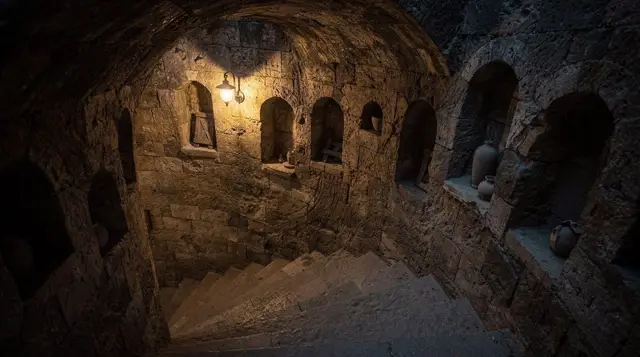
Nobody warns you about this in most Cappadocia itineraries: the underground cities are not one continuous tight squeeze, and they are not fully open and roomy either. They alternate. A chamber will be tall enough to stand up straight, sometimes taller than a normal room, and then the route narrows into a connecting passage between levels where the ceiling drops and the walls close in to something close to shoulder width. On those stretches, most adults have to bend at the waist and keep moving, sometimes for two or three metres, occasionally longer. That is the part that catches people who thought they had prepared for “a cave” and instead found a doorway they had to duck through while someone else’s torch light bobbed ahead of them.
If you deal with claustrophobia, or you simply don’t know how you will react until you’re in it, this is worth taking seriously rather than either dismissing or catastrophising. The honest picture: the difficult sections are real, they are short, and the overwhelming majority of visitors who go in nervous come out having managed it fine. This guide is about knowing which sections those are, how Derinkuyu and Kaymaklı differ, and what you can control before and during the visit.
Derinkuyu versus Kaymaklı for a nervous visitor
The two sites get grouped together constantly, but they are built differently, and that difference matters more here than almost anywhere else in Cappadocia.
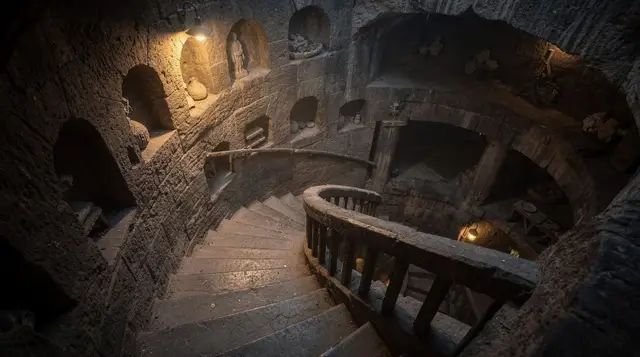
Derinkuyu is the deeper of the two, descending roughly 85 metres, with eight levels open to the public. It was carved with more vertical ambition: stables and storerooms nearer the surface, a chapel and communal spaces further down, and a network of ventilation shafts that still moves air today.
The individual connecting passages here can be the tightest in the whole region, particularly as you move toward the lower open levels, but each squeeze tends to be brief before the route opens back into a room. You also pass some of the original defensive stone doors, thick circular slabs that were rolled across the corridor to seal it off from the inside — a detail that tends to either fascinate visitors or unsettle them further, depending on temperament.
Kaymaklı is shallower with four levels open, and its rooms are on average wider than Derinkuyu’s. The trade-off is the layout: it spreads out more horizontally, and the route between chambers is genuinely maze-like, with more turns and less obvious sense of which direction leads back to daylight. For someone whose unease is really about disorientation rather than physical tightness, Kaymaklı’s layout can be the harder of the two, even though its passages are, on paper, less cramped than Derinkuyu’s.
| Derinkuyu | Kaymaklı | |
|---|---|---|
| Depth open to visitors | ~85 m, 8 levels | Shallower, 4 levels |
| Passage width | Tightest connecting sections in the region | Generally wider |
| Layout | More vertical, clearer sense of “down and up” | More horizontal, maze-like |
| Typical stretch bent over | Short, repeated | Shorter but more frequent turns |
| Crowds | Busier — the main coach stop | Slightly quieter on average |
| Best for | Visitors more bothered by tightness than direction | Visitors more bothered by feeling lost than by ceiling height |
Neither is objectively “easier.” If tight ceilings are your specific trigger, Kaymaklı’s wider rooms may suit you better. If losing your sense of direction is what unsettles you, Derinkuyu’s more linear vertical structure can feel more manageable, tight passages and all.
What actually helps, practically
A few concrete choices make a real difference, more than general reassurance does.
Go early. Both sites are calmest at or shortly after opening. A tight passage with nobody in front of or behind you is a completely different experience from the same passage jammed with a tour group moving in fits and starts. Midday, when several coach groups overlap, is when the queues form inside the passages themselves — and standing still in a low corridor is worse than moving through it.
Stay on the upper levels if you’re unsure. Both Derinkuyu and Kaymaklı let you stop after the first two or three levels without missing the sites’ most interesting features — the stables, the storage rooms, and in Derinkuyu’s case the upper chapel are all reachable without descending to the deepest open point. There is no requirement to go all the way down, and no one checks.
Know that you can turn back. The routes are effectively one-way loops with staff and signage rather than a single locked corridor. If a passage ahead looks worse than you expected, you can step aside, let others pass, and either wait a moment or turn around. This surprises people — many assume once they’re in, they’re committed to finishing.
Book a private guide if the layout is your main concern. A half day private underground tour with guide lets you set the pace and choose the depth, rather than following a group timed to a coach schedule. Compare that with a fixed-departure option like the Cappadocia: Underground Cities Kaymaklı Derinkuyu Tour, which is efficient and well guided but moves at group pace through both sites in one day.
Consider a single site rather than both in one day. Doing Derinkuyu and Kaymaklı back to back, which several tours bundle together, means two separate periods of tight passages in one day. If you’d rather test the experience once and decide from there, a single-site option such as the Derinkuyu: Underground City Tour is a lower-commitment way to find out how you react.
Skip the deepest, least-visited sites unless you’re already comfortable. Özkonak, Mazı and Gaziemir are quieter and less commercial, which sounds appealing, but quieter also means less reliable lighting and no queue of other visitors to set a pace behind. These suit people who already know the passages don’t bother them, not people testing the waters.
What most visitors actually experience
It’s worth saying plainly: most people who go in nervous do fine. The passages that require bending over are measured in metres, not in sustained minutes. You are never more than a short walk from a room tall enough to stand upright in, and the air, while warmer and more humid than the surface, moves steadily through the original ventilation shafts — these were functioning air systems for people who lived down there for weeks at a time, not sealed pockets.
What surprises people more often than the tightness itself is the heat and the queueing. In the busiest midday hours, a slow-moving group ahead of you in a low passage, combined with the underground warmth, is a worse combination than the architecture on its own. That’s the practical argument for going early rather than for skipping the visit entirely.
If you have a diagnosed condition where confined spaces cause genuine panic rather than ordinary unease, that’s a different calculation, and there’s no reason to force it — Cappadocia’s fairy chimney valleys, the Göreme Open Air Museum, and the balloon flights are all open-air and give you the region’s essentials without going underground at all.
Before you go down: a short preparation routine
Most of the work happens before the first step underground. Decide in advance how far you are willing to go, and tell whoever you are travelling with. A shared plan such as “we stop after the stables and storerooms if either of us wants to” removes the pressure of negotiating in a narrow passage, where nobody wants to hold up a line of people behind them.
Wear what you would wear for a walk, not for a photo. Closed shoes with a decent grip matter because the stone floors are worn smooth in places and slope between levels. Leave bulky backpacks in the car or at the hotel: a bag that scrapes the wall behind you makes a tight passage feel tighter, and carrying it in front of you is awkward when you are already bent over. A small bottle of water and a light layer you can take off are enough, since the air below is warmer than the surface and the temperature change is part of what some people notice first.
It also helps to eat and drink normally beforehand. Anxiety tends to hit harder when you are hungry, dehydrated or short of sleep, and an early start for a balloon flight followed by a long day is exactly that combination. If you are stacking this visit onto a sunrise, the notes in balloon sunrise timing by season will help you judge how tired you are likely to be by the time you reach the entrance.
Techniques that work inside the passages
Slow, deliberate breathing is the oldest advice and still the most useful. Breathe out for longer than you breathe in, and keep your eyes on the next chamber rather than the ceiling above you. The low stretches are short, and treating each one as a single task, from here to the next open room, makes it more manageable than thinking about the whole route at once.
Keep moving at your own rhythm, but avoid rushing. Hurrying through a low passage tends to raise your heart rate and make the walls feel closer. If you need a pause, wait inside a chamber where you can stand upright, not in the middle of a squeeze. Chambers are where you can step aside, take a drink and let the group behind you pass without anyone feeling hurried.
Position matters too. Many nervous visitors prefer to walk near the front of a small group, where they can see the passage open ahead of them, while others feel safer in the middle with someone they trust directly behind. Neither is wrong. What tends to go badly is being at the very back of a long line, losing sight of the others and hearing voices echo from somewhere you cannot place. If you are with a guided group, say so quietly to the guide at the start; guides are used to this and will usually adjust where you walk without making it a topic.
Travelling with someone who is nervous
If your companion is the anxious one, resist the urge to reassure constantly or to push them to continue. A calm “we can stop whenever you like” works better than a pep talk. Let them set the depth, and treat turning back as an ordinary decision, not a failure. Agree on a simple signal beforehand so they do not need to explain themselves in a crowded corridor.
Families with children should read underground cities with kids, because a child’s reaction is hard to predict and the passages are not forgiving to anyone who freezes in the middle of one. For travellers with reduced mobility, the descent has its own considerations, covered in Cappadocia with limited mobility.
If you decide to skip it, or to see it differently
Choosing not to go down is a legitimate decision, and the region gives you plenty to replace it. The history that makes these places remarkable can be understood above ground first: how the underground cities worked explains the stables, the stone doors and the ventilation without asking you to stand inside them. Reading it before a visit also takes away much of the surprise that fuels anxiety, because you will recognise what you are looking at.
If you want a gentler version, the quiet underground cities are worth a look, with the caveat already mentioned about lighting. For a day built mostly above ground, Cappadocia in one day and the Red Tour and Green Tour comparison show how to fit the region together without a deep descent, and the Ihlara Valley hike is a good open-air alternative that still gives you a sense of the area’s cut-rock history.
Combining the visit with the rest of your day
Both underground cities sit south of Göreme and are usually paired with other stops on the same route. Derinkuyu and Kaymaklı themselves are about 10 minutes apart by road, which is why so many tours cover both. If you want the underground element without dedicating a full separate day to it, the Göreme: Cappadocia Red Tour with Underground Lunch works one underground stop into a broader day above ground, which spreads out the experience rather than concentrating it.
For a longer day that continues south to the Ihlara Valley and the cliff-cut monastery at Selime, an option such as the Cappadocia: Derinkuyu Underground City and Ihlara Tour pairs one underground visit with several hours of open-air walking afterwards — useful if you’d rather not end the day on an underground note.
Whichever route you choose, the practical points are the same wherever the site: check what to expect from the underground cities before you go, compare Derinkuyu against Kaymaklı directly if you’re deciding between them, and remember that stopping partway through is a normal, unremarkable choice that plenty of visitors make.
Underground city tours on GetYourGuide
Verified deep-linked GetYourGuide tours. Book through these links and we earn a small commission at no cost to you.
GetYourGuide does not provide a product photo for this activity — the image shows the meeting point, photographed by us.