A smaller network built for people who already know what an underground city is
Most first-time visitors to Cappadocia’s underground cities go to Derinkuyu or Kaymaklı, and for a first visit that is the right call: both are larger, better lit, and included on the standard Green Tour and Blue Tour routes sold out of Göreme. Özkonak is a different proposition.
It is a genuine underground settlement, cut into the same soft tuf as its bigger neighbours, but with a smaller open network, sparser signage, and almost none of the group traffic that fills Derinkuyu’s stairwells by mid-morning. It rewards a specific kind of visitor: someone with their own car, who has either already ticked off a major underground city or who values an empty corridor over a comprehensive one.
If this is your first and only underground city on the trip, read the Derinkuyu guide or the Kaymaklı guide instead, and see the comparison between the two before deciding which one suits you. Come back to this page once you have decided Özkonak is the second stop, not the only one.
Where it sits, and why so few people make it here
Özkonak lies north of Avanos, on the far side of the pottery town from Göreme, which already puts it outside the natural loop of a day spent around the Rose and Red valleys. It is not on the Red Tour, the Green Tour or the Blue Tour itineraries, which is the main reason coach groups never appear here: no operator routes a bus this way. The site was discovered relatively late, in the 1970s, when a local farmer noticed his irrigation water draining into a hole in his field, and it has stayed a secondary attraction ever since, run with a much smaller staff presence than the two big sites.
That obscurity is the whole point of visiting. Where Derinkuyu can feel like a queue with tuf walls during peak hours, and Kaymaklı can back up in its lower, narrower passages, Özkonak is usually just you, whoever you arrived with, and long stretches of silence. The trade-off is that there is less to see, the lighting is more basic, and if you are hoping for the kind of thorough interpretation panels you get elsewhere, you will not find much of it here.
What you will actually see inside
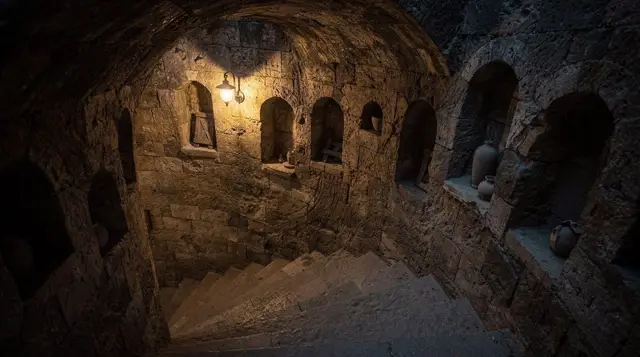
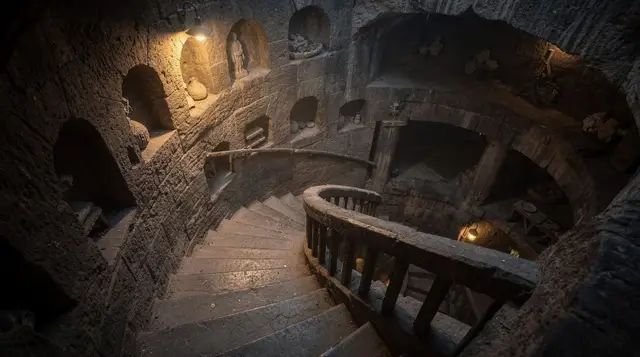
Özkonak’s officially open network runs to a small number of levels, considerably less than Derinkuyu’s eight or Kaymaklı’s four. Expect storage rooms, a stable area for animals, sections that were clearly living quarters, and the site’s signature feature: narrow vertical shafts connecting one level to the one below, cut straight through the ceiling rather than routed via a staircase.
These are usually described locally as communication holes, thought to have let people on different levels pass warnings or messages to each other quickly, without walking the connecting tunnels end to end. Neither Derinkuyu nor Kaymaklı has anything quite like them in this form, which is the detail worth coming for if you already know the basic layout of a Cappadocian underground city from a previous visit.
Do not expect a chapel on the scale of Derinkuyu’s cruciform church, and do not expect Kaymaklı’s wider, more worked communal rooms. Özkonak is plainer, and a guide who tries to sell it as more architecturally significant than it is doing you a disservice. Go in expecting a smaller, rougher, quieter version of the same idea, and it delivers exactly that.
| Site | Open levels | Typical crowd | Passage height | Standout feature |
|---|---|---|---|---|
| Derinkuyu | 8 | Busy, tour groups | Comfortable on main routes | Deepest network, rolling stone doors |
| Kaymaklı | 4 | Busy, tour groups | Low, more stooping | Wider rooms, shorter walk |
| Özkonak | Small, single-digit | Quiet, mostly independent visitors | Moderate | Vertical communication holes |
| Mazı and Gaziemir | Very small, partial | Almost empty | Variable, sometimes unlit | Off-route, unpredictable opening |
Getting there without a group tour
There is no realistic way to reach Özkonak on a scheduled dolmuş, and no standard Göreme day tour stops here, so this is a self-drive or taxi destination by default. From Göreme, allow roughly 40 to 45 minutes by car, routing past Avanos and continuing north; the roads are minor but paved and manageable in an ordinary rental. If you have not driven in Turkey before, the driving in Cappadocia guide and the car rental guide cover what to expect before you commit to a self-drive day.
If you would rather not drive at all, a taxi from Göreme or Avanos is the practical fallback, but agree a return fare before you go down into the site, since there is very little passing traffic out here to flag another car.
For travellers who want the reassurance of a guided day instead of arranging their own transport, it is worth being honest that no packaged tour actually includes Özkonak; the closer substitutes are a guided day covering Derinkuyu or Kaymaklı alongside Ihlara valley and Selime, or a dedicated underground city tour focused on Derinkuyu if seeing an underground city matters more to you than seeing this specific one.
For anyone weighing whether to bother with a car at all this trip, seeing Cappadocia without a tour lays out what independent travel here actually looks like day to day, and where it runs into limits.
What a visit here misses, honestly
Be clear-eyed about the trade-offs before you drive 40 minutes for this. Özkonak’s open network is genuinely smaller than the two main sites, so if scale and drama are what you are after, you will likely leave a little underwhelmed. Signage is sparser and less multilingual than at Derinkuyu, and staffing can be thin, which occasionally means shorter hours or a less confident answer if you have a question about a specific passage.
There is also less ventilation infrastructure on display than at Derinkuyu, whose stone air shafts are a highlight in their own right; read how the underground cities worked beforehand if that engineering detail matters to you, since Özkonak’s version of it is more modest.
None of this makes Özkonak a poor use of time for the right visitor. It simply means the site is honestly a second underground city, not a replacement for a first one. If you are choosing between Özkonak and either of the main sites and can only fit in one, the Derinkuyu or Kaymaklı comparison is the more useful page to read first.
Where Özkonak fits into a self-drive day
Because Özkonak sits north of Avanos rather than south toward Ihlara, it pairs naturally with a loop through the north of the region rather than a Green Tour-style day to Derinkuyu, Ihlara and Selime. A workable structure: start in Avanos for the pottery workshops and the Kızılırmak riverfront, continue up to Özkonak for the underground city, then loop back through Çavuşin or across toward Hacıbektaş if the tekke there interests you, before returning to Göreme by evening. This keeps driving distances sensible and avoids doubling back across the region in one day.
If you would rather see Derinkuyu or Kaymaklı as your underground city and treat this one as optional, a Red Tour day that folds an underground city into the north Cappadocia sightseeing loop covers most of the same geography with a driver and guide included. Travellers specifically chasing quiet sites over famous ones sometimes prefer the Blue Tour, which pairs Kaymaklı with the far less crowded Soğanlı valley rather than the busier Red or Green routes.
Travellers who want to go further into the “quiet underground city” idea, rather than stopping at one, can continue on to Mazı and Gaziemir, which sit even further off the tour-bus map than Özkonak and are correspondingly less predictable to find open. The dedicated page on the quiet underground cities rounds up all three for anyone building a day specifically around avoiding crowds.
Practical details: tickets, timing, what to bring
Bring cash. Özkonak’s ticket booth, like most smaller sites in the region, is not guaranteed to take cards, and the entry fee itself is modest compared with Derinkuyu or Kaymaklı, generally sitting in the lower end of the price range for the region’s underground cities. Prices for all of these sites have moved with the lira in recent years, so treat any figure as a rough guide and expect to pay in Turkish lira on the day rather than relying on a fixed number from before your trip.
Wear closed shoes with grip; the tuf underfoot inside these sites is often smooth and can be damp in places, regardless of which underground city you visit. Bring a torch or use your phone’s light for the dimmer stretches, since Özkonak’s lighting is less consistently maintained than at the two major sites. Expect a temperature noticeably cooler than the surface, similar to Derinkuyu and Kaymaklı, which makes it a sensible stop on a hot summer afternoon when the open-air valleys above ground offer no shade at all.
If you struggle with tight, low spaces, read underground cities and claustrophobia before committing to any of these sites, Özkonak included; while its passages are not as consistently low as Kaymaklı’s, there are still stretches that require stooping and a period without natural light. Families travelling with young children should also check underground cities with kids, since the thinner staffing here means less supervision infrastructure than at Derinkuyu.
The bottom line
Özkonak is not the underground city to build a Cappadocia itinerary around, and no honest guide would tell you otherwise. It is the underground city for the traveller who has already done that, has a car, and would rather spend 45 quiet minutes underground than queue behind a tour group at a busier site. If that describes your trip, it is a worthwhile detour north of Avanos. If it does not, spend the time at Derinkuyu or Kaymaklı instead, and save Özkonak for a return visit.
Özkonak underground city: questions travellers ask
Is Özkonak worth visiting if I have already seen Derinkuyu or Kaymaklı?
Yes, on its own terms. Özkonak will not out-do either of the two big sites for scale, but it is a genuinely different experience: near-empty corridors, no group traffic, and the vertical communication holes that neither Derinkuyu nor Kaymaklı has in the same form. Go for the contrast, not for something bigger.
How do I get to Özkonak underground city?
Özkonak sits north of Avanos, off the standard tour routes, so it is realistically a self-drive or taxi destination. There is no dolmuş service running directly to the site, and it is not included on the Red, Green or Blue Tour itineraries sold in Göreme.
How long does a visit to Özkonak take?
Most visitors are done in 45 to 60 minutes. The open network is smaller than Derinkuyu’s eight levels or Kaymaklı’s four, so there is simply less ground to cover, and the site rarely has queues to slow you down.
What are the vertical communication holes at Özkonak?
They are narrow shafts cut straight down through the ceiling of one level into the one below, used to pass messages or warnings between floors without walking the connecting tunnels. Derinkuyu and Kaymaklı rely mainly on stairs and passages for this; Özkonak’s vertical holes are its most distinctive engineering feature.
Is Özkonak open all year?
The underground cities in this region generally stay open year-round, though hours can shorten in winter and a quieter, less-staffed site like Özkonak is more exposed to unannounced closures than Derinkuyu or Kaymaklı. If you are visiting outside the April to October window, build in a backup plan.
Can I visit Özkonak without a car?
It is difficult. Taxi from Göreme or Avanos is the practical option if you do not have a rental car, since public dolmuş routes and organised tours do not stop here. Confirm a return fare with the driver before you head down, since there is little passing traffic to flag another taxi from the site itself.
Is Özkonak suitable for people with claustrophobia?
It suits claustrophobia better than Kaymaklı, whose passages are noticeably lower and more crowded, but any underground city involves low ceilings, narrow stairs and stretches without natural light. If tight spaces are a real concern, read up on what to expect before booking anything underground.
How does Özkonak compare to Mazı and Gaziemir?
All three are quiet, self-drive underground cities away from the main tour routes, but Özkonak is generally the easiest of the three to find open with a ticket booth staffed, while Mazı and Gaziemir can be less predictable, sometimes without a guard or reliable lighting on site.