Özkonak: Cappadocia's quiet underground city
What makes Özkonak different from Derinkuyu and Kaymaklı?
Özkonak is smaller and largely off the organised tour circuit, so it stays quiet even at midday when the two major underground cities are full of groups. Its defence relied on holes drilled between levels for pouring liquid or oil onto intruders below, rather than the large rolling stone doors used at Derinkuyu and Kaymaklı.
Why Özkonak stays empty when the big two don’t
Cappadocia has more than Derinkuyu and Kaymaklı. Both of those sites appear on nearly every organised itinerary sold in Göreme, which is exactly why they fill up: coaches on the Green Tour and the South Cappadocia circuits are timed to arrive within the same few hours, so from mid-morning to mid-afternoon both cities run with a steady flow of groups moving through the same narrow corridors. Özkonak sits about 14 kilometres north-east of Avanos and simply isn’t part of that circuit. No standard day tour stops there, so the traffic that defines Derinkuyu and Kaymaklı never arrives.
That absence is the whole story. Özkonak is not larger, not older, and not more dramatic than the two major underground cities — if anything it’s more modest in scale, with fewer opened levels and a shorter, simpler circuit. What it offers instead is the experience those two sites promise in their brochures but rarely deliver in practice: walking through carved rooms and connecting shafts without another group’s flashlight three metres behind you.
This guide is not a case for skipping Derinkuyu or Kaymaklı — read the Derinkuyu underground city guide or the Kaymaklı guide for those, and see Derinkuyu or Kaymaklı if you’re choosing between them. It’s a case for treating Özkonak as a genuine third option, not a lesser substitute.
What Özkonak actually is
Like Derinkuyu and Kaymaklı, Özkonak was carved into the soft volcanic tuf that underlies this part of Cappadocia, extending a village’s normal cave-dwelling habit downward into a defensive refuge. Local accounts date its rediscovery to the 1970s, decades after Derinkuyu was opened to the public in 1969, and it never received the same level of excavation or investment.
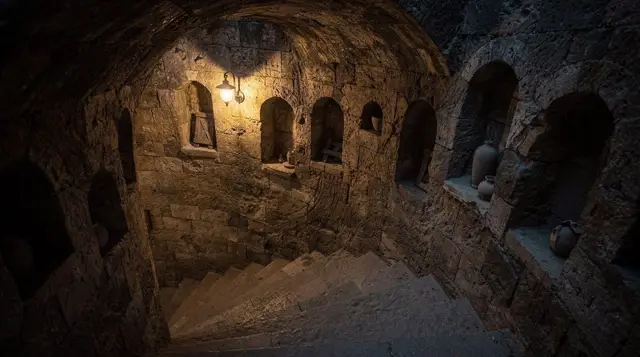
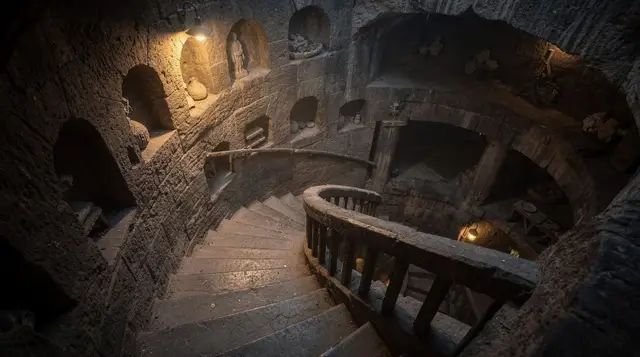
Only a limited number of the underground levels have been opened and lit for visitors; the rest remain closed, either unexcavated or judged unsafe. What is open includes storage rooms, a winery area with a stone press, ventilation shafts, and living spaces connected by the same kind of narrow, low tunnels found throughout the region’s underground network — you will stoop and duck in places, more than you would at Derinkuyu’s wider main shaft.
The scale is the honest trade-off here. If you’ve come to Cappadocia wanting the sheer size of an eight-level city, Özkonak will feel small. If you’ve already done that at Derinkuyu, or would rather skip the queue entirely, Özkonak gives you the same underlying idea — a whole community living, storing food, and defending itself below ground — at a size you can absorb in 45 minutes to an hour rather than two.
A different way of defending the city
The detail worth knowing before you go is how Özkonak’s builders handled defence, because it isn’t the same system used at the major sites. At Derinkuyu and Kaymaklı, each level could be sealed off by a massive circular stone door — essentially a millstone set into a groove in the tunnel wall — rolled across the passage from the inside to block intruders completely. It’s a blunt, effective solution: nobody gets past a metre-thick stone disc without the people on the other side choosing to move it.
Özkonak used something more targeted. Small holes were drilled through the ceiling of a lower chamber into the floor of the level directly above, usually positioned near a junction, a doorway, or a stretch of passage that any intruder would have to cross. Defenders stationed above could look or listen through the hole to track movement below, and — according to the accounts given on site — pour hot oil or another liquid down through the opening onto anyone passing beneath.
It’s a smaller-scale, more surgical version of the same problem the rolling stones solved: rather than sealing an entire level shut, you make specific chokepoints lethal to cross. Look for these holes as you move through the circuit; they’re easy to miss if you’re not told what you’re looking at, and guides at the major sites rarely mention them because Özkonak isn’t part of their route.
Özkonak, Derinkuyu and Kaymaklı compared
| Derinkuyu | Kaymaklı | Özkonak | |
|---|---|---|---|
| Levels open to visitors | 8 | 4 | Fewer, more compact |
| Approx. depth | ~85 m | Shallower, wider chambers | Shallower still |
| Passage character | Vertical shafts, some tight stretches | Wide but low — more stooping | Narrow tunnels, frequent ducking |
| Main defence | Rolling stone doors | Rolling stone doors | Ceiling holes for pouring liquid onto intruders |
| On organised tour circuits | Yes — Green Tour, South Cappadocia tours | Yes — Green Tour alternative stop | No — self-drive or taxi only |
| Typical crowd level, midday | Busy, group bottlenecks | Busy, group bottlenecks | Usually near-empty |
| Time needed | 45–75 minutes | 45–60 minutes | 30–45 minutes |
Two other underground cities, Mazı and Gaziemir, sit in the same off-circuit category as Özkonak — quieter, less developed, rarely visited. They have their own dedicated page at Mazı and Gaziemir: off the tour route and aren’t covered in detail here, but if Özkonak’s quiet appeals to you, that guide is the natural next stop.
Getting there: why self-drive is the normal approach
There’s no dedicated organised tour built around Özkonak the way the Green Tour is built around Derinkuyu. Occasionally a private or custom itinerary will include it as an add-on, but as a standard bookable product it doesn’t really exist. That makes a rental car the practical default.
From Göreme, the drive runs through or near Avanos and takes roughly 30 to 35 minutes on ordinary roads — see driving in Cappadocia for what the roads and signage are actually like before you commit to renting. A taxi is the other realistic option if you’d rather not drive yourself; agree the return fare, including waiting time, before you set off, since there’s no rank of cars waiting at the site the way there is at Derinkuyu.
If you don’t want to drive at all, see getting around without a car — Özkonak is one of the harder sights to reach by dolmuş, since the minibus network concentrates on the villages closest to Göreme and doesn’t run a convenient direct service out here. For most visitors without a car, this site simply won’t make the cut, and that’s fine: Derinkuyu and Kaymaklı are both reachable by organised tour or by dolmuş via Nevşehir, and either covers the “underground city” box on a trip without a rental.
What to expect on site
Arrive expecting a simpler operation than Derinkuyu or Kaymaklı. There’s a ticket booth, basic lighting through the open sections, and — unlike the two major sites, which run a steady stream of visitors and staff — you may find long stretches with nobody else around. That’s the appeal, but it also means the polish is lower: signage is sparser, and you should not expect the kind of staffed checkpoints and crowd management the busier sites have built up over decades of coach traffic.
Bring the same practical kit you’d want at any of the region’s underground sites: closed shoes with grip, since the stone floors are uneven and can be damp near the lower levels, and a phone torch as backup even where lighting exists. If you’re prone to feeling boxed in in tight spaces, read underground cities and claustrophobia before deciding whether Özkonak’s narrower passages suit you — it’s a fair question to ask honestly, since the tunnels here run tighter in places than Derinkuyu’s main shaft.
Travelling with children works similarly to the major sites; see underground cities with kids for what to plan around regardless of which site you choose. For the mechanics of how any of these cities functioned day to day — ventilation, food storage, water — how the underground cities worked applies just as well here as at Derinkuyu.
Pairing Özkonak with the rest of the day
Because Özkonak sits north of Avanos rather than south toward Derinkuyu and Kaymaklı, it doesn’t naturally slot into the same day as the Green Tour sites — that’s a separate half-day in the opposite direction. What it does pair with easily is Avanos itself: the pottery town on the Kızılırmak river, Turkey’s longest river, whose red clay has supplied local workshops since the Hittite era.
A loop from Göreme that takes in Avanos’s workshops and then Özkonak makes a sensible half-day without retracing ground you’ll cover on a Green Tour day. If you’re building a longer stay around this kind of pairing rather than a single day trip, a three-day itinerary like Cappadocia in three days has room to slot in an off-circuit half-day like this one alongside the standard sights.
Booking the major sites, if you’d rather not self-drive to Özkonak
If the logistics of reaching Özkonak independently don’t suit your trip, the two major underground cities remain the reliable, well-organised choice, and they’re easy to book as part of a wider day. A standard combined visit covers both in one trip:
a Kaymaklı and Derinkuyu underground cities tour that takes in both sites in a single day with a guide explaining the layout as you go.
For a broader south Cappadocia day that folds an underground city into a wider loop with Ihlara Valley and Selime, there’s the South of Cappadocia Green Tour, which is the standard version of the itinerary most agencies in Göreme sell under that name.
If you’d rather move at your own pace with a private guide instead of a fixed group schedule, a half-day private underground tour gives you that flexibility while still handling the transport and entry logistics for you.
Whichever way you visit — self-drive to Özkonak’s quiet or a guided day at Derinkuyu and Kaymaklı — see the things to do: underground cities hub for the full set of options and comparisons across all of Cappadocia’s underground sites.
Frequently asked questions about Özkonak underground city
Is Özkonak worth visiting instead of Derinkuyu or Kaymaklı?
It depends on what you want. Özkonak is smaller and has fewer opened levels, so it doesn’t match the scale of Derinkuyu’s eight floors or Kaymaklı’s wider chambers. Its appeal is the opposite of scale: you can walk it without queuing behind a tour group, which almost never happens at the two main sites.
How do you get to Özkonak without a tour?
Self-drive is the normal way in. There is no dedicated organised tour that stops at Özkonak specifically, so most visitors reach it by rental car or taxi from Göreme, roughly 30 to 35 minutes away via Avanos.
How deep is Özkonak underground city?
Özkonak’s opened levels are shallower than Derinkuyu’s roughly 85 metres, and only a handful of floors are accessible to visitors, with tunnels believed to continue further but closed off. Expect a more compact, more intimate circuit than either major site.
What was the communication hole system at Özkonak?
Holes were drilled through the ceiling of a lower level into the floor of the one above, positioned near doorways and junctions. Defenders on the upper level could see or hear anyone passing below and pour hot liquid or oil through the hole, a more localised defence than the huge rolling stone discs used to seal entire corridors at Derinkuyu and Kaymaklı.
Is Özkonak underground city safe and well maintained?
It is open to the public with lighting in the main circuit, but it is far less polished than Derinkuyu or Kaymaklı: fewer staff, simpler signage, and passages that feel more raw. Closed sturdy shoes and a torch on your phone are worth having.
Can you combine Özkonak with other sights in one day?
Yes. Özkonak sits close to Avanos on the Kızılırmak river, so the two pair naturally into a single half-day loop from Göreme without needing to book anything in advance.
Does Özkonak get busy at any time of day?
Rarely. Because it isn’t a standard stop on the Red, Green or Blue Tour circuits, there is no coach traffic to create a midday peak. Even in August, it is common to have entire chambers to yourself.
Underground city tours on GetYourGuide
Verified deep-linked GetYourGuide tours. Book through these links and we earn a small commission at no cost to you.
GetYourGuide does not provide a product photo for this activity — the image shows the meeting point, photographed by us.