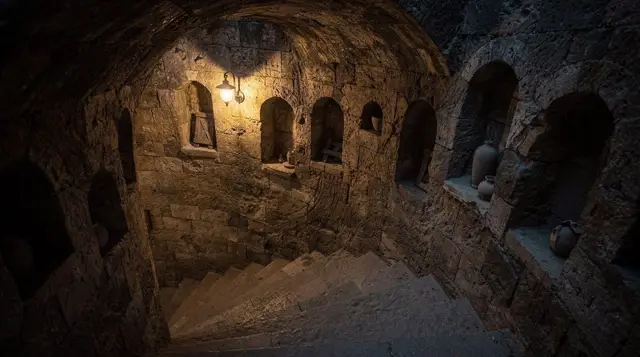
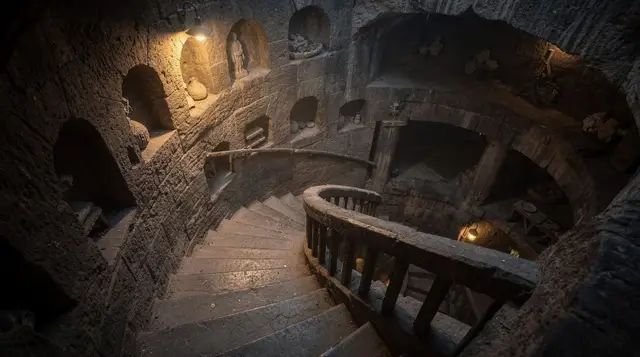
Mazı is one of the region’s minor underground cities, and it isn’t run the way Derinkuyu or Kaymaklı are. There’s no ticket booth with fixed hours, no lit circuit, and no certainty that anyone will be there to let you in. What draws a small number of visitors out to it anyway is a mix of genuine quiet and a piece of local legend: that a tunnel once linked Mazı to Kaymaklı, and that it has never been fully explored or mapped. Nobody can confirm that from a guidebook, and this page won’t pretend otherwise — it’s told locally, and it should be treated as that, not as a verified fact.
This is not a page telling you Mazı is an equivalent alternative to the two big underground cities. It isn’t equipped like they are, and comparing it on comfort or facilities sets the wrong expectation. The honest way to think about Mazı is as an optional, car-dependent detour for someone who has already done the main circuit and wants to see an unmanaged site, on the understanding that the trip might end at a locked gate.
Where Mazı fits among Cappadocia’s underground cities
Cappadocia’s underground cities were carved from the same soft volcanic tuf that shaped the valleys above ground, and there are dozens of them scattered across the region — most unrecorded, some partly excavated, a handful open to the public. Derinkuyu and Kaymaklı are the two that receive organised tourism: ticketed, lit, staffed, and included on most Red and Green Tour itineraries. Özkonak, Mazı, and Gaziemir sit a level below that — smaller in scale or less developed for visitors, and mostly left off the tour operators’ routes altogether.
Mazı belongs to that second group. It’s grouped with Gaziemir here deliberately, because the two share the same defining trait: neither has the infrastructure that makes Derinkuyu and Kaymaklı simple to visit. For background on how these smaller cities generally work, see the quiet underground cities and, specifically for Mazı and its neighbour, Mazı and Gaziemir: off the tour route.
If you’re deciding which underground city to prioritise on limited time, read Derinkuyu or Kaymaklı first — that’s the decision most visitors actually need to make. Mazı is for a different trip: a second or third underground city, not a first.
Getting to Mazı by car
Mazı is reachable only by road, and there’s no dolmuş service or organised transfer that covers it — this is a self-drive or private-driver destination, full stop. From Göreme, allow around 45 minutes, similar in scale to the drive out to Kaymaklı but continuing further into quieter countryside. There’s no meaningful public transport option, so if you don’t have a car, cross this off your list; the alternative isn’t a longer bus ride, it’s not going.
Local signage for Mazı is inconsistent, and mobile signal in this area can’t be relied on for navigation once you’re off the main road. Download or screenshot your route in advance. If you’re new to driving in the region, read driving in Cappadocia before you set out — the practical issues are unmarked turns and shared roads with slow farm traffic, not anything more serious. For the car itself, see car rental in Cappadocia.
Build slack into your day. Because arrival doesn’t guarantee entry, treat the drive to Mazı as one stop within a longer self-drive loop — perhaps combined with Kaymaklı or a run out towards Aksaray — rather than as a dedicated round trip. That way, if Mazı is closed when you arrive, the day isn’t wasted.
What you’ll find underground
Where it has been opened, Mazı consists of carved chambers and connecting passages cut into the same soft tuf as the region’s better-known sites: storage rooms, ventilation shafts, and stretches of tunnel at a scale that feels domestic rather than monumental. It doesn’t have the depth or the multi-level structure that Derinkuyu is known for, and it isn’t laid out for a guided walk-through the way Kaymaklı is. What’s actually open to see on a given day depends on who, if anyone, is managing access at the time.
The story attached to Mazı — a tunnel running underground towards Kaymaklı, several kilometres away, never fully explored — is the reason it gets mentioned at all outside specialist circles. Underground cities across Cappadocia were built to be defensible and interconnected in exactly this way, so the premise isn’t implausible in principle. But “never fully explored” also means unverified, and no official body publishes confirmation of a completed Mazı–Kaymaklı tunnel. Go for the quiet and the informality, not for the promise of an underground link to somewhere else — you’re very unlikely to be able to test it yourself, and no one on site will be able to walk you down it.
The access problem: no guaranteed guide or lighting
This is the point that matters more than anything else on this page. At Derinkuyu and Kaymaklı, a ticket buys you a lit, marked circuit and staff on site throughout opening hours. At Mazı, none of that is fixed. Depending on when you turn up:
- There may or may not be a gate open.
- There may or may not be anyone present to let you in or answer questions.
- Lighting, where it exists, may not be working.
- Signage inside, where it exists, is minimal to non-existent.
None of this is a guarantee you can plan around, and nothing on this page should be read as one. If you go, go with your own torch (a proper one, not just a phone light — phone batteries drain fast underground and you want a spare source), sturdy closed shoes, and someone else with you.
Don’t attempt to push further into unlit passages than you’re confident is safe, and don’t treat the tunnel legend as an invitation to look for it yourself; unmapped, unlit tuf tunnels are exactly the kind of place a fall or a wrong turn becomes a real problem, with no phone signal to call for help. If the site is locked or unstaffed when you arrive, treat that as the normal outcome, not a stroke of bad luck — and have a fallback stop already in mind for the rest of your day.
Mazı versus Derinkuyu and Kaymaklı
| Derinkuyu | Kaymaklı | Mazı | |
|---|---|---|---|
| Levels open | 8 | 4 | Uncertain, informal |
| Ticket booth | Yes, fixed hours | Yes, fixed hours | No |
| Guide or staff on site | Always | Always | Not guaranteed |
| Lighting | Fixed, reliable | Fixed, reliable | Not guaranteed |
| Crowds | Heavy, especially 10am–3pm | Heavy, especially 10am–3pm | Very light to none |
| Access by | Car, tour, taxi | Car, tour, taxi | Car only |
The trade is straightforward: Derinkuyu and Kaymaklı sell you certainty and crowds together; Mazı offers the opposite, with no crowds and no certainty. Neither side of that trade is objectively better — it depends what you already have from your Cappadocia trip and what you’re specifically looking for on this one stop. For more on how the two main sites actually feel to visit, see how the underground cities worked and, if you’re travelling with children, underground cities with kids — a note relevant here too, since Mazı’s unlit, unstaffed passages are a poor match for younger children regardless of how the main sites compare.
Gaziemir, the quieter option nearby
Gaziemir shares Mazı’s basic profile: off the organised tour route, no reliable staffing, no guaranteed lighting, reached only by car. It isn’t a straightforward “if Mazı is closed, try Gaziemir instead” swap — the same access uncertainty applies there too, and driving between the two on spec can eat most of a day for an uncertain outcome. If you’re weighing the two together, read Mazı and Gaziemir: off the tour route, which covers both in the same terms as this page: honestly, and without promising an opening time neither of us can verify in advance.
What to bring if you go
| Item | Why |
|---|---|
| Torch (plus a spare battery or backup light) | Lighting inside is not guaranteed to work |
| Closed, sturdy shoes | Uneven tuf floors, low unlit passages |
| A companion, not a solo trip | No staff on site to call on if something goes wrong |
| Water | No facilities on site |
| A downloaded map or offline route | Mobile signal is unreliable in the area |
| A backup plan for the rest of the day | The site may be locked when you arrive |
Combining Mazı with the rest of your day
Because Mazı can’t anchor a full day on its own, most visitors who make the trip build it into a longer self-drive loop. A reasonable pairing is a morning at Kaymaklı followed by the drive out towards Mazı in the early afternoon, with Aksaray or Güzelyurt as a fallback if the site turns out to be closed.
If you’d rather not manage the logistics and uncertainty of a self-drive detour like this at all, a run through the region’s main underground city with a fixed schedule is the more dependable choice — the half-day Derinkuyu underground city tour covers the site Mazı’s legend refers back to, with none of the access risk.
The Red Tour with underground city visit folds an underground stop into a wider day around Göreme’s northern sights, and the Blue Tour to Soğanlı and Kaymaklı is the closest organised itinerary gets to this quieter corner of the region, without the guesswork.
If your interest in Mazı is really about wanting fewer people and more open ground rather than the underground city specifically, it’s worth saying plainly: Cappadocia’s quiet side is more reliably found above ground. A day of walking, such as the full-day hiking route through the national park, delivers the same low-crowd experience with none of the access uncertainty that defines a Mazı visit.
For more on that trade-off directly, see seeing Cappadocia without a tour and safety and scams in Cappadocia, which covers the more common risks you’ll actually meet on a self-drive trip through the region — road conditions and stray dogs, not tunnels.
For the two organised underground cities more broadly, underground cities and claustrophobia is worth reading before any of them, Mazı included, since low ceilings and long stooped stretches apply everywhere in this category, not just at the sites with tickets.
Mazı underground city: frequently asked questions
Is Mazı underground city officially open to the public?
There’s no fixed answer to give here that would still be reliable by the time you read it. Mazı doesn’t operate on the same footing as Derinkuyu or Kaymaklı, with a ticket office and published hours; access has varied over time and can depend on who is available locally on a given day. Confirm locally, close to your visit date, rather than planning around anything written here or elsewhere.
Do I need a guide to visit Mazı?
You won’t necessarily be offered one. Unlike the two main underground cities, Mazı has no guaranteed staff presence, so you may end up exploring unaccompanied if the site is accessible at all. Treat that as a reason for caution, not as a selling point.
Is there an entry fee?
If someone is on site to grant access, a small informal fee is the usual arrangement, well below the ticket price at Derinkuyu or Kaymaklı. There’s no official published rate, since there’s no official ticket booth.
Is the tunnel to Kaymaklı real?
It’s a local legend, repeated often enough to be the main reason Mazı gets mentioned at all. No verified, mapped tunnel connecting the two sites has been published. Go for the site itself, not for the story.
Can I visit Mazı without a car?
Not practically. There’s no dolmuş route or organised transfer out to Mazı, so a private car, rental, or driver is the only realistic way to reach it.
Is Mazı safe to explore alone?
Go with at least one other person, and don’t push into unlit or unmarked passages beyond what you’re confident is safe. There’s no staff on site to help if something goes wrong, and no phone signal to call for it either.
How does Mazı compare to Gaziemir?
They’re similar in character — both off the main tour route, both without guaranteed staffing or lighting. Neither is a dependable back-up for the other; each can just as easily be inaccessible on the day you visit.
When is the best time to try visiting Mazı?
Late morning on a dry day between April and October gives the most daylight underground and the best chance of the site being staffed, though none of that is a guarantee. Avoid winter visits, when short daylight hours and wet or icy conditions make an already unreliable site harder to reach and less safe to explore.