Cappadocia’s deepest underground city
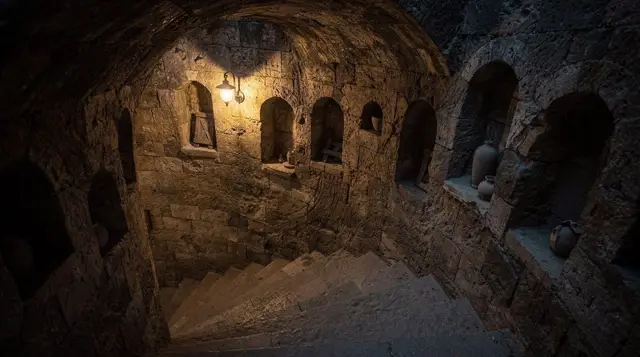
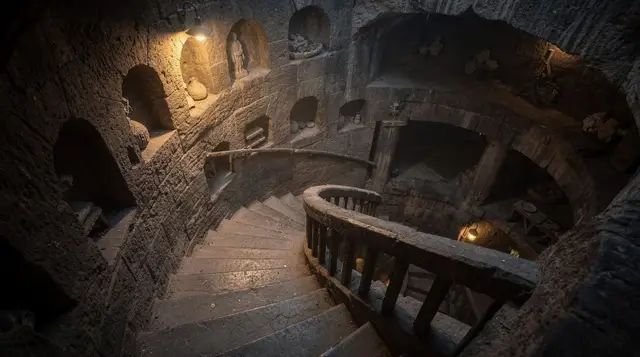
Derinkuyu is a full underground settlement carved into the soft volcanic tuf beneath a small town about 45 minutes south of Göreme. Of the dozens of levels the complex is thought to reach — some estimates go well beyond 85 metres, though nobody has fully mapped the lowest sections — 8 are currently open to visitors.
That is what sets Derinkuyu apart from Kaymaklı, the other major underground city on the tourist circuit: Derinkuyu goes down, Kaymaklı spreads out. If you only have time for one, the choice comes down to whether you would rather descend through narrower, steeper passages or move through a shallower, broader network with less stooping. Neither is objectively better; they are different experiences of the same idea.
The city was carved from Byzantine-era tuf, most likely built up over centuries and expanded by successive communities who used it as refuge during raids. It stayed in local use as storage and occasional shelter long after that, and wasn’t opened to the public until 1969, after clearance and stabilisation work made the upper levels safe to walk.
What you see today is a working system: ventilation shafts that still move air through the complex, stables for livestock near the surface where animals wouldn’t have to be led far underground, storage rooms for grain and wine, a barrel-vaulted room used as a chapel with a cruciform layout, and large circular stone doors — thick millstone-like slabs — that could be rolled across a corridor from the inside to seal a level in minutes. A few of these stone doors are still in place and demonstrated to visitors; they were the city’s real defence, not weapons.
Why depth changes the visit
The practical difference between Derinkuyu and Kaymaklı is not how impressive either site looks in a photograph — both look similar in pictures, which is part of why people underestimate the gap. It’s what your body does on the way through. At Derinkuyu, connecting several of the 8 levels means genuinely low ceilings and narrow shafts between floors, sections where adults duck or shuffle sideways for short but sustained stretches, not just the odd doorway. Kaymaklı’s rooms are wider and its slopes gentler, so even though its levels feel more cramped side to side, you spend less time bent double.
If you are prone to claustrophobia, read this as a genuine warning rather than a formality: some of the connecting passages at Derinkuyu are tight enough, and long enough, that turning back partway isn’t always comfortable either, especially when a tour group is moving through behind you. The widest chambers — the ones used in most marketing photos — are not representative of the whole route.
For a fuller breakdown of which sections are worst for tight spaces, see underground cities and claustrophobia. Families with younger children, or anyone with knee or back problems that make crouching difficult, may find Kaymaklı the more comfortable option; our Derinkuyu or Kaymaklı comparison goes through this level by level.
The real limiting factor: crowds, not depth
Ask people who have visited both cities what actually made the difference, and depth rarely comes up first. What does is timing. Derinkuyu sits on the main route for Green Tour minibuses, and between roughly 10:30 and 14:00 in high season, several groups can be moving through the same narrow corridors at once, coming from opposite directions. In a space already narrow enough to require single file, that means standing aside, waiting for a queue of people ducking through a connecting shaft ahead of you, and losing much of the sense of the place.
Outside that window the experience changes completely. Arrive at opening, or in the last hour before closing, and it’s possible to walk long stretches without meeting another group, hear the ventilation shafts working, and actually read the information panels rather than being swept past them. This one adjustment — visit time, not visit difficulty — does more for how much you enjoy Derinkuyu than any other decision you make about the trip.
The 8 levels, roughly
Signage and guide commentary vary, but the visitor route through Derinkuyu’s 8 open levels generally covers, from top to bottom:
| Level (approx.) | What’s there |
|---|---|
| 1–2 | Stables, storage rooms, a wine or oil press |
| 3 | Living quarters, kitchens with soot-blackened ceilings |
| 4 | A cruciform chapel with a barrel vault |
| 5 | Storage rooms and a wide connecting shaft |
| 6 | A meeting or school room, often pointed out by guides |
| 7 | Deep storage, some of the narrowest connecting passages |
| 8 | The lowest open level, with a water well shaft continuing further down |
The well on the lowest level is a good reminder of how the whole system worked: shafts like it supplied water and, more importantly, air, ventilating a city that could shelter thousands of people and their animals for extended periods without anyone climbing back to the surface.
Visiting: tickets, guides, and timing
Derinkuyu is open daily, with earlier closing in winter and later closing in summer; check current hours locally rather than relying on an old printed schedule, since Cappadocia’s site hours shift with daylight more than most tourist attractions. Entry is by paid ticket at the gate; there is no need to book ahead for individual entry, though organised tours bundle the ticket into their price.
Self-guided visits are entirely possible — the route is one-way and reasonably well signed — but a guide adds real value here specifically because so much of what you’re looking at (ventilation logic, the stone doors, why rooms are shaped the way they are) isn’t obvious from the stonework alone. If you’d rather not drive or navigate parking, an organised half-day covering a guided Derinkuyu underground city tour handles entry, transport and commentary in one booking.
Most visitors don’t do Derinkuyu in isolation. It sits naturally alongside Kaymaklı as a comparison stop, or as part of a longer south Cappadocia day that also takes in Ihlara Valley and Selime. A tour that pairs both underground cities in one day, such as an underground cities tour covering Kaymaklı and Derinkuyu, is the efficient way to see the difference for yourself rather than take a guide’s word for it.
For travellers who’d rather combine the descent with a full canyon walk, a deluxe day combining Ihlara Canyon, Derinkuyu and Selime covers all three in one long day, transport included — worth it if your schedule is tight, hard work if you’re not used to a full day of walking and stairs back to back.
Getting there without a tour
By car, Derinkuyu is about 45 minutes from Göreme via Nevşehir, and there’s a car park at the site entrance. Without a car, dolmuş minibuses run from Nevşehir to Derinkuyu town during the day, though services thin out in the afternoon and there is no direct dolmuş from Göreme itself — you would connect via Nevşehir, which adds time and makes an organised tour considerably more convenient if you’re short on days. See getting around without a car for the wider picture on dolmuş routes and timing across the region.
If you want it quieter: alternatives nearby
Derinkuyu and Kaymaklı are the two underground cities equipped for large-scale tourism, with ticket booths, defined routes, and lighting throughout. A short distance away, Mazı and Gaziemir offer a genuinely different experience: far fewer visitors, sometimes no fixed lighting or on-site staff, and a rawer sense of exploring the tuf rather than following a managed route.
They’re not a substitute if you want solid information and clear safety signage, but for travellers who found Derinkuyu itself too busy, or who want to see how the smaller, undeveloped sites compare, they’re worth the detour — covered in Mazı and Gaziemir: off the tour route. Özkonak, north of the main underground-city cluster, is another quieter option, smaller in scale but with its own version of the rolling stone doors.
Practical notes
Wear closed shoes with grip — the stone underfoot is smooth in places from decades of foot traffic. Bring a light layer even in summer; the underground temperature stays cool and fairly constant year-round, which is a relief in July but a genuine chill by October. There’s minimal natural light past the first level, so the site is lit artificially throughout, but a small torch or phone light is a reasonable backup. Mobile signal is unreliable to absent for most of the route. If you find yourself hurrying through a low passage because a group is pressing from behind, that’s the crowding problem described above, not something wrong with your visit — it’s the single strongest argument for going early or late rather than in the midday window.
For families, younger children can find both the physical demands and the enclosed, dim environment more than they bargain for; see underground cities with kids before committing to Derinkuyu specifically over the gentler Kaymaklı.
Frequently asked questions about visiting Derinkuyu
How deep is Derinkuyu underground city?
The open, visitor-accessible levels descend roughly 85 metres across 8 floors. The full extent of the complex, including unexcavated or closed-off sections, is generally thought to go considerably deeper, though there’s no precise, agreed figure for the entire system.
Is Derinkuyu better than Kaymaklı?
Neither is straightforwardly better — they’re different shapes of the same kind of site. Derinkuyu is deeper with more vertical, narrower connecting passages; Kaymaklı is shallower and wider with gentler transitions between its 4 open levels. Visitors comfortable with tight spaces and stairs generally prefer Derinkuyu’s scale; those who find enclosed spaces uncomfortable often find Kaymaklı easier.
How long does it take to visit Derinkuyu?
Plan on 1 to 1.5 hours for a self-guided walk through the open levels, longer with a guide who stops to explain the ventilation system, the stone doors and the room functions. Add travel time from Göreme, which is around 45 minutes each way.
Is Derinkuyu suitable for claustrophobic visitors?
Approach with caution. Several connecting passages between levels are narrow and low enough to require sustained stooping, and turning back mid-route isn’t always straightforward when other visitors are behind you. If tight, enclosed spaces are a real problem for you, Kaymaklı is the gentler alternative, though it isn’t entirely open either. See underground cities and claustrophobia for a level-by-level breakdown.
What’s the best time of day to visit Derinkuyu?
Early morning at opening, or the final hour before closing. Between roughly 10:30 and 14:00, tour buses on the Green Tour route converge here and the narrow corridors get genuinely congested, which affects the experience far more than the site’s depth or difficulty does.
Can I visit Derinkuyu without a car?
Yes, but it takes planning. Dolmuş minibuses connect Nevşehir to Derinkuyu town during the day, but there’s no direct service from Göreme, and afternoon frequency drops off. Most visitors without a car join an organised tour, which also solves parking and timing in one booking.
Should I visit Derinkuyu or Kaymaklı if I only have time for one?
If depth, narrower passages, and a longer, more physically involved route interest you, choose Derinkuyu. If you’d rather move through wider chambers with less crouching, choose Kaymaklı. Both cover similar historical ground — stables, storage, chapels, ventilation, defensive stone doors — so the decision is really about physical comfort rather than content. Our full Derinkuyu or Kaymaklı guide compares them level by level.
Can Derinkuyu and Kaymaklı be visited on the same day?
Yes, and it’s a common pairing on organised itineraries, since the two towns are roughly 10 minutes apart by road. A combined tour such as a south Cappadocia tour typically visits one underground city plus other south-region stops like Ihlara Valley rather than both underground cities in one day — check the itinerary carefully if seeing both is your goal, since some Green Tour packages only include one.