Derinkuyu underground city: what the visit is actually like
What is it like to visit Derinkuyu underground city?
Derinkuyu is the deepest underground city open to the public in Cappadocia, with eight levels reaching around 85 metres. Expect low, narrow passages you'll walk stooped in places, stone millstone doors still sitting in their grooves, and air shafts that light the deeper floors. The tightest corridors, not the depth, are what slows most visitors down, especially when tour groups cross in the middle of the day.
Forty minutes from Göreme, then straight down
Derinkuyu sits about 40 minutes’ drive south of Göreme, and it’s the one underground city in the region that visitors consistently describe as the “big one” — not because it’s dramatic to look at from outside (it isn’t; the entrance is an unremarkable doorway in a small town), but because of how far it goes down and how much of it is open.
This guide sticks to what you’ll actually see and feel walking through it. If you’re trying to decide between Derinkuyu and its smaller, more famous neighbour, that comparison lives on a separate page — Derinkuyu or Kaymaklı — and the mechanics of how the whole system worked are covered in how the underground cities worked. Here, it’s just the visit itself.
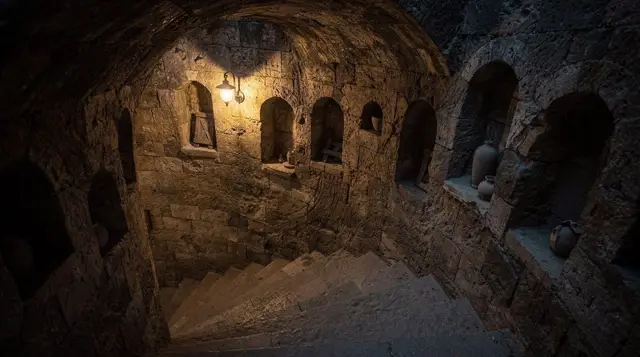
You buy your ticket at the gate in Derinkuyu town and descend through a stone stairway that narrows almost immediately. There’s no gradual easing in — within a few minutes you’re below the level of the town’s cellars and into rock that was cut, not built.
What the eight levels actually look like
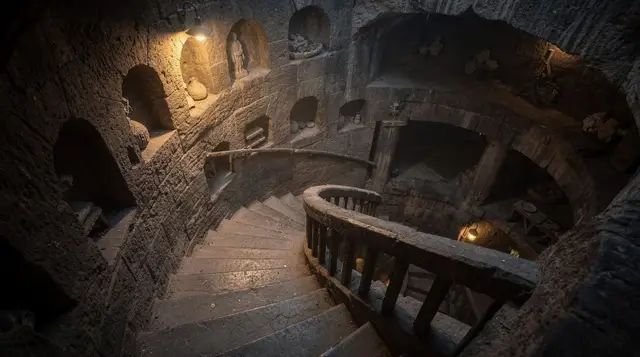
Of the many floors carved into the tuff here, eight are open to the public, taking you down to around 85 metres. Each level has a distinct character, though they blur together a little as you move through:
- The upper levels hold what feel like domestic spaces — stables with stone mangers cut straight into the walls, storage rooms, and what’s thought to have been a wine or oil press, its channel still visible in the floor.
- The middle levels open into wider chambers, including a cruciform chapel with a barrel-vaulted ceiling, one of the few spaces underground where you can actually stand up straight and look around.
- The lower levels get noticeably cooler and quieter. This is where the passages narrow further and the stonework feels rougher, closer to the working core of the city than its living quarters.
Nothing is labelled in much detail at the site itself, so a guide (or at least a plan you’ve looked at beforehand) makes a real difference to knowing what you’re looking at rather than just filing past dark openings in the rock.
a half-day tour that covers Derinkuyu underground and pairs it with Kaymaklı is the standard way most visitors see it, with a guide walking the levels in order rather than doubling back.
The passages: where you’ll be walking bent double
This is the part photos don’t prepare you for. Connecting passages between chambers are often barely a metre and a half high, and in the busiest sections you’ll be walking stooped for stretches of ten or fifteen metres at a time. The tunnels aren’t uniform either — some open up into a short section where you can straighten your back, then narrow again without warning.
The route is largely one-way through the deeper levels, marked by arrows and, in peak season, by the simple fact that a queue has formed behind you. There’s no shortcut back to the surface from level six or seven; once you’re committed to a level, you finish it. That’s worth knowing before you go rather than discovering it with a group pressing in from behind.
Floors are smooth stone, worn by decades of foot traffic and slightly damp in the lower sections. Grippy, closed shoes are not optional here — the same advice that applies across the region’s valleys on foot applies underground too, just with less light and less room to catch yourself if you slip.
The millstone doors, still in their grooves
One of the more striking details at Derinkuyu is also one of the easiest to miss if you’re moving quickly: at several junctions between levels, large circular stone doors — effectively millstones cut to fit — still sit in the grooves carved for them, ready to be rolled across a corridor to seal it from the inside. They’re roughly a metre across and remarkably heavy-looking even at rest. Guides usually point them out and explain how they were operated only from the inner side, but even without commentary they’re worth pausing at; they’re the clearest physical evidence of what this place was built to do.
Air shafts: where the light and the air come from
Derinkuyu’s air shafts are cut vertically through all eight open levels, some running the full depth of the site down to what would once have been a water source at the bottom. A handful are wide enough that you can look up and see daylight as a small, distant circle above you — genuinely one of the more memorable moments of the visit, and a useful cue for orientation if you’ve lost track of which level you’re on. These shafts did double duty as ventilation for the levels below, which is part of why the air underground stays surprisingly breathable even at the deepest accessible point, rather than stale or heavy.
Crowds slow you down more than depth does
Depth sounds like it should be the limiting factor at Derinkuyu. In practice, it’s rarely what causes a bottleneck. The real obstacle is the middle of the day, when several tour buses land at once and their groups end up funnelled through the same one-metre-wide corridors at the same time. A visit that takes 45 minutes at 9am can stretch past ninety minutes at 1pm, almost entirely because you’re waiting for the group ahead to clear a chamber before you can move.
If your schedule allows it, arrive close to opening or in the final hour before closing. Both ends of the day see noticeably thinner crowds, and you’ll get long stretches of passage to yourself rather than shuffling behind a dozen people. A private guide, such as a half-day private underground city tour, also helps simply because you set the pace rather than a coach group’s itinerary.
| Time of day | What to expect |
|---|---|
| First hour after opening | Quietest, shortest queues, easiest to move at your own pace |
| Late morning to mid-afternoon | Multiple tour groups overlapping, slow-moving queues in narrow sections |
| Final hour before closing | Thins out again, though some chambers may close slightly earlier than the main gate |
Doing it with a tour or on your own
Derinkuyu can be visited independently — buy a ticket at the gate, follow the marked route and arrows, and you’ll see everything that’s open. What you’ll miss without a guide is context: which chamber was which, how the millstone doors worked, roughly how old different sections are thought to be. A guided visit, like the guided Derinkuyu tour that includes lunch, fills that gap and also takes the logistics off your hands if you’re not renting a car.
If you are driving yourself, Derinkuyu fits easily into a loop with Ihlara Valley and Selime to the south, which is roughly the shape of the itinerary followed by red tour, green tour, blue tour, explained — Derinkuyu is one of the fixed stops on the Green Tour. Details on renting and driving yourself are covered in car rental in Cappadocia; general safety notes for the region, including underground sites, are in safety and scams in Cappadocia.
Quieter alternatives, if the crowds put you off
Derinkuyu is the largest and busiest of the region’s underground cities open to the public, but it isn’t the only one. Özkonak, Mazı and Gaziemir sit well off the main tour routes and see a fraction of the visitors, often without a fixed guide or reliable lighting on site. They’re smaller in scope than Derinkuyu and not a substitute for it, but if you’ve already done one underground city and want a second without the queues, they’re worth knowing about — more on that in the quiet underground cities and Mazı and Gaziemir, off the tour route.
Who might want to skip it
The combination of low ceilings, narrow one-way corridors and no quick exit from the deeper levels means Derinkuyu isn’t for everyone. If enclosed spaces are a real problem for you, it’s worth reading claustrophobia and the underground cities before booking anything, rather than turning back halfway down a crowded level six. Travelling with children brings its own set of practical questions — stairs, stooping, patience for queues — covered separately in underground cities with kids.
Anyone with significant mobility issues should also think carefully: there’s no accessible route to the lower levels, and the stairways are steep, uneven stone with no handrail for long stretches.
Combining Derinkuyu with the rest of the day
Because Derinkuyu sits south of Göreme rather than in the main cluster of valleys, most visitors pair it with other stops on the same day rather than treating it as a standalone trip. The day tour that combines Derinkuyu with Ihlara Valley and Selime is the most common pairing, and it makes sense geographically — all three sit within a short drive of one another south of the main fairy chimney valleys.
If you’d rather build your own route, aksaray and Güzelyurt day trip covers the wider area, and how many days in Cappadocia can help work out where an underground city fits into a shorter or longer stay.
Before you go down: a short preparation list
A little preparation changes the visit more than any amount of effort once you’re underground. Eat and drink beforehand, since there is no café at the bottom and you won’t want to turn back to find one. Leave bulky rucksacks in the car or at your hotel: a large bag catches on the low ceilings and makes every narrow passage harder for you and for the person behind you. Keep your hands free, because you will use them on the walls and stair edges more than you expect.
A small torch or phone light is useful for reading the rock in the side chambers, though the main route is lit. Carry the light in a pocket rather than in your hand, so both hands stay available for balance. Wear clothes that let you bend and crouch without restriction; stiff jeans or a tight skirt are a poor choice for a route where you spend part of the time stooped.
How to pace yourself inside
Treat the descent as a slow walk rather than a race. The passages reward looking up, sideways and down: the tool marks on the walls, the worn grooves in the floor, the way one room opens into the next through an opening barely wider than your shoulders. If you rush to reach the deepest level, you arrive tired and bent over, with little attention left for what you came to see.
Pause in the wider chambers rather than in the corridors. A stop in a narrow passage blocks everyone behind you, while a few steps further on there is usually a room where you can step aside, catch your breath and let a group pass. If you’re travelling with someone who is nervous, agree beforehand on a simple signal and on who leads, so that nobody has to explain themselves in the middle of a crowded stretch.
On the way back up, the stairways feel steeper than they did going down. Take them steadily, keep to one side so others can pass, and don’t be surprised if the surface light feels very bright and the heat very sudden after the cool air below.
Where Derinkuyu fits in a wider trip
Derinkuyu works best as a half-day anchor rather than the centre of a whole itinerary. It pairs naturally with a slower afternoon elsewhere, and the contrast helps: after the closed, cool world of the tuff, a walk through an open valley feels like a relief. If you’re planning several days, Cappadocia in two days and Cappadocia in three days show where a southern day with an underground city sits among the balloon mornings and valley walks, and the three-day first-timer itinerary gives a ready-made order.
Visitors who prefer to travel on their own schedule will find the practical side in getting around without a car, and those weighing a coach trip against a hired car can read guided tour versus self-drive. For a second underground stop on the same day, Kaymaklı is the obvious neighbour, and Özkonak is the quieter option for anyone who wants less company.
If you want a private pace without building the day yourself, a private guided tour of the region can include Derinkuyu among its stops and lets you decide how long to spend underground.
Questions about visiting Derinkuyu underground city
How deep does Derinkuyu go, and how many levels can you visit?
Derinkuyu descends roughly 85 metres, and eight of its levels are open to visitors. Deeper sections exist but stay closed to the public, mainly for safety and airflow reasons rather than lack of interest.
How long does a visit to Derinkuyu take?
Most visitors spend 45 minutes to an hour underground, longer if you linger at the ventilation shafts and the chapel level or get caught behind a slow-moving group. Add another 15 minutes for the ticket queue in high season.
Is Derinkuyu suitable if I’m claustrophobic?
Some stretches are genuinely tight, low-ceilinged and one-way, with no quick route back to the surface once you’re committed to a level. If enclosed spaces bother you, read up on which sections are worst before you go rather than finding out underground.
What should I wear to visit Derinkuyu?
Closed, flat shoes with grip, since the stone floors are worn smooth and slightly damp in places. Bring a light layer too: the underground air stays notably cooler than the surface, even in the middle of a hot Cappadocian summer.
Is Derinkuyu accessible for people with limited mobility?
Not really. The route involves steep, narrow stone stairways and passages low enough that most adults have to stoop, with no lift or accessible alternative path to the deeper levels.
What time of day should I visit to avoid the crowds?
Aim for the first hour after opening or the last hour before closing. Corridors are narrow enough that a handful of tour buses arriving at once can turn a one-hour visit into two, entirely because of queuing rather than the site itself.
Underground city tours on GetYourGuide
Verified deep-linked GetYourGuide tours. Book through these links and we earn a small commission at no cost to you.
GetYourGuide does not provide a product photo for this activity — the image shows the meeting point, photographed by us.