Kaymaklı underground city: a practical visitor's guide
What makes Kaymaklı different from Cappadocia's other underground cities?
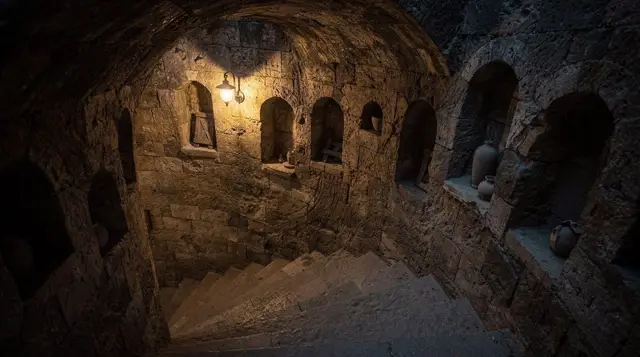
Kaymaklı has four levels open to the public, fewer than some of the other sites, but its rooms and storage areas are noticeably wider than the passages linking them. The trade-off is a maze-like layout with several stretches where the ceiling drops low enough that adults need to stoop.
What sets Kaymaklı apart once you’re actually inside
Kaymaklı is the second most-visited underground city in Cappadocia, after Derinkuyu, and the two get compared constantly. This guide isn’t that comparison — for how the two sites stack up against each other, see our separate Derinkuyu or Kaymaklı guide, and for the general mechanics of how these places worked (air shafts, communal spaces, defensive design), see how the underground cities worked. What follows here is specific to Kaymaklı: what the route actually feels like as you walk it, where the ceilings drop, and why so many visitors come out saying they lost their sense of direction within ten minutes.
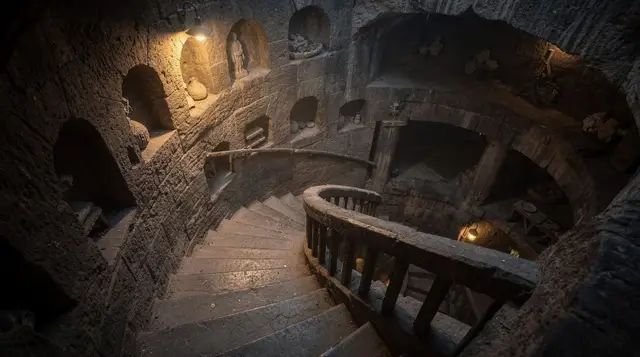
Kaymaklı has four levels open to visitors. That’s fewer than some of the other excavated cities in the region, but the comparison in levels alone is misleading. What you notice on the ground isn’t depth — it’s width. The rooms at Kaymaklı are, on the whole, broader and more open than the tight corridors that link them, which gives the site a different rhythm from a city built around one long, narrow descent. You move from a wide chamber, through a low connecting passage, into another wide chamber, rather than winding steadily downward on a single route.
Walking the route: entrance to exit
The visitor route at Kaymaklı is signed with arrows, and it’s designed as a loop rather than an out-and-back path, so you enter and exit at different points near the village centre above. The entrance drops you fairly quickly into the upper level, where the rooms are largest — this is where most groups gather, and where a guide will usually pause longest to explain what you’re looking at before the route narrows.
From there, the path threads down and across rather than straight down. Expect to duck through several short connecting tunnels between chambers on the second and third levels — these are the sections where the ceiling genuinely drops, sometimes to a height where anyone over about 1.7 metres needs to bend at the neck or crouch slightly to keep moving. It isn’t sustained crawling, and nobody needs to get down on hands and knees on the marked route, but it happens often enough that you’ll feel it in your back by the time you’re back on the surface.
The lower level open to the public is where the wide-room pattern is most obvious: broad storage-style chambers connected by short, low passages, rather than one continuous shaft. The exit brings you back up a shorter, more direct route than the way in, which is part of why the layout confuses people — the way out doesn’t retrace the way in, and there’s no single central staircase to reorient yourself by.
The maze problem, and why it’s not a flaw
If you come away from Kaymaklı slightly unsure of which direction is which, you’re not misremembering — the layout is genuinely closer to a maze than a shaft. Rooms open off each other at odd angles, several passages look near-identical, and the one-way arrow system is what keeps most visitors moving in a coherent line rather than any obvious sense of the geography. This is exactly the kind of thing a guide earns their fee on: someone walking the route independently for the first time will often double back without realising it, while a guide who knows the loop will keep the pace moving and explain what each type of room was likely used for as you pass through it, rather than leaving you to work it out from a signboard.
If you’d rather see the mechanics of underground city design explained properly before you go in — ventilation shafts, the logic of communal versus defensive space — that’s covered in full in our how the underground cities worked guide, so it isn’t repeated here.
a guided visit to Kaymaklı underground city takes the guesswork out of the layout and is worth the small premium over a solo ticket, particularly on a first visit.
How long to allow, and how busy it gets
Most visitors spend somewhere between 45 minutes and an hour inside Kaymaklı. That’s shorter than a full visit to Derinkuyu tends to run, partly because there’s less vertical distance to cover and partly because the loop naturally pushes you through at a steadier pace. Tour groups moving through the site in blocks are the main source of congestion — in the widest chambers this barely registers, but in the low connecting passages a group ahead of you can create a genuine bottleneck, since there’s often no way to pass.
If Kaymaklı is on your itinerary alongside other stops the same day — commonly paired with Derinkuyu, the Ihlara valley, or as part of a wider loop covered in our Red, Green and Blue tour guide — build in more time than the bare visit length suggests, since finding parking, buying tickets and simply getting oriented at the entrance all add up.
Getting to Kaymaklı from Göreme
Kaymaklı sits roughly 35 minutes by road from Göreme, further out than Ürgüp or Uçhisar but well within range of a half-day out. It’s most commonly visited as part of an organised circuit rather than as a standalone trip, which is why so many day tours pair it with Derinkuyu or the Ihlara valley on the same run south. If you’re planning your own route rather than booking a set tour, our one-day Cappadocia itinerary shows where an underground city visit realistically fits alongside the valleys and viewpoints closer to Göreme.
A private option removes the group-pace problem entirely: a half-day private underground city tour lets you move through the low passages at your own speed rather than queuing behind a coach group. For a day that mixes walking with the underground visit, a Red Valley trek combined with a visit to Kaymaklı is a way to see both without arranging transport separately.
Visiting with kids, mobility limits, or claustrophobia
The wide upper rooms at Kaymaklı are genuinely easier going for children than the deeper, narrower stretches of some other sites, and there’s plenty to hold a child’s attention in the storage chambers and the general strangeness of the space. That said, the low connecting passages are exactly the kind of thing that unsettles a nervous child or adult — dim lighting, a ceiling close overhead, and other visitors moving through the same narrow point.
If that’s a concern for anyone in your group, it’s worth reading our dedicated guide on underground cities and claustrophobia and our notes on visiting underground cities with kids before you commit to going in.
Mobility is a separate issue from claustrophobia here. There’s no long staircase to manage, which helps, but the floors are uneven stone, the passages narrow suddenly, and there’s no accessible alternative route through the low sections. Anyone with limited mobility should treat Kaymaklı as a genuinely difficult site rather than assume the shallower depth makes it easier than Derinkuyu.
Kaymaklı versus the quieter underground cities
Kaymaklı, along with Derinkuyu, is one of the two underground cities built for volume — ticket booths, marked routes, coach parking, and steady footfall for most of the day. If the crowding or the coach-group bottlenecks put you off, Özkonak, Mazı and Gaziemir sit at the other end of the spectrum: far fewer visitors, much less infrastructure, and sometimes no fixed lighting or on-site guide at all.
They’re a different kind of visit rather than a lesser one, and we cover what to expect at each in the quiet underground cities and in more detail in Mazı and Gaziemir, off the tour route.
If your interest in Kaymaklı is really an interest in underground cities generally rather than this one specifically, it’s worth deciding before you go whether you want the well-lit, well-marked, busier experience or the rougher, quieter one — both are legitimate ways to see the same kind of engineering, and Kaymaklı is squarely the former.
Booking a guided visit
For visitors who want the layout explained rather than puzzled out room by room, a guided day that covers Kaymaklı among the region’s highlights bundles the underground city visit with other stops and takes the logistics off your hands. Whichever way you book, the same rule applies at Kaymaklı as anywhere in the region: closed shoes, layers you can move in, and a torch or phone light are worth having, since not every corner of the route is evenly lit. Our general Cappadocia packing list covers what’s worth bringing for a day that includes a stop like this one.
Before you go down: a short preparation list
A little preparation changes how the visit feels. Wear shoes with a grip that copes with smooth, worn stone, and keep your hands free rather than carrying a bag in one of them; you will want a hand to steady yourself and another to protect your head in the low passages. A small bag worn on the front is easier to manoeuvre than a rucksack that catches on the walls. Tall visitors often find it helps to walk with the knees slightly bent from the start instead of repeatedly straightening up and hitting the ceiling.
It also helps to decide in advance who in the group wants to lead and who prefers to follow. In a maze-like layout, the person at the back sees the least and feels the most hemmed in, so anyone who is nervous is usually better placed near the front, close to the guide or the arrows. Agree on a simple signal for “I need a moment” so nobody has to explain themselves in a narrow passage with a queue behind them.
What to look for in the rooms
Because the wide chambers are the real reward at Kaymaklı, it is worth slowing down in them rather than hurrying toward the next passage. Look at how the rooms are shaped: the rounded storage spaces, the niches cut into the walls, and the way one chamber opens into the next at an angle. These details are easy to miss when you are focused on where to put your feet, and they are what turn a walk through tunnels into a picture of daily life underground.
Pay attention, too, to how the space is organised around the passages. The broad rooms feel made for people to gather, store food and wait, while the narrow links feel made to be crossed one at a time. That contrast is the clearest way to understand why the city was built the way it was, and it is explained in more depth in how the underground cities worked. If you enjoy this kind of detail, the neighbouring site described in the Derinkuyu underground city guide offers a very different rhythm for comparison.
Fitting Kaymaklı into a wider trip
Kaymaklı rarely fills a whole day, so the interesting question is what to put around it. Some travellers pair it with a walk in the valleys, which makes for a pleasing contrast between a closed, cool interior and open landscape. Others fold it into a longer plan such as Cappadocia in two days or the three-day first-timer itinerary, where it sits comfortably alongside the open-air museum and a balloon morning.
If you are weighing it against a day spent entirely above ground, the question is simply what you want from the day. An underground city offers shelter from the weather and a sense of scale that photographs rarely convey, which is why it also works well as a plan B when conditions outside are poor; our guide to rainy-day activities in Cappadocia lists other options. For anyone who prefers to arrange everything in one booking, a single day of regional highlights that includes the underground city is the simplest way to avoid planning the transport yourself.
After the visit
Come back up slowly and give your eyes a moment to adjust to the daylight. Most people find a sit-down and a glass of tea in the village above is the natural way to end the visit, and it is a good moment to compare impressions of which room surprised you most. For ideas on what to eat and drink afterwards, see Cappadocian food guide and Turkish tea and coffee culture.
Frequently asked questions about visiting Kaymaklı
How many levels of Kaymaklı can visitors actually see?
Four levels are open to the public. The city itself is known to extend further down, but those lower sections are not part of the visitor route.
Do I need to stoop or crawl anywhere inside?
You’ll need to stoop in several connecting passages, particularly between the upper levels. Nobody has to crawl on hands and knees on the marked route, but tall visitors will duck more often than they expect.
Is Kaymaklı an easy visit or a strenuous one?
It’s easy in the sense that there are no long staircases like the descent at Derinkuyu, since the levels are more spread out horizontally. It’s harder on the neck and back because of the low sections, and the layout genuinely disorients most first-time visitors.
How long does a visit to Kaymaklı take?
Most visitors spend 45 minutes to an hour inside. A guide who explains the layout as you go tends to make the visit faster and clearer than working it out alone.
Can I visit Kaymaklı without a guide?
Yes, independent visits are possible and the main route is marked with arrows. Without a guide, though, it’s easy to retrace your own steps without realising it, since several passages look alike.
Is Kaymaklı suitable if I’m claustrophobic?
The upper levels are relatively open and the wide rooms help, but the low connecting passages and the sense of being boxed in by the maze layout are real triggers for some people. Read up on what to expect before committing to a full visit.
Are Kaymaklı, Özkonak, Mazı and Gaziemir the same kind of site?
They’re all excavated underground settlements in the same volcanic tuf, but Kaymaklı is developed for large-scale tourism while Özkonak, Mazı and Gaziemir sit well off the main circuits, with far fewer visitors and much less infrastructure.
Where is Kaymaklı in relation to Göreme?
Kaymaklı is about 35 minutes by road from Göreme, on the way toward Derinkuyu and the Ihlara valley, which is why the two underground cities are often paired with a Green Tour.
Underground city tours on GetYourGuide
Verified deep-linked GetYourGuide tours. Book through these links and we earn a small commission at no cost to you.
GetYourGuide does not provide a product photo for this activity — the image shows the meeting point, photographed by us.