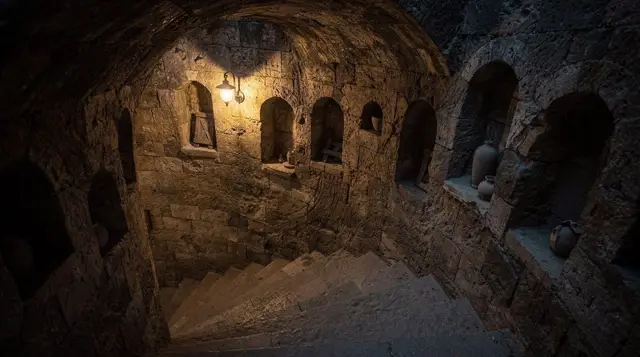
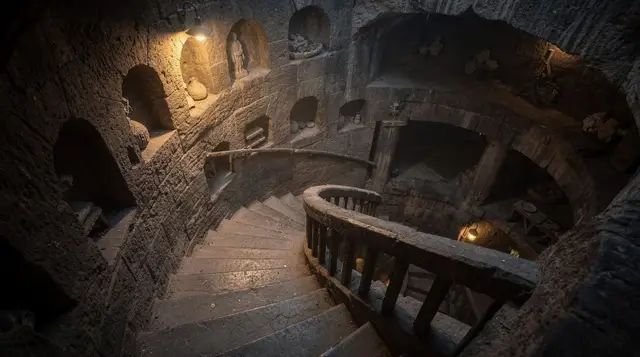
An underground city that nobody promises you will see
Most guides to Cappadocia’s underground cities compare Derinkuyu and Kaymaklı, then stop. Gaziemir barely gets a mention, and for good reason: it sits well outside the tour circuit, it has no dedicated visitor infrastructure to speak of, and whether you can actually get inside on the day you turn up is not something anyone can guarantee in advance. This page treats it honestly, in the same register as Mazı: a real place, not a polished attraction, and one that suits a narrow kind of traveller.
If you have not yet been to Derinkuyu or Kaymaklı, go there first. Both are open daily, staffed, lit, and give you a proper sense of how these settlements worked — read the guide to how the underground cities worked before either visit. Gaziemir is for the traveller who has already done that and wants to see what an underground city looks like when nobody has restored it for visitors.
What is actually known about Gaziemir
Reliable, up-to-date information on Gaziemir is thin, and this page will not pretend otherwise. Reputable sources agree on the broad picture: it is one of the smaller, minor underground settlements scattered across the Cappadocia plateau alongside better-documented sites like Özkonak and Mazı, cut into the same volcanic tuf that shaped the whole region. Beyond that, claims about its exact number of levels, its layout, or its total extent vary between sources and are not something this guide can confirm — so we are not going to invent a level count or a floor plan for you here. Treat any figure you read elsewhere with some scepticism unless it comes from a source that has actually surveyed the site recently.
What matters more for planning a visit is not how deep the city goes but whether you can get into it at all on a given day. That is the real constraint, and it is worth understanding before you commit half a day to the drive.
The real limiting factor: access, not depth
At Derinkuyu and Kaymaklı, the limiting factor is crowding around midday and the height of the passages, which forces taller visitors to walk stooped for long stretches. At Gaziemir, that problem barely arises, because the harder problem comes first: getting in.
Minor sites like this one are not run to a fixed public timetable the way Derinkuyu and Kaymaklı are. There may or may not be a caretaker present when you arrive. Lighting, where it exists, is not something you should assume is working — carry your own torch or a phone with a reliable flashlight function, and a spare power source, because you may be relying on it for longer than planned. Signage is minimal to non-existent. None of this is a complaint about the site; it simply is what an off-circuit underground city looks like in practice, and it is the reason so few visitors bother.
The practical upshot: build in a backup plan. If Gaziemir is closed, unattended, or the access point is not obvious when you arrive, do not push into unlit passages alone looking for a way in — turn around and treat the trip as a scenic drive instead. Safety and scams in Cappadocia covers the general precautions worth knowing before you explore any of the region’s underground or troglodyte sites alone.
How Gaziemir compares to the other underground cities
| Site | Visitor infrastructure | Crowds | Typical visit |
|---|---|---|---|
| Derinkuyu | Staffed, lit, 8 levels open | Busy, especially late morning | 45–90 minutes |
| Kaymaklı | Staffed, lit, 4 levels open, lower ceilings | Busy, tour-bus stops | 45–75 minutes |
| Özkonak | Usually staffed, more basic | Light | 30–45 minutes |
| Mazı | Uncertain, often unattended | Near-empty | 20–45 minutes, if accessible |
| Gaziemir | Uncertain, often unattended | Near-empty | 20–45 minutes, if accessible |
The pattern is clear: as you move down the list, comfort and certainty drop while solitude goes up. Gaziemir sits at the far end of that trade-off alongside Mazı. For a fuller picture of that whole spectrum, the guide to Mazı and Gaziemir off the tour route and the quiet underground cities both go into more detail on which minor sites tend to reward the effort.
Who should actually go
Gaziemir is not a first underground city, and it is not a good fit for anyone short on time, travelling with young children, or looking for a comfortable, informative visit. It suits:
- travellers who have already walked through Derinkuyu or Kaymaklı and found the crowds got in the way of the experience
- self-drivers who are comfortable adjusting plans on the spot if a site turns out to be closed
- photographers who want undisturbed, unlit passages rather than the illuminated, railed sections of the major sites
- anyone genuinely curious about how many of these settlements exist across the plateau, beyond the two or three that make it into every itinerary
It is a poor fit for anyone with claustrophobia — read underground cities and claustrophobia before considering any of these sites — for families with small children, given the uneven, unlit ground, and for travellers on a tight one- or two-day visit who need to prioritise the reliable sights first. If that describes you, spend the time at Derinkuyu, Kaymaklı, or the Göreme Open-Air Museum instead, and read Derinkuyu or Kaymaklı to decide between the two.
Getting there
Gaziemir sits away from the main road network that links Göreme to the well-known sites, and it is not served by dolmuş or organised tour. Realistically, this means a rental car, a private driver, or a taxi arranged for a half-day out and back. Budget 45 minutes to an hour of driving each way from Göreme, more if you also want to stop at Mazı or Özkonak on the same loop — a reasonable pairing, since all three sit in a similar direction and none takes long to see.
The guide to driving in Cappadocia and car rental in Cappadocia cover what you need to know before setting out, and the itinerary for exploring without a car is worth reading first if you are weighing whether a rental is worth it just for this kind of detour.
Local roads near minor sites like this one are not always well signposted, and phone signal can be patchy once you are off the main routes, so download offline maps before you leave Göreme and confirm the route on the Cappadocia map tool in advance. Fuel up before heading out; there is little reason to expect services nearby.
What to bring
Treat a visit to Gaziemir the way you would treat any unlit, unstaffed site:
- a torch or a phone flashlight you trust, plus a way to recharge it
- closed, sturdy shoes with good grip — the tuf floors are uneven and can be dusty or damp depending on the season
- a bottle of water; there is nothing to buy nearby
- a companion, if possible — going alone into an unlit underground passage with nobody aware of your route is not sensible, regardless of how confident you feel
- cash in small denominations, in case a caretaker is present and expects a modest entry fee; card payment should not be assumed
None of this is exotic advice, but it is the difference between an interesting half-day and a genuinely uncomfortable one if the site turns out to be less accessible than hoped.
If Gaziemir does not work out
Because access is not guaranteed, it is worth having a fallback built into the day rather than treating Gaziemir as the only stop. Özkonak, a short drive away, is a more consistently staffed minor underground city and a sensible plan B. If you are already out this way and the underground city itself is a bust, the surrounding countryside and villages still make for a reasonable scenic drive back toward Avanos or Göreme.
For travellers who would rather see an underground city properly than gamble on solitude, booking a structured visit removes the uncertainty entirely. A guided half-day tour of Derinkuyu covers the levels that are actually open to the public with a guide explaining what you are looking at, and the Blue Tour taking in Soğanlı and Kaymaklı pairs an underground city with one of the quieter valley routes in a single organised day. Neither substitutes for the specific experience Gaziemir offers, but both guarantee you will actually get inside somewhere.
If what appeals about Gaziemir is really the idea of quiet, effort-earned corners of Cappadocia rather than the underground city specifically, a full day on foot may serve you better: a full-day hiking tour through the national park covers ground most visitors never walk, without depending on whether a minor site happens to be open that day.
Nearby, if the trip is not wasted
If you do get inside and still have time on your hands, the surrounding area rewards a slow afternoon rather than another tick-box stop. Avanos, with its pottery workshops on the banks of the Kızılırmak, is a manageable onward drive, and the pottery workshops guide explains what to expect. For a broader sense of how the quieter underground cities fit into a wider trip, seeing Cappadocia without a tour lays out how independent travellers piece together days like this one without relying on organised circuits at all.
Questions about visiting Gaziemir underground city
Is Gaziemir open every day?
There is no reliable, published fixed schedule. Access depends on whether a caretaker is present on the day you visit, and this can vary. Build a backup plan into your day rather than relying on Gaziemir being open.
How deep is Gaziemir underground city?
There is no dependable public data on its exact depth or number of levels, and this guide will not repeat unverified figures found elsewhere. What is consistent across sources is that it belongs to the same family of minor tuf-cut settlements as Mazı and Özkonak.
Do I need a guide to visit Gaziemir?
There is no organised tour that includes it, so a guide in the conventional sense is not an option. What matters more is going with a companion, carrying your own light source, and being willing to turn back if the site is not accessible.
Is Gaziemir safe to visit alone?
Visiting any unlit, unstaffed underground site alone carries more risk than visiting Derinkuyu or Kaymaklı, where staff and lighting are guaranteed. If you go, tell someone your plan, bring a reliable light, and do not press on into unlit passages if conditions feel uncertain.
How does Gaziemir compare to Mazı?
They occupy a similar position: both are minor underground cities outside the tour circuit, with uncertain access and little visitor infrastructure. Travellers weighing one against the other usually visit whichever fits their route better rather than choosing based on any real difference between the two.
Should a first-time visitor to Cappadocia go to Gaziemir?
No. First-time visitors are better served by Derinkuyu or Kaymaklı, which are staffed, lit, and give a far clearer sense of how these underground settlements functioned. Gaziemir suits travellers who have already done that and specifically want somewhere quieter.
Can I combine Gaziemir with other sites in one day?
Yes, and it is the sensible approach given the drive involved. Pairing it with Mazı or Özkonak, which sit in a broadly similar direction, spreads the risk of one site being inaccessible and makes better use of the driving time.
Is there an entry fee for Gaziemir?
If a caretaker is present, a modest fee may be expected; carry small cash, since card payment should not be assumed. There is no confirmed standard published price, so treat any figure as approximate.