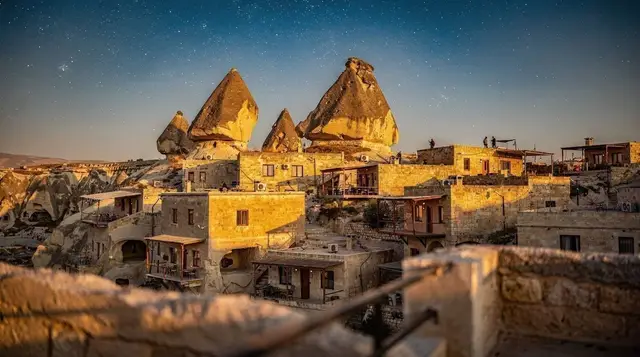
Rainy day activities in Cappadocia
What should you do in Cappadocia when it rains?
Skip the valley trails, since wet tuf gets slippery and some paths become genuinely unsafe. Head underground to Derinkuyu or Kaymaklı, walk the covered churches at the Göreme Open-Air Museum, try a pottery wheel in Avanos, or spend the afternoon in a wine cellar in Ürgüp.
When the tuf gets wet
Cappadocia’s valleys are carved from tuf, the soft volcanic rock that erosion has shaped into fairy chimneys and canyon walls over thousands of years. Dry, that same rock is easy to grip and easy to read underfoot. Wet, it turns slick fast, and dust that was firm an hour earlier can become a thin layer of slippery mud over hard stone. On a flat, short walk like Devrent Valley, that mostly means damp shoes. On something steeper or narrower, it is a different question.
Trails through Rose Valley, the descent sections of Red Valley and the roughly 380 steps down into Ihlara Valley all have stretches where the path narrows, drops away on one side, or runs close enough to a rock face that a slip has consequences beyond wet trousers.
None of this is exaggerated danger — plenty of people walk these valleys in a light shower without incident — but sustained rain changes the calculation, and it is worth reading a broader note on hiking safety in the valleys before deciding whether to go ahead. The honest advice from most guides in Göreme is simple: if it has been raining for more than an hour, postpone the walk rather than push through it. The valleys are not going anywhere, and Cappadocia’s dry continental climate means a wet spell is far more often a single afternoon than a lost trip.
That leaves the question of what to do instead. The answer is not to swap one outdoor activity for another — a jeep track or a viewpoint café is not meaningfully drier than a valley trail — but to move somewhere the weather cannot reach at all.
Underground cities: unaffected by the weather
The most reliable rainy-day option in the region is also one of its best attractions on a clear day too: the underground cities carved beneath the plateau. Derinkuyu descends roughly 85 metres through eight levels open to visitors, with ventilation shafts, stables, storage cellars, a chapel, and the large stone discs that were rolled across corridors to seal them off.
Kaymaklı is shallower, with four levels open, but its passages run lower and narrower, so expect more time spent stooped as you move between rooms. Neither city has any meaningful exposure to surface weather — the temperature underground stays cool and steady whatever is happening above, and rain has no effect on the corridors, the lighting or the footing.
If you are choosing between the two, Derinkuyu or Kaymaklı is worth reading first: the short version is that Derinkuyu goes deeper and feels more varied, while Kaymaklı is wider but demands more crouching. Either is a full, worthwhile stop on its own, and a wet morning is arguably the best time to visit, since the surface crowds that build up around these sites in good weather thin out when the forecast turns.
For a quieter alternative, Mazı and Gaziemir sit off the main tour routes, without the coach groups that fill Derinkuyu and Kaymaklı in the middle of the day; they can lack reliable lighting or a permanent guide, so they suit travellers comfortable with a more improvised visit rather than a polished one.
Cave churches at the Göreme Open-Air Museum
The Göreme Open-Air Museum is a UNESCO World Heritage site inscribed in 1985, and most of a visit there is spent stepping in and out of a dozen or so rock-cut churches from the tenth and eleventh centuries. Once you are inside a church, rain makes no difference — you are looking at frescoed ceilings and carved columns in a sheltered chamber. The catch is that the paths connecting the churches within the site are outdoors, and after rain they can be as slippery as anywhere else on the plateau, so this is a partial rather than complete shelter from the weather.
Budget one and a half to two hours for the museum itself. The Karanlık Kilise, or Dark Church, requires a separate ticket beyond the general entrance, and it is the one worth paying extra for: it has the best-preserved frescoes in the complex precisely because its limited window let in so little light over the centuries. Details on what makes it different from the rest of the site are covered in the guide to the Dark Church. Bring a poncho or a compact umbrella and shoes with real grip, since the paved paths between churches can pool with water, and treat the museum as a mixed indoor-outdoor visit rather than a fully sheltered one.
Avanos: a wheel, some clay, and a roof overhead
Avanos sits on the Kızılırmak, Turkey’s longest river at around 1,355 kilometres, and the red clay pulled from its banks has been worked here since the Hittite era. A number of workshops in town let visitors sit at a potter’s wheel for a short, guided attempt — genuinely indoors, genuinely hands-on, and a reasonable way to fill an hour or two while the weather clears outside. It suits most ages and does not require any prior skill; a member of staff usually keeps the wheel centred while you shape the clay.
Pair a workshop with a walk through the pottery quarter, where showrooms display finished pieces ranging from simple household bowls to large decorative urns. It is worth going in with a sense of what a fair price looks like before any conversation starts, since some showrooms lean on a hard sell; nobody is obliged to buy, and a polite decline is a completely normal response. A broader look at the town, including where the workshops sit relative to the river, is in the Avanos walking guide.
Ürgüp: wine cellars for the afternoon
Cappadocia has been a wine-producing region for a very long time, and Ürgüp is its most visible centre for it today, with a number of cellars set directly into the rock — sheltered, cool, and entirely unaffected by rain on the surface. Local grapes worth trying include Emir, a white variety, alongside reds such as Kalecik Karası and Boğazkere. Tastings are typically informal: a handful of pours, a short explanation from whoever is pouring, and no pressure to buy a case on the way out. The Ürgüp wine cellars guide lists specific addresses, and the Cappadocia wine guide goes into the grape varieties and the region’s history in more depth.
a full-day tour from Göreme that combines a wine tasting with other rock-cut sites is a sensible way to structure a wet day if you would rather not plan the logistics yourself — most of the stops on this kind of itinerary are indoors or underground by design, rather than valley walking. For adults travelling without children, an afternoon that moves from a cellar tasting to a sit-down meal is a good use of a day the weather has taken off the table; the where to eat in Ürgüp guide has options nearby.
Other indoor options worth knowing about
A handful of other activities in the region are effectively weatherproof, and worth keeping in reserve for exactly this kind of day:
| Activity | Where | Roughly how long |
|---|---|---|
| Turkish bath (hamam) | Göreme, Ürgüp | 1–1.5 hours |
| Cave hotel spa treatment | Various cave hotels | 45 min–1.5 hours |
| Carpet or textile viewing | Göreme, Avanos, Ürgüp | 30–60 minutes |
| Onyx or jewellery workshop visit | Avanos area | 30–45 minutes |
| Whirling dervish ceremony | Various venues, evening | ~1 hour |
A Turkish bath is a straightforward, entirely indoor way to spend an hour, and several cave hotels run their own small spas for guests and outside visitors alike. Carpet showrooms and onyx workshops are common stops on organised tours; it is fine to look without buying, and what to know before buying a carpet or a piece of onyx or jewellery is worth a read before any conversation about price gets serious. In the evening, a whirling dervish ceremony is held indoors and runs regardless of what the sky is doing outside.
Building a whole day around the weather
A wet day works best when it has a shape. Rather than hopping between attractions and getting damp in the gaps, pick one anchor and let the rest follow. A common pattern is to start underground in the morning, when the cities are at their quietest, then move to something with a roof and a seat in the afternoon: a pottery wheel, a cellar tasting or a long lunch. Because the underground sites and the workshops are indoors, you spend the minimum time moving between them in the rain, and the car or minibus does most of the work.
If you are travelling without a car, rain makes the logistics a little harder, since waiting at a roadside stop is no fun in a downpour. The notes on getting around without a car and public transport in Cappadocia explain what is realistic, and in practice a taxi for the short hops between sites, or a guided day that handles the driving, is often worth the small extra spend when the weather is poor. If you do have a car, remember that wet roads and poor visibility call for slower driving, and the advice in the driving in Cappadocia guide applies doubly.
Pack for a day of getting in and out of vehicles and buildings rather than a day on the trail. A light waterproof layer, shoes with a proper sole and a small bag that can survive a splash will do more for your comfort than any amount of planning. The Cappadocia packing list covers the basics, and it is worth keeping a dry pair of socks in your bag, because damp feet are what turns a good wet day into a miserable one.
Rainy days with children
Families usually have the hardest time on a wet day, because energy has to go somewhere. The good news is that the underground cities tend to suit children well: the narrow passages, hidden rooms and sealing stones feel like a game, and the cool, steady air means nobody overheats. The guide to underground cities with kids explains which parts are easiest for small legs and which low passages are better skipped, and anyone who dislikes tight spaces should read about underground cities and claustrophobia before committing.
A pottery workshop in Avanos is the other natural fit, since a child who is allowed to get their hands covered in clay is rarely bored. Keep the rest of the day loose: a warm drink in a café, a short stretch in a hotel with a cosy common room, and an early dinner will usually do more good than a packed itinerary. For more ideas aimed at younger travellers, the wider guide to Cappadocia with kids is a useful companion.
Small ways to make a wet day pleasant
Not every rainy-day plan has to be an attraction. Some of the nicest hours in Cappadocia on a grey day are spent doing very little: a long Turkish breakfast that stretches into late morning, a pot of tea by a window with the valley half hidden in cloud, or an afternoon reading in the common room of a cave hotel. The pages on Turkish tea and coffee culture and Cappadocian food are good starting points if you want to turn a slow day into a tasting of its own.
Cloudy weather also changes the light in a way photographers often enjoy. Mist in the valleys and dark, wet stone give the landscape a moodier, more saturated look than the bright midday sun, and when a break in the rain arrives, the colours of the rock can look richer than usual. It is worth keeping a camera or phone within reach and being ready to step outside for twenty minutes when the sky opens up, as long as the paths you choose are flat and firm rather than steep.
Finally, be flexible about the order of your trip. If rain is forecast for one day and clear skies for the next, swap your plans rather than forcing the original sequence. Most of the indoor options in this guide can be done on any day, whereas the valley walks, the viewpoints and anything involving open ground reward good conditions. Thinking of the wet day as the one reserved for underground cities, museums and workshops makes the weather feel like part of the plan rather than a disruption to it.
The balloon flight, in the background
If a hot air balloon flight is part of your plans, it is worth saying plainly: rain is not usually the direct cause of a cancellation, but it rarely arrives without wind or low cloud alongside it, and either of those is enough to ground the fleet. Flights are already cancelled for wind on several days most months, more often in winter and spring, and there is no way to predict a specific morning in advance.
If you already know this, a rainy day is really just a reminder of why booking a flight for your first morning in Cappadocia rather than your last matters: it leaves a second and third chance if the first is called off. The Cappadocia hot air balloon guide covers timing and pricing in full, and the note on balloon flight cancellations and wind explains what operators typically offer when a flight does not go ahead.
a sunrise balloon flight over Göreme is worth booking for the earliest morning of your stay for exactly this reason — not because it helps with today’s rain, but because it protects the rest of your trip from a single bad forecast.
When the rain clears
Cappadocia’s dry climate means a rainy spell is usually short, and the valleys dry out faster than you might expect once the sun is back — tuf sheds water quickly. Treat a wet day as a reshuffle rather than a loss: move the hike to tomorrow, and use today for the underground cities, the museum, Avanos or Ürgüp instead.
Once the ground has firmed up again, activities that only make sense in dry conditions are worth returning to. a jeep safari through the valleys around Göreme covers rougher tracks that are genuinely unpleasant, and sometimes unsafe, when wet, so it is one to hold off on until conditions improve rather than attempt around a rain shower. If you are planning a longer stay through an unsettled stretch of weather, the Cappadocia in winter itinerary is built with exactly this kind of flexibility in mind, spacing outdoor and indoor days across the trip rather than betting everything on one forecast.
Family-friendly tours on GetYourGuide
Verified deep-linked GetYourGuide tours. Book through these links and we earn a small commission at no cost to you.
GetYourGuide does not provide a product photo for this activity — the image shows the meeting point, photographed by us.