Cappadocia wine: a plain guide to the region's vineyards
Is Cappadocia known for wine?
Yes, in a modest way. Grapes have been grown on the volcanic plateau around Ürgüp for centuries, using varieties such as Emir and Kalecik Karası, but total output is small next to Turkey's main wine regions on the Aegean coast.
Wine on a volcanic plateau
Most visitors arrive in Cappadocia thinking about balloons and rock-cut churches, and few expect to find vineyards. But grapes have been grown here for a long time, on the same volcanic plateau that produced the fairy chimneys, and the region has a genuine, if modest, wine tradition centred on Ürgüp.
This page covers what that tradition actually consists of: which grapes, why the volcanic soil and altitude matter, how the industry compares to Turkey’s better-known wine regions, and where the practical business of tasting and buying happens. For the specifics of which cellars to visit in Ürgüp and what a tasting there involves, see the Ürgüp wine cellars guide; this page stays at the level of background and orientation.
The grapes: Emir and Kalecik Karası
The white grape most closely tied to central Anatolia, and to Cappadocia specifically, is Emir. It’s a native variety grown on the plateau around Nevşehir and Kayseri, and it forms the backbone of much of the region’s white wine. It’s typically made into a light, crisp, relatively neutral wine, though styles vary by producer.
Among reds, Kalecik Karası is the variety most often mentioned alongside Cappadocia, though its historical home is further north around Ankara province; it’s grown across a wider swathe of central Anatolia and shows up in local blends and cellar lists in Ürgüp. Other reds on offer in the region — Öküzgözü and Boğazkere — are grown more widely in eastern and south-eastern Turkey and are best understood as varieties that Cappadocian producers work with rather than grapes unique to the plateau itself.
If a cellar or restaurant list in Ürgüp names a specific grape you don’t recognise, it’s worth asking directly rather than assuming: Turkey has a long list of indigenous varieties, and producers experiment with international grapes too, so what’s poured on a given evening isn’t always predictable.
Why altitude and volcanic soil matter
The vineyards around Ürgüp sit on the same central Anatolian plateau as Göreme, at roughly 1,000 metres above sea level. That altitude means cooler nights than you’d get at sea level even in the same latitude, which slows ripening and tends to preserve acidity in the grapes — a factor winemakers generally see as useful for balance.
The soil itself is built from volcanic tuff, laid down by eruptions of Mount Erciyes and Hasan Dağı and then eroded over millennia into the same rock that forms the region’s valleys and cave dwellings. Vines grown in volcanic soil are widely associated, in wine regions around the world, with a distinct mineral quality in the finished wine. That’s a real characteristic of terroir, not a marketing claim specific to Cappadocia — but it is a genuine part of what makes wine from this plateau recognisable rather than generic.
None of this adds up to international acclaim. Cappadocian wine isn’t sold as a prestige product outside Turkey, and you shouldn’t expect a cellar visit here to resemble a tour of a famous European wine region. What you get instead is a wine tradition shaped by an unusual landscape, worth tasting on its own terms rather than against a reputation it doesn’t claim.
Ürgüp: the historic centre of the region’s cellars
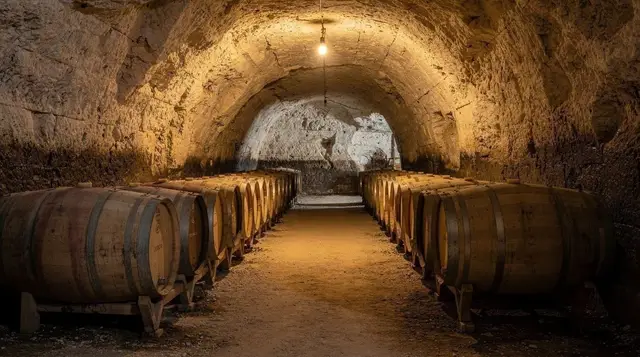
Ürgüp is where the region’s wine business is concentrated, and has been for a long time — the town’s caves, originally cut for storage and cool cellaring rather than tourism, turned out to suit wine production well. Several producers run tastings and cellar visits there today, ranging from small family operations to larger commercial cellars with tasting rooms built for visitors.
The Ürgüp wine cellars guide covers which cellars are set up for casual visitors, what a typical tasting costs and includes, and how to combine a cellar stop with the rest of a day in Ürgüp. This page won’t repeat that detail — the short version is that Ürgüp is a 15-minute drive or dolmuş ride from Göreme, and a wine stop fits comfortably into a half-day out, whether arranged independently or as part of an organised tour.
How it compares to Turkey’s main wine regions
It’s worth being honest about scale. Turkey’s largest and most established wine regions are on the Aegean coast, in and around Izmir and further south, where vineyard area and export volumes are far larger than anything on the central Anatolian plateau. Cappadocia’s production is a fraction of that — a regional industry serving mostly domestic drinkers and visitors passing through, not a major contributor to Turkey’s wine exports.
That doesn’t make it not worth trying. It does mean you shouldn’t arrive expecting the density of producers, the range of labels, or the international recognition of a major wine region. Think of Cappadocian wine as a genuine local product tied to an unusual terroir, similar in scale to a small regional appellation rather than a flagship industry.
| Cappadocia (Ürgüp area) | Aegean coast | |
|---|---|---|
| Scale | Small, regional | Turkey’s largest wine region |
| Known for | Emir, Kalecik Karası, volcanic-soil character | Wider range of native and international varieties |
| Typical visit | Cellar tastings in and around Ürgüp | Established wineries, some open for tours |
| Export presence | Minimal | The bulk of Turkey’s wine exports |
Tasting wine as part of a visit
For most travellers, wine in Cappadocia is something encountered alongside other things — a stop on a tour, a glass with dinner, a cellar visit fitted into an afternoon in Ürgüp — rather than the sole purpose of a trip. A few practical ways it comes up:
Guided tastings. A dedicated half-day trip to the vineyards is the most direct way to taste several wines with some explanation of what you’re drinking.
a private half-day vineyard and wine-tasting tour out of GöremeCombined with a full touring day. Several two-day itineraries that cover the region’s main valleys and underground cities also build in a wine-tasting lunch, which suits travellers who don’t want a separate wine-only outing.
a two-day guided tour that includes a wine-tasting lunchDinner with wine or rakı. For an evening rather than a daytime cellar visit, a set dinner built around local dishes and a glass of wine or rakı is a simpler way to try the region’s drinks without a dedicated tasting itinerary.
a traditional dinner with wine or rakıFood first, wine alongside. If wine is a secondary interest and cooking is the main draw, a hands-on class with a local host usually touches on what to drink with the dishes you make.
a Turkish cooking class with a local hostWhat a bottle costs
Bottle and glass prices vary a great deal by producer, label and where you’re buying — direct from a cellar in Ürgüp, from a shop, or on a restaurant wine list in Göreme. The Turkish lira has also been volatile over recent years, which makes any specific figure a poor guide by the time you read it.
As a general pattern rather than a fixed number: buying directly from a producer’s cellar in Ürgüp tends to be noticeably cheaper than paying for the same or a comparable bottle on a restaurant wine list in a tourist-facing town like Göreme, where markups are higher. If a fixed price matters to your planning, check current prices locally rather than relying on anything printed or published in advance.
Food pairings
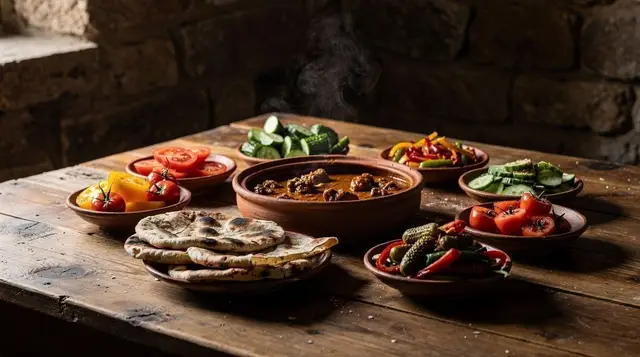
Wine here is usually drunk alongside the region’s food rather than as a separate ritual, and the local menu gives it plenty to work with. Testi kebab — meat and vegetables slow-cooked in a sealed clay pot, cracked open at the table — is the dish most associated with the region and pairs reasonably with a local red. Lighter dishes such as mantı (Turkish dumplings), gözleme and pide sit well with Emir or another local white. For a broader look at what’s on offer beyond wine specifically, the Cappadocian food guide and the guide to where to eat in Ürgüp cover restaurants and dishes in more detail.
Tea (çay) and Turkish coffee remain the region’s everyday drinks by far — wine is very much the occasional choice, not the default, which is part of why its scale stays modest. The guide to Turkish tea and coffee culture covers that side of things if it’s of interest.
Beyond Ürgüp
Wine growing isn’t confined strictly to Ürgüp — vines are grown more widely across the villages of the plateau, including around Nevşehir and towards Avanos — but Ürgüp remains where the cellars, tasting rooms and commercial production are concentrated, and where a visitor is most likely to encounter the industry directly rather than incidentally. Mustafapaşa, a short drive from Ürgüp with its own well-preserved stone architecture, is sometimes combined with a wine stop on the same half-day out; see the Mustafapaşa (Sinasos) guide for that side of things.
If your interest runs more towards how the volcanic landscape itself formed — the eruptions that eventually gave the soil its character — the guide to the volcanoes that made Cappadocia covers Erciyes and Hasan Dağı in more depth.
More organised ways to see the wider region
a guided tour of the underground cities
For travellers building a longer, unhurried stay that has room for a cellar visit without rushing it, see the slow five-day itinerary, which spreads out the region’s sights rather than compressing everything into back-to-back tour days.
Cappadocian wine FAQ
Is Cappadocia known for wine?
Yes, in a modest way. Grapes have been grown on the volcanic plateau around Ürgüp for centuries, using varieties such as Emir and Kalecik Karası, but total output is small next to Turkey’s main wine regions on the Aegean coast.
What grape varieties grow in Cappadocia?
The white grape most associated with the region is Emir, a variety mostly grown in central Anatolia. Reds include Kalecik Karası, along with Öküzgözü and Boğazkere, which are grown more widely across Turkey but appear in Cappadocian blends and cellar lists too.
Why does Cappadocian wine taste different?
The vineyards sit on a volcanic plateau at around 1,000 metres, on soil built from the same tuff that forms the fairy chimneys. Altitude brings cooler nights and a longer ripening season, and the mineral content of volcanic soil is a recognisable feature of wines grown on it, in Cappadocia as in other volcanic regions worldwide.
Is Cappadocia a major wine-producing region?
No. It is a small, old wine-growing area, not a major exporter. Turkey’s larger and better-known wine regions are on the Aegean coast, around Izmir and further south; Cappadocia’s output serves mostly the domestic and tourist market.
Where is the best place to try Cappadocian wine?
Ürgüp, about 15 minutes from Göreme, is the historic centre of the region’s wine cellars, with several producers offering tastings. See our separate guide to the Ürgüp wine cellars for specific visits and what a tasting involves.
Can I visit vineyards in Cappadocia without a car?
Yes. Ürgüp is reachable by dolmuş from Göreme, and several half-day and full-day tours include a vineyard stop or a wine tasting as part of a wider itinerary, which is easier than arranging cellar visits independently without a car.
Is Cappadocian wine expensive?
Bottle prices vary widely by producer and label, and the Turkish lira has moved a great deal in recent years, so any fixed figure dates quickly. As a rule, wine bought directly from a cellar in Ürgüp costs less than the same or similar bottles on a restaurant list in Göreme.
Does Islam in Turkey affect the availability of wine?
Wine is legally produced and sold in Turkey, and it’s widely available in restaurants, hotels and shops in tourist areas like Cappadocia. Alcohol taxes are high, which affects prices more than availability.
Cappadocia food & drink tours on GetYourGuide
Verified deep-linked GetYourGuide tours. Book through these links and we earn a small commission at no cost to you.
GetYourGuide does not provide a product photo for this activity — the image shows the meeting point, photographed by us.