Sinasos before Mustafapaşa
The name on the road signs is Mustafapaşa, but the village has an older one that still shows up on hotel signs, in guidebooks and in conversation with anyone who’s lived there a while: Sinasos. Until 1923 this was a Greek-Orthodox village, and by the standards of rural Anatolia a wealthy one — money sent home by Sinasos merchants who had made their fortunes in Istanbul paid for stone houses that look more like something from the Aegean islands than from the rest of Cappadocia.
That ended with the population exchange of 1923, the compulsory swap of Orthodox Christians in Turkey for Muslims in Greece that followed the Greco-Turkish war. The Greek families of Sinasos left, most of them for good, and Muslim families arriving from Greece took over the empty houses. The village was renamed Mustafapaşa. A century on, the street plan and the stone are still recognisably Sinasos; the people living behind those facades are not the people who built them.
That history is the whole reason to come here. Mustafapaşa doesn’t have a fairy chimney valley, an underground city or a headline church. What it has is a built environment that tells a specific, dated story more directly than almost anywhere else in the region, and a scale — a few streets, walkable in an afternoon — that makes it easy to actually take in rather than tick off.
Stone houses that look like nowhere else in Cappadocia
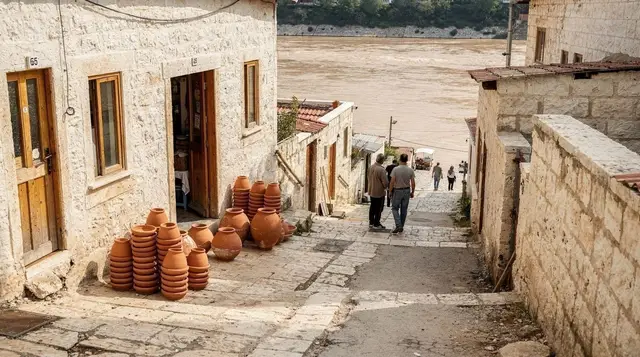
Most Cappadocian villages are carved: rooms hollowed straight out of the tuff, with plain openings and little applied decoration, because that was cheap, practical and matched to the rock. Sinasos was built differently. Its merchants weren’t just carving into a hillside, they were commissioning houses, and the results show it — dressed stone facades with carved relief work around doors and windows, symmetrical elevations, and neoclassical touches (pediments, pilasters, decorative cornices) borrowed from the grander architecture its patrons had seen in Istanbul and further afield.
Walk the older streets and you’ll notice details that don’t appear in Göreme or Uçhisar at all: carved rosettes and grapevine motifs over doorways, dated lintels, courtyard houses arranged around an internal space rather than opening straight onto the street. Some facades carry Greek inscriptions, faint but still legible. None of this is roped off or labelled for visitors — it’s simply the fabric of the village, which is part of what makes it worth the detour rather than a curiosity to photograph and leave.
The contrast is sharpest if you’ve already seen, or go on to see, the villages nearby that weren’t part of this Greek merchant network. Ayvalı and Cemil, both a short drive away, are built in the plainer local vernacular — carved or roughly built, functional, without the imported decorative language. Seeing Mustafapaşa alongside either makes the point better than any description does: this is a different architectural tradition sitting in the middle of the same volcanic landscape, not a variation on it.
The churches that stayed empty
A Greek-Orthodox village needed churches, and Sinasos had several, built or enlarged with the same merchant money that paid for the houses. With the community gone in 1923, the churches lost their congregations overnight. Some were repurposed — as storage, as workshops — and some were simply left. A few have been restored enough to visit, with frescoed interiors that show the same craftsmanship as the house facades outside, painted rather than carved. Ottoman-Greek civil buildings from the same period, including a school building associated with the village’s Greek community, sit alongside them, part of the same abandoned public life.
None of this is presented as a formal museum circuit with fixed hours and a single ticket. It’s a scattered set of buildings you find by walking, some open, some not, some clearly signed and others requiring a bit of asking around. That’s very different from the choreographed experience of the Göreme Open Air Museum, and it’s worth setting expectations accordingly — this is a village to wander, not a site to queue for.
Getting here from Ürgüp and Göreme
Mustafapaşa sits well under 15 minutes from Ürgüp and about 20 minutes from Göreme, which makes it a straightforward half-day addition for anyone staying in either base. From Ürgüp specifically, it’s close enough that a taxi there and back, with an hour or two to wander in between, is a reasonable and inexpensive plan without booking anything ahead. Dolmuş minibuses run between Ürgüp and the surrounding villages during the day, though services thin out by early evening, so it’s not the place to plan a late return without your own transport.
From Göreme, most visitors either drive, take a taxi, or see Mustafapaşa as part of a tour that also covers Soğanlı valley or the villages further south. It also sits close to Ortahisar and the wine-producing land around Ürgüp, so it’s easy to combine into a loop that takes in a village, a viewpoint and a cellar without much backtracking.
| From | Distance / time | Typical way to get there |
|---|---|---|
| Ürgüp | Well under 15 minutes | Taxi, dolmuş, or a short drive |
| Göreme | About 20 minutes | Car, taxi, or organised tour |
| Ortahisar | A few minutes further than from Ürgüp | Car or taxi |
| Ayvalı / Cemil | A short additional drive | Car or taxi, easily combined |
Seeing Mustafapaşa on the Blue Tour
Cappadocia’s day tours are sold by colour, and Mustafapaşa’s slot is the Blue Tour, which runs south-east of Göreme and typically also covers Soğanlı valley and the Keslik monastery. It’s worth knowing this mainly because the Blue Tour is the least booked of the three, well behind the Red Tour’s fairy chimneys and the Green Tour’s Ihlara valley and underground cities. If a quieter tour bus matters to you more than ticking off the best-known sights, the Blue Tour — and Mustafapaşa specifically — is where that trade-off pays off.
Independent travellers don’t need the tour to reach the village, but a guided option is a reasonable choice if you’d rather have the history explained on the spot than piece it together from signage that’s often minimal.
a Blue Tour that pairs the villages with Mazı underground city covers Mustafapaşa alongside a less-visited underground site, which suits anyone who’s already done Derinkuyu or Kaymaklı and wants a quieter alternative. For a route built specifically around villages rather than a single headline stop, a guided tour through Cappadocia’s hidden valleys and villages takes in Mustafapaşa as one stop among several. And if you’d rather set your own pace and skip the group entirely, a private Cappadocia tour can be built around Mustafapaşa, Ürgüp’s wine cellars and Ortahisar in a single half day.
What a visit actually looks like today
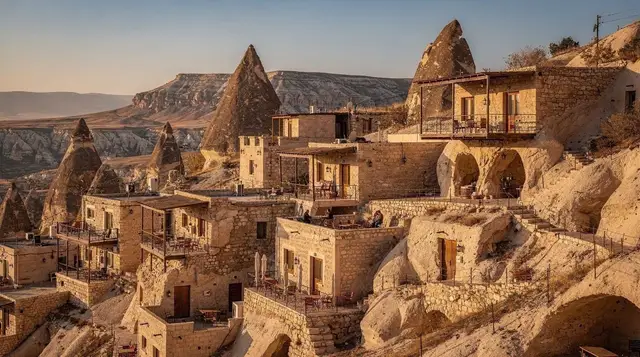
It’s worth being honest about what Mustafapaşa is and isn’t. It is not a preserved-in-amber heritage village kept as a museum piece; it’s a working, modest settlement where people live ordinary lives inside houses with a remarkable history. Streets are unpaved in places, some buildings are in poor repair, and there’s no single ticketed entrance or curated route. A handful of the finest houses have become boutique cave-and-stone hotels or cafés, which is the easiest way to see an interior without intruding on anyone’s home, but most of the village is simply lived in.
That’s not a criticism — it’s the reason the place feels real rather than staged, and it’s the same texture you’ll find in Ayvalı, Cemil and Taşkınpaşa further along the same back roads. Come expecting a quiet walk through a village with an unusual past, not a polished attraction, and it delivers. Come expecting restored facades and interpretive panels at every corner, and you’ll be disappointed.
A sensible half day looks like: arrive mid-morning, walk the older quarter and its main square, look into whichever churches happen to be open, stop for tea or lunch, then either continue on to Ortahisar or one of the Ürgüp wine cellars before heading back to base. There’s no need to rush it, and there’s equally no need to allocate a full day — two to three hours on the ground is realistic for most visitors.
Where to eat and what to buy
Mustafapaşa has a small number of cafés and restaurants, several set in converted stone houses with a courtyard, which is as good a way as any to sit inside the architecture rather than just look at it from the street. Expect simple, well-priced Turkish food rather than a food destination in its own right — this isn’t where you’ll find Cappadocia’s best restaurant, but a coffee or a plate of gözleme in a 19th-century courtyard is a pleasant enough reason to slow down.
For a proper meal, most visitors are better served back in Ürgüp, which has a far wider choice and is close enough to make the round trip painless. If wine is on the agenda, the cellars around Ürgüp are a natural add-on to a Mustafapaşa morning, since the village sits right in the middle of one of Cappadocia’s older wine-producing areas.
There’s little in the way of dedicated souvenir shopping here, which, again, is part of the appeal — you’re less likely to be steered into a carpet showroom than in busier villages, though it’s not entirely absent either.
Mustafapaşa and the Sinasos exchange: your questions answered
Why is Mustafapaşa also called Sinasos?
Sinasos was the village’s Greek name and its population was Greek Orthodox until the 1923 population exchange between Greece and Turkey, when the community left and was replaced by Muslim families arriving from Greece. The Turkish name Mustafapaşa came afterwards; older maps, books and some locals still use Sinasos.
What makes Mustafapaşa’s architecture different from other Cappadocian villages?
Sinasos was a prosperous merchant community, and its houses were built rather than carved: dressed limestone facades with relief carving, arched doorways and neoclassical details borrowed from Istanbul and the Greek islands. Villages like Ayvalı and Cemil, only a short drive away, are built in the plainer, rougher local vernacular, which makes the contrast obvious once you’ve seen both.
How far is Mustafapaşa from Ürgüp and Göreme?
It’s a short hop from Ürgüp, well under 15 minutes by road, and about 20 minutes from Göreme. Anyone staying in Ürgüp can treat it as a half-day outing without organising transport in advance; from Göreme it’s easiest by taxi, rental car or an organised tour.
Is Mustafapaşa included in an organised tour?
It’s the main stop on the locally sold Blue Tour, alongside Soğanlı valley and the Keslik monastery, and it’s the quietest of the three colour-coded tours. It also turns up on some private and small-group itineraries built around villages and valleys rather than the standard Red or Green Tour stops.
How much time should I set aside for Mustafapaşa?
Two to three hours covers the old quarter, the main churches and a coffee or lunch stop. It’s not a site with a ticket booth and a fixed route, so the visit is really a walk, and it’s easy to compress it into a stop on a longer day rather than a destination in itself.
Are the old Greek houses open to visitors?
A handful have been converted into boutique hotels, cafés or a small museum-style courtyard you can step into; most are private homes and stay closed, which is exactly why the streets still feel lived-in rather than staged. Look at the facades from the street and don’t assume an open door is an invitation.
Is Mustafapaşa touristy?
No. It gets a fraction of the visitors that Göreme or Ürgüp see, partly because it has no headline sight and partly because it’s the Blue Tour village rather than the Red or Green Tour one. On most days you’ll share the streets with residents going about the day more than with other travellers.
When is the best time to visit?
Spring and autumn give the most comfortable walking weather and the best light on the carved stone. Summer afternoons get hot with little shade between buildings; winter is quiet and cold but the churches and streets are unaffected, so it stays a reasonable option if that’s when you’re in Cappadocia.