Walking Mustafapaşa: old Sinasos on foot
How long does it take to walk around Mustafapaşa (Sinasos)?
Allow 1.5 to 2 hours to cover the old streets and stone mansions of Mustafapaşa at an easy pace, longer if you stop for tea or step inside one of the former Greek churches. The village sits about 20 minutes from Ürgüp and moves at a noticeably slower pace than Göreme or Ürgüp's centre.
Most people who visit Mustafapaşa come for an hour, tick off the square and one church, and drive back to Ürgüp for lunch. That’s a shame, because the reason to come here isn’t a single monument — it’s the walk itself. Mustafapaşa is a village built almost entirely by one community, Greek Orthodox stonemasons and merchants, in the decades before they were forced to leave in 1923, and its streets still read as a single, coherent piece of building rather than a patchwork of eras. This guide covers the walk on foot: the streets worth taking, what the carved houses tell you, and how the pace here compares to Göreme and Ürgüp.
A village built by people who left
Mustafapaşa was called Sinasos, and until 1923 it was a Greek Orthodox village whose wealth came from outside it. Sinasiot men worked as merchants and craftsmen in Istanbul and further afield, and a good number of them sent their earnings home to build stone mansions, churches, and a school. That money is the reason the village looks the way it does: carved façades with a level of detail you don’t find in most Cappadocian villages, built by families who had the means and the taste to commission proper stonework rather than a functional cave house.
That building period ended abruptly. Under the Greek-Turkish population exchange of 1923, Sinasos’s Greek Orthodox residents were resettled to Greece, and Muslim families from the Balkans were moved in. The village was renamed Mustafapaşa. Its Greek churches were emptied and, in some cases, repurposed; the mansions passed to new owners who used them as ordinary homes rather than showpieces. Nobody grew the village much after that, which is precisely why the streetscape still looks like it did around a century ago — nobody had the money, or the inclination, to knock the old stone down and build something bigger.
That history matters for the walk because it explains what you’re looking at on every street: not a museum reconstruction, but the actual houses of a community that left in a single year and was never fully replaced.
Getting there from Ürgüp
Mustafapaşa sits about 6 km south of Ürgüp, roughly a 15 to 20-minute drive or dolmuş ride, and it’s an easy stop to combine with a morning or afternoon in Ürgüp itself. From Göreme, add another 15 minutes or so on top of that. There’s no train or fixed rail link in the region — everything here runs by road — and dolmuş services between Ürgüp and Mustafapaşa run through the day but thin out by early evening, so plan to be back on a service, or have a taxi arranged, before dusk if you’re not driving yourself.
Parking in the village is informal and easy to find near the main square; this isn’t a site with ticket gates or a car park fee, and you can simply walk in from wherever you leave the car.
The walk: from the square to the hilltop churches
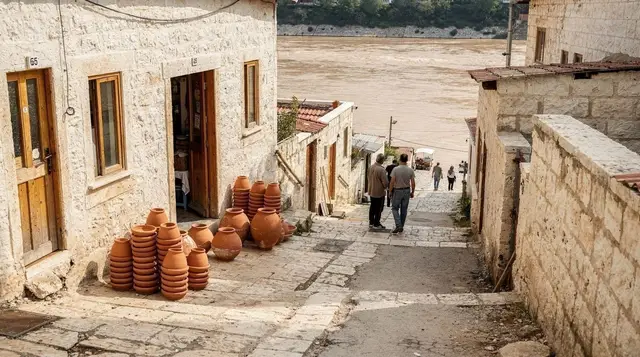
Start in the small central square, which is really just a widening of the main street where a couple of cafés put out tables. From here, the walk has no fixed route — that’s part of the appeal. Head uphill along the main street first, and you’ll pass the bulk of the carved mansion façades: doorways framed with rope-twist and rosette motifs, upper-floor windows with stone lintels, the occasional coat of arms or Greek inscription left over a doorway. Most of these buildings are private homes now, so the detail worth stopping for is the façade itself, not the interior.
A short climb takes you up to Aios Vasilios (Saint Basil), a rock-cut church carved into the hillside above the village, with faded frescoes and a plain, worn interior — modest compared with the painted churches of the Göreme valleys, but worth the climb for the view back over the rooftops as much as the church itself. A second, larger church, sometimes shown as a converted monastery building, sits closer to the main street and is easier to find; check locally whether it’s open, since hours here are informal and can change.
From the churches, loop back down through the side streets rather than retracing the main road. This is where the walk earns its name: narrow lanes, stone steps, cats sleeping in doorways, and far fewer other visitors than the main street sees. Give yourself permission to double back on a dead end — several streets here don’t connect through, and that’s normal rather than a sign you’ve gone wrong.
The whole loop, main street plus a churches plus side streets, covers maybe 2 to 3 km on foot, almost all of it flat to gently sloped, with a short climb to the hilltop church being the one real exertion.
Why it feels slower than Göreme or Ürgüp
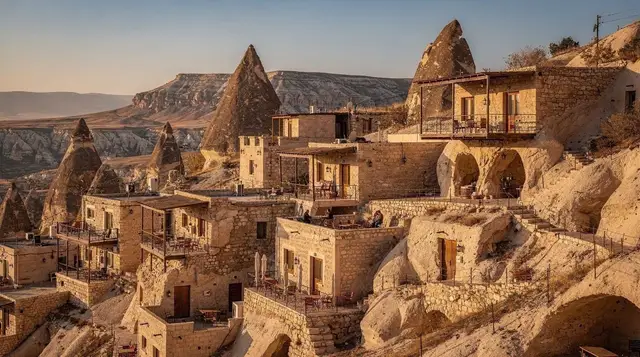
The comparison with Göreme and Ürgüp is worth being specific about, because “quieter” undersells the difference. Göreme’s centre is built around tour buses, balloon pickups, and a steady flow of foot traffic between the open-air museum and the town; Ürgüp has grown into the region’s most complete small town, with a wider spread of restaurants, hotels, and a proper commercial street. Mustafapaşa has almost none of that infrastructure. There are a few cafés and a handful of boutique cave hotels converted from old mansions, and that’s about it — no strip of souvenir shops, no queue for anything.
The practical effect is that you can walk here without being funnelled along a single route or competing for space at a viewpoint. It also means the village runs on a shorter clock: most cafés close earlier than their Ürgüp equivalents, and there’s very little to do here after dark. Treat Mustafapaşa as a daytime walk, not a base for an evening out.
What else the walk turns up
A few details worth watching for as you go: door lintels carved with dates, several from the 1870s to 1900s, which mark the peak of Sinasos’s building boom; the occasional Greek lettering left uncovered above a doorway; and courtyards, visible through open gates, that show the same carved stonework the street façades do, since Sinasiot builders decorated the parts of the house meant to be seen by family and guests, not only the parts facing the road.
If a mansion has been converted into a small hotel, its courtyard is often visible from the street and worth a glance even if you’re not staying there — it’s usually the best-preserved example of what a wealthy Sinasiot household looked like, since these are the buildings that have had money spent on their upkeep rather than being left to a private family’s budget.
Eating and stopping
Mustafapaşa’s food options are limited by design — this is a village of a few hundred people, not a resort town. The square has a couple of cafés serving tea, coffee, and simple snacks, which is the right register for a stop here: a glass of çay on a shaded terrace rather than a sit-down meal. For lunch or dinner with more choice, most visitors head back to Ürgüp, which has the region’s better restaurant scene by some distance. If you want to understand the tea-drinking side of things a bit better before you go, it’s worth a quick look at how Turkish tea and coffee culture actually works here, since ordering and paying etiquette differs from a standard café.
Doing it as part of a longer day
Mustafapaşa pairs naturally with a morning or afternoon in Ürgüp, or as one stop on a longer loop through the villages south and east of Göreme. It works well folded into a three-day Cappadocia trip rather than treated as its own half-day, and if you’re mapping out where it fits, our three-day itinerary gives a sense of how a village stop like this slots between the bigger sights.
If you’d rather not drive yourself and want the history explained on the spot, a guided village tour covers this alongside a couple of the other quieter stops in the region:
a small-group tour through Cappadocia’s hidden valleys and villages, which typically covers ground like this rather than the headline sights.
Most visitors, though, see Mustafapaşa as a stand-alone stop from a Red or Green Tour day, or as an extra on a day already built around Ürgüp. If you’re choosing between the region’s set-piece day tours, a combined Red and Green Tour with an English-speaking guide covers the underground cities and valleys that Mustafapaşa’s own walk doesn’t touch, and is worth booking for a separate day rather than trying to combine it with the village.
For a slower, more physical alternative to a bus tour, a guided sunset hiking tour through the valleys gives you the kind of pace this village rewards, just applied to a rock-cut valley rather than a street plan.
Practical notes
- Distance from Ürgüp: about 6 km, 15-20 minutes by car or dolmuş.
- Distance from Göreme: roughly 20 minutes.
- Time needed: 1.5 to 2 hours for the core walk; add 30 minutes for tea or a longer look inside a church.
- Cost: the village itself is free to walk; individual churches sometimes charge a small entry fee, paid on the spot.
- Best time of day: late morning to mid-afternoon, when the churches are more likely to be open; the village has little shade, so summer visits are more comfortable earlier rather than at midday.
- Terrain: mostly flat cobbled and paved streets, one short uphill stretch to the hilltop church; manageable for most fitness levels, though the cobbles and stone steps make it harder going for anyone using a wheelchair or with limited mobility — see our notes on accessibility across the region before planning around it.
- What to bring: comfortable flat shoes for cobbles, water, and cash for tea and any church entry fees, since card readers are inconsistent in a village this small.
Timing your visit to the wider region also matters. If you’re building a trip around when the weather and crowds work best, our guide to the best time to visit Cappadocia covers how the seasons shift here, and our packing list has the shoe and layering advice that applies just as much to a village walk like this as it does to the valleys.
One last comparison worth making: nearby villages like Ayvalı, Cemil, and Taşkınpaşa each have their own stone-built character and their own separate write-ups on this site — Mustafapaşa isn’t a stand-in for them, and this walk sticks to what’s inside the village itself rather than trying to cover the wider Ürgüp countryside in one page. If Mustafapaşa’s pace suits you, those are worth a look on a different day. For wine after a day of walking, Ürgüp’s wine cellars are the closest proper stop, about 20 minutes back the way you came.
Frequently asked questions about walking Mustafapaşa (Sinasos)
How long does it take to walk around Mustafapaşa (Sinasos)?
Budget 1.5 to 2 hours for the core streets and the two main churches. Add 30 minutes if you sit down for tea in the square or want to look inside a converted mansion. There’s no set route to follow, so the walk stretches or shrinks depending on how many side streets you take.
How far is Mustafapaşa from Ürgüp?
About 6 km, roughly 20 minutes by car or dolmuş, and closer to 10-15 minutes on a quiet road. It’s an easy half-day add-on to a base in Ürgüp, and workable as a longer stop from Göreme, around 20 minutes further.
What was Sinasos before 1923?
Sinasos was a prosperous Greek Orthodox village, its wealth built on stonemasons and merchants who worked as far as Istanbul and sent money home to build churches and carved mansions. The population left under the 1923 Greek-Turkish population exchange, and the village was resettled and renamed Mustafapaşa.
Are the old Greek houses open to the public?
A handful have been converted into boutique hotels and can be seen from their courtyards if you’re a guest or ask politely at the door; most are private homes and stay closed. The carved façades are the part you can see freely from the street, which is where most of the detail is anyway.
Is Mustafapaşa busier or quieter than Göreme?
Quieter, consistently. Göreme’s centre and open-air museum draw coach traffic through the day; Mustafapaşa gets a fraction of that, mostly cars and small guided groups, and its streets rarely feel crowded even at midday.
Do I need a guide to visit Mustafapaşa?
No. The village is small enough to walk on your own with a map, and the main sights, the two churches and the mansion façades, are on view from the street. A guide adds background on the Greek Orthodox history that isn’t posted anywhere on site, which is the main reason to book one.
Is Mustafapaşa worth visiting if I’ve already seen Ürgüp?
Yes, they’re different villages. Ürgüp has more of everything, restaurants, hotels, wine cellars, traffic; Mustafapaşa has fewer of all of it and a more uniform 19th-century streetscape, because it wasn’t rebuilt and expanded the way Ürgüp was.
What should I eat or drink while I’m there?
A handful of cafés around the square serve Turkish tea and simple food; it’s a good stop for çay rather than a full meal. For a proper lunch or dinner, most visitors head back to Ürgüp, which has a much wider choice of restaurants.
City sightseeing tours on GetYourGuide
Verified deep-linked GetYourGuide tours. Book through these links and we earn a small commission at no cost to you.
GetYourGuide does not provide a product photo for this activity — the image shows the meeting point, photographed by us.