What Ayvalı actually is
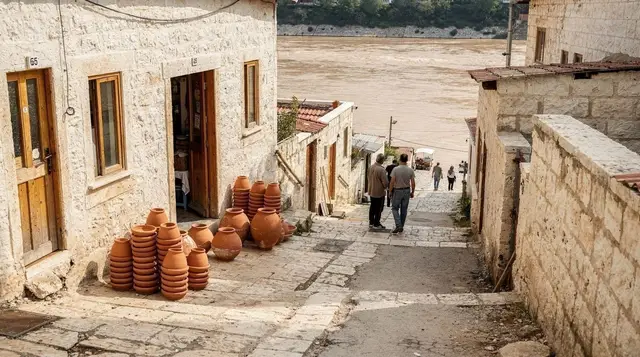
Ayvalı is a small farming village a short drive south-east of Ürgüp, in the same rural pocket as Cemil and Taşkınpaşa. It has no open-air museum, no fairy chimney valley marked on a tour map, and no ticket booth. What it has is orchards, vineyards, stone houses built into the hillside, and residents going about ordinary work — pruning vines, tending fruit trees, moving between houses on foot. If you are looking for a checklist of things to see, Ayvalı will disappoint. If you have already spent a few days in Cappadocia and want to see what the region looks like away from a coach park, it is a reasonable half-morning.
This page is aimed specifically at that second visitor: someone on a second Cappadocia trip, or well into a longer first one, who has already done Göreme’s open-air museum, an underground city and a valley walk, and wants something quieter rather than something bigger. It is not written for someone with two or three days trying to hit the essentials — for that itinerary, see Cappadocia in two days or Cappadocia in three days, neither of which needs to include Ayvalı.
Where it sits, and how it compares to Ürgüp and Cemil
Ayvalı belongs to the same rural belt as Ürgüp, Ortahisar and Cemil, a few kilometres south-east of central Ürgüp. Ürgüp is the market town of the area: it has restaurants, wine cellars, a Thursday market and enough infrastructure that most visitors base a night or two there. Cemil is smaller and quieter than Ürgüp but still has a handful of rock-cut churches worth a stop. Ayvalı sits a further step down in scale — it is a working village first, and whatever a visitor sees is incidental to that, not built for the visit.
The comparison matters because it sets expectations correctly. Ürgüp gives you infrastructure and a proper meal. Cemil gives you a short, specific sight — its churches — worth twenty or thirty minutes. Ayvalı gives you neither a meal you can count on nor a specific sight; it gives you a walk through a place that has not been organised for tourism, which is exactly why some visitors value it and most should skip it.
| Village | What it offers | Time needed | Tourist infrastructure |
|---|---|---|---|
| Ürgüp | Market town, restaurants, wine cellars, hotels | Half day to overnight | Developed |
| Cemil | Rock-cut churches, quiet streets | 30–45 minutes | Minimal |
| Ayvalı | Working village, orchards, stone houses | 1–2 hours on foot | Essentially none |
| Mustafapaşa | Greek-era architecture, a few restaurants | 1–2 hours | Light |
Getting there from Göreme
Ayvalı is roughly 20–25 minutes from Göreme by car, via Ürgüp. There is no dolmuş running directly into the village, which is one of the clearest signals of how little tourist traffic it sees — Göreme, Ürgüp, Ortahisar, Avanos and Nevşehir all have regular dolmuş connections between them, and Ayvalı is not on that network. Practical options are:
- Rental car: the simplest route, and it lets you combine Ayvalı with Cemil and Taşkınpaşa in one loop without waiting on anyone. See car rental in Cappadocia and driving in Cappadocia for what to expect on unmarked rural roads.
- Taxi from Ürgüp: agree a return time with the driver, since there is nowhere reliable to call one from once you’re in the village.
- A private tour with flexible stops: an Cappadocia private tour can be built around off-circuit villages like Ayvalı if you specify it in advance, since it sits outside the fixed Red, Green and Blue Tour routes described in the red tour, green tour, blue tour guide. A driver arranged through a private Cappadocia sightseeing experience works the same way, at a different price point.
Nobody sells a group tour that stops in Ayvalı specifically. If you’re relying on organised tours for the rest of your trip, this village is simply not going to appear on any of them, which is the honest reason most visitors never see it.
What there is to see and do
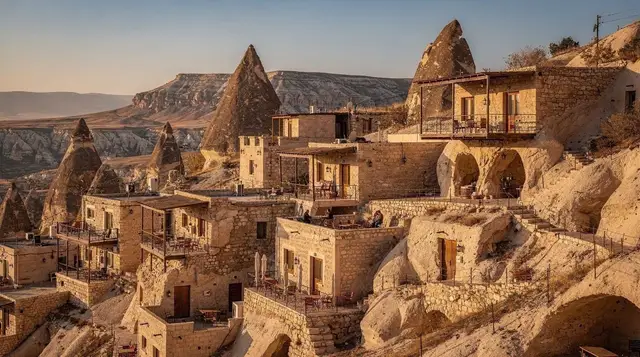
There is no single sight to aim for. The point of Ayvalı is walking its lanes: stone houses stacked up a gentle hillside, courtyards with vines trained over them, orchards of apricot and apple depending on the season, and the ordinary rhythm of a village where farming, not tourism, is still the main activity. Some older houses use rock-cut storage spaces in the same tuff that produced the fairy chimneys elsewhere in the region, though nothing here is presented or lit for visitors the way, say, Uçhisar castle or the Göreme open-air museum are.
Spring brings blossom in the orchards; late summer and early autumn bring harvest, with fruit and grapes being picked and moved. Neither is staged for photographs — you are watching people work, not a display. Wine growing is part of the wider area’s identity, and nearby Ürgüp’s wine cellars are the place to actually taste something, not Ayvalı itself.
Realistically, budget one to two hours of walking. There is no marked route and no map to follow; you go where the lanes take you, and the village is small enough that getting properly lost is not really possible. This is not a hike, and it should not be confused with the marked trails covered in best hikes in Cappadocia — it’s a slow, low-effort walk on quiet roads.
Eating and staying — the honest picture
Ayvalı has little to no dedicated tourist food. What exists is inconsistent, seasonal, and not something to plan a meal around. If a small place happens to be open, treat it as a bonus, not a destination. The sensible approach is to eat before or after in Ürgüp, which has a proper range of restaurants covered in where to eat in Ürgüp, or in Mustafapaşa, which has a small but real selection.
The same applies to accommodation: there is no meaningful hotel infrastructure in Ayvalı, cave-style or otherwise. Base yourself in Göreme, Ürgüp or Uçhisar and visit Ayvalı as a half-morning excursion. For a comparison of where to actually stay, see where to stay in Cappadocia and Göreme versus Ürgüp.
Do not arrive expecting a café with a view or a lunch spot with a menu in English. That expectation belongs in Göreme or Ürgüp, both of which have built genuine tourist infrastructure over the past two decades; Ayvalı has not, and that absence is a large part of what makes it feel different from the rest of the region.
Who should bother coming, and who shouldn’t
Come if you have already done the region’s headline sights — the balloon flight, the open-air museum, one underground city, a valley walk — and you’re curious what an ordinary Cappadocian village looks like when nobody has built a visitor centre in it. Come if you have a car and are already routing through Ürgüp and Cemil, since the detour costs very little extra time. Come if you’d rather watch a village go about its day than tick off another attraction.
Skip it if this is your first trip and you have two or three days total — that time is much better used on the sights covered in Cappadocia in one day or the itineraries above. Skip it if you don’t have a car, taxi or flexible private driver, since there’s no dolmuş to rely on. Skip it if you’re travelling with people who need a defined activity or a place to sit down and eat — Ayvalı offers neither reliably.
Combining Ayvalı with Ürgüp, Cemil and Mustafapaşa
The most sensible way to see Ayvalı is as one stop in a half-day loop through the rural south-east of the Ürgüp area, rather than a dedicated trip on its own:
- Start in Ürgüp — its centre, market streets and a wine cellar visit if timing allows.
- Drive to Cemil (roughly ten minutes) for its rock-cut churches, a 30–45 minute stop.
- Continue to Ayvalı for an hour or two on foot.
- Finish in Mustafapaşa, formerly Sinasos, for its Greek-era stone architecture — see the Mustafapaşa and Sinasos guide — and a proper meal.
This loop suits a self-drive day or a private driver, and it fits comfortably into an afternoon. It does not fit into a standard Red, Green or Blue Tour day, since those routes are fixed and don’t detour into villages like Ayvalı. For visitors without their own transport who still want this kind of slower day, seeing Cappadocia without a tour covers the taxi and dolmuş logistics involved.
If you’d rather spend the morning in the air than on foot, the region’s balloon flights launch from valleys within this same broad area at sunrise; a deluxe Cappadocia balloon flight followed by an afternoon loop through Ürgüp, Cemil and Ayvalı makes a full and honestly varied day, mixing the region’s most staged experience with one of its least.
Practical notes
Bring water and wear normal walking shoes — nothing technical is needed, but village lanes are unpaved in places and can be dusty in summer or muddy after rain. There is no shade to speak of once you’re between orchards. Mobile signal is generally fine since Ayvalı is not remote in the way Soğanlı or the Ihlara valley floor can be, but don’t count on finding an open shop for water once you’re there — bring what you need from Ürgüp.
Respect that this is someone’s working village, not an attraction: keep to public lanes, don’t wander into private courtyards or orchards, and don’t expect anyone to stop what they’re doing for a photograph. A short, polite greeting goes further here than in a place used to daily visitor traffic.
If hiking is more the point of your day than village-watching, a guided full day hiking tour in the national park covers proper marked trails through Cappadocia’s valleys, which is a different and more structured experience than the loose walk Ayvalı offers.
Frequently asked questions about visiting Ayvalı
Is Ayvalı worth visiting if I only have a few days in Cappadocia?
Probably not. With two or three days, time is better spent at the Göreme open-air museum, one underground city and a valley walk. Ayvalı rewards someone who has already seen those and wants a slower, unstaged stop, not a first-timer’s shortlist.
What is there actually to do in Ayvalı?
Walking the lanes between stone houses, watching orchard and vineyard work depending on the season, and seeing a village that functions without being arranged for visitors. There is no monument, museum or paid site.
Are there restaurants or cafés in Ayvalı?
Very few, and none guaranteed to be open. Eat in Ürgüp or Cemil before or after, and treat any tea offered in Ayvalı as village hospitality rather than a service to expect.
How do I get to Ayvalı without a car?
There is no direct dolmuş service. The practical options are a taxi from Ürgüp, a rental car, or a private tour that can build in a short stop, since Ayvalı sits off the fixed Red, Green and Blue Tour routes.
Can I combine Ayvalı with Ürgüp and Cemil in one outing?
Yes, and this is the sensible way to see it. The three sit within about ten to fifteen minutes of each other, so a half-day loop covering Ürgüp’s centre, Cemil’s churches and a walk through Ayvalı works well with a car or taxi.
Is Ayvalı a photogenic place?
It photographs well in an ordinary way: stone facades, vine-covered courtyards, working orchards. It has none of the dramatic rock formations that make other parts of Cappadocia photogenic, and it is not set up with viewpoints or signage for visitors.
Does Ayvalı have any connection to Cappadocia’s rock-cut heritage?
Some older houses and storage spaces are cut into the local tuff in the same way as elsewhere in the region, but Ayvalı has no equivalent to the churches of Cemil or the open-air museum. Its interest is the living village, not carved monuments.