A village, not a sight
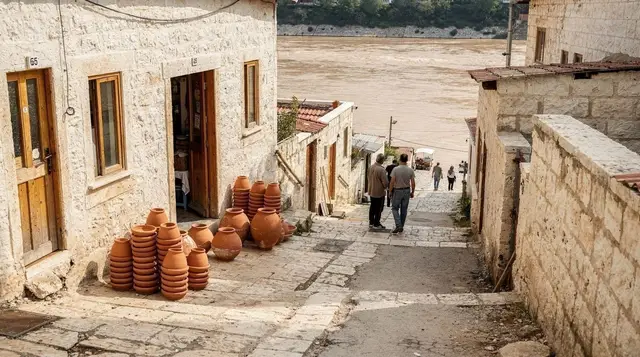
Cemil sits in the farmland south-east of Ürgüp, one of a handful of small settlements — along with Ayvalı and Taşkınpaşa — that dot the back roads between the tourist circuit and the Soğanlı valley. It has no open-air museum, no fairy chimney formation with a name, no ticket booth and no dedicated car park. What it has is stone houses built the way this region has always built them, working orchards and vineyards, and the kind of unhurried village life that the more visited towns lost once the tour buses started arriving.
That’s worth being clear about from the start, because Cemil gets mentioned on a lot of “hidden gem” lists that oversell it. It isn’t a hidden version of the Göreme open-air museum, and it doesn’t hold a landmark building the way Mustafapaşa does with its carved stone houses and Greek Orthodox churches. It’s an ordinary village. If you come expecting a specific thing to see, you’ll be disappointed. If you come because you’re already driving through the Ürgüp countryside and want a genuine, unpolished look at how people here actually live and farm, it does that well.
Where Cemil fits into a Cappadocia trip
Cemil isn’t a stop most itineraries need. None of the organised colour-coded circuits — Red, Green or Blue — routes through it, and it doesn’t appear on the standard day-trip lists alongside Derinkuyu or the Ihlara valley. It exists as an option for people who have their own car and a spare hour, usually on the same day they’re visiting Mustafapaşa, Taşkınpaşa or the Ürgüp wine cellars.
If your trip is built entirely around the tour buses out of Göreme, you can skip Cemil without missing anything essential — see our note on where the itinerary mistakes usually happen if you’re trying to prioritise a short trip. If you’re the type who prefers seeing Cappadocia without a tour, rents a car, and likes filling gaps between the big sites with unscripted stops, Cemil is a reasonable choice for one of those gaps.
Getting there from Göreme
There’s no dolmuş service to Cemil and no organised tour includes it as a stop, so a private car — your own rental or a driver — is the only realistic way to get there. From Göreme it’s roughly 20 to 25 minutes, most of it along the main road through Ürgüp before turning off onto smaller village roads. Signposting on the back roads is inconsistent, so download an offline map before you set out; mobile coverage thins out once you’re off the main routes.
If you’re renting a car for the trip, our guide to car rental in Cappadocia and the notes on driving in Cappadocia cover what to expect on roads like this one — mostly quiet, occasionally narrow through village centres, and shared with tractors and livestock more than traffic. There’s nowhere to park with signage or a dedicated area; you leave the car on the roadside near the village centre, as locals do.
What you’ll actually find
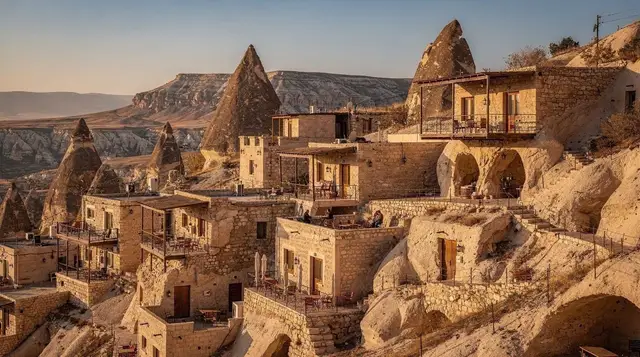
Cemil’s houses are built from the same soft volcanic stone as everywhere else in the region, cut into blocks rather than carved directly into cliff faces the way many Göreme and Uçhisar homes are. Some are still lived in and maintained; others are empty, roofs partly collapsed, doors left open to the weather. Walking the lanes between them is the main activity — there’s no marked route, no interpretive signage, and no fee.
Around the village, orchards and small vineyards climb the low hillsides. This is the same wine country that supplies the cellars around Ürgüp, and outside the summer months you’ll likely see people working the rows, pruning or harvesting depending on the season. It’s ordinary agricultural work, not staged for visitors, and that’s the honest appeal of the place: nobody here is performing “traditional village life” for a photograph. It’s just happening.
There is no café built for tourists, no gift shop, and no toilet block. If a resident is around and willing to chat, a smile and basic courtesy go further than English does — very little English is spoken here compared with Göreme or Ürgüp. Treat it as you would any small residential village you’re passing through: quiet, respectful, no wandering into private courtyards or through open doors.
How to walk the village without intruding
The best way to see Cemil is slowly and on foot, leaving the car at the edge of the village centre and following whichever lane looks interesting. Because nothing is signposted, the visit has no fixed order: you drift, you stop when a doorway, a wall or a view over the orchards catches your eye, and you move on. Photographers will find that the stone changes colour with the angle of the sun, which is why the hours of a spring or autumn morning suit the place better than a hard midday glare.
Keep your photography to the lanes and the outsides of buildings. A house that looks abandoned may still belong to a family who return for the harvest, and a courtyard that looks open is still someone’s yard. If a villager greets you, answer with a greeting and a smile; that small exchange is often the most memorable part of a stop like this, and it costs nothing. Our notes on safety and scams in Cappadocia are mostly about tourist towns, but the general advice on common sense and courtesy applies just as well in a quiet village.
What to pair with the visit
Because Cemil asks so little of your day, it combines easily with something more substantial. A walk through a valley earlier in the morning, such as the Love Valley walk or a stretch of the Zemi Valley hike, leaves you well placed to spend an unhurried hour in the countryside afterwards. If you would rather spend the rest of the day on something with a definite payoff, Soğanlı valley is the natural next step, and our Soğanlı valley guide explains why it suits travellers who like quiet places. For a wider view of how a day outside the main circuit can be put together, see a slow day in Cappadocia and the Cappadocia without a car itinerary, which shows the alternative if you decide not to drive.
Cemil compared with Mustafapaşa
It’s worth being direct about the difference between Cemil and its better-known neighbour, because the two get lumped together in some trip-planning content. Mustafapaşa — the old Greek Orthodox village of Sinasos before the population exchange of 1923 — has an identifiable architectural heritage: carved stone façades, a handful of restored churches, boutique cave hotels, and restaurants set up for visitors. Our Mustafapaşa and Sinasos guide covers what’s actually there to see and why it holds up as a stop in its own right.
Cemil has none of that infrastructure and no equivalent architectural landmark. It’s a working village first, with old houses that are interesting to look at but not preserved, labelled or promoted as heritage. If you only have time for one of the two, Mustafapaşa is the one with something concrete to show you. Cemil is the one you add on afterwards if you’re still curious about the countryside and have the time.
Who Cemil suits — and who should skip it
Cemil works for a narrow set of travellers:
- People with a rental car who are already touring the Ürgüp-Mustafapaşa-Taşkınpaşa area and have 30 to 45 minutes spare
- Photographers who want stone architecture and rural landscapes without a crowd of other photographers in the frame
- Travellers who find the sanitised, tour-bus version of Cappadocia’s villages a bit hollow and want to see one that hasn’t been set up for them
- Repeat visitors who’ve already covered Göreme, Uçhisar and Ortahisar and are looking for something further off the standard list
It doesn’t work well for:
- First-time visitors with two or three days who haven’t yet covered the essential sites — Göreme’s open-air museum, an underground city, a valley walk — those come first
- Anyone without their own transport, since no bus or organised tour reaches the village
- Travellers expecting a specific attraction, view, or building to justify the trip out there
- Families with young children who need facilities nearby, since there’s nowhere to eat, rest or use a toilet in the village itself
Eating, sleeping and other practicalities
There’s nothing to plan around in Cemil on this front, and it’s worth saying plainly rather than stretching for something positive. No restaurants, no cafés set up for passing visitors, and no accommodation — no cave hotels, no guesthouses. If you’re building an overnight base for this part of the region, Ürgüp and Mustafapaşa both have a proper range of options; our guide to where to stay in Cappadocia breaks down how the main bases compare, including why some travellers pick Ürgüp specifically over Göreme for a quieter evening.
Bring water with you, use facilities before you leave Ürgüp, and don’t expect to buy anything beyond the occasional roadside fruit stall in season. This is entirely normal for a small Cappadocian farming village and shouldn’t be read as a mark against it — it simply means Cemil is a stop within a day, never the anchor of one.
Making a loop out of the Ürgüp countryside
Cemil earns its place best as one leg of a half-day loop rather than a destination on its own. A reasonable combination starting and ending in Ürgüp or Göreme: Ürgüp itself for a coffee and a walk through the old quarter, a short drive to Cemil for the village and the orchards, on to Taşkınpaşa for its own quiet stone buildings, then Mustafapaşa to finish with lunch and its churches. That whole loop, done unhurried with stops, runs to roughly half a day.
If wine is part of your interest, the Ürgüp wine cellars sit conveniently on the same side of town and pair naturally with this route, since Cemil’s own vineyards feed into the same regional production. None of this needs to be booked in advance — it’s a self-drive circuit, best approached with a rough plan and the flexibility to skip anything that isn’t holding your interest that day.
Booking a tour instead of driving yourself
Because no packaged tour stops in Cemil specifically, seeing it means either driving yourself or hiring a private guide who’s willing to route through it as part of a custom day. If you’d rather not self-drive but still want a flexible, off-the-standard-circuit day around Ürgüp and the surrounding villages, a private, customisable Cappadocia tour is the more realistic option — you can ask the driver to include Cemil, Taşkınpaşa and Mustafapaşa in the same run, something no fixed-departure tour will do.
A private Cappadocia sightseeing day works the same way and is worth comparing on price and inclusions before booking. If you’d rather stick to the established circuits and treat villages like Cemil as something for a future trip, the Blue Tour through Soğanlı and Kaymaklı covers the quieter southern sites that are actually set up for visitors, including an underground city and the Soğanlı valley’s rock-cut churches — a more efficient use of a single day than chasing an unmarked village.
Setting the right expectations
The kindest way to judge Cemil is to measure it against what it claims to be, which is nothing more than a village. Visitors who arrive with no agenda tend to enjoy it; visitors who arrive with a checklist tend to feel they have driven out for very little. Think of it as a pause between larger stops, a chance to step out of the car, stretch your legs and see the landscape at walking pace, rather than as a reason to plan a day. If it turns out to be less than you hoped, the road back towards Ürgüp and Mustafapaşa is short, and the rest of your loop is waiting. If it turns out to be a quiet highlight, you will have found it the way most people find the best corners of Cappadocia: by leaving a little room in the plan.
Cemil questions before you drive out
Is there an entrance fee for Cemil?
No. There’s no ticketed site, museum or managed attraction in the village, so there’s nothing to pay to enter or walk through.
How long should I spend in Cemil?
Thirty to forty-five minutes is realistic for most visitors — enough to walk the main lanes and look at the older houses. It isn’t a place that rewards lingering for hours the way a valley walk or an underground city does.
Can I visit Cemil without a car?
Not practically. No dolmuş route or organised tour serves the village, so you need your own rental car or a private driver willing to include it in a custom itinerary.
Is Cemil the same as Mustafapaşa?
No, and the two are sometimes confused. Mustafapaşa (old Sinasos) has restored churches, carved stone façades and hotels set up for visitors. Cemil is a working village with old houses and orchards but no comparable heritage sites or tourist infrastructure.
Are there restaurants or cafés in Cemil?
No. There’s nowhere set up to eat or drink in the village. Ürgüp and Mustafapaşa, both a short drive away, have the region’s restaurants and cafés.
Can I stay overnight in Cemil?
No accommodation operates in the village. Ürgüp, roughly 20 minutes away, is the nearest base with a proper range of hotels and cave guesthouses.
Is Cemil worth adding to a short Cappadocia trip?
Only if you already have your own car, have covered the essential sites, and have a spare 30 to 45 minutes while exploring the Ürgüp-Mustafapaşa countryside. On a first trip of two or three days, it isn’t a priority.
What should I be respectful of when visiting?
Cemil is a residential village, not a tourist site. Stick to public lanes, don’t enter private courtyards or open doors, and keep noise down — people live and work here year-round.