Why Soğanlı sits outside the usual circuit
Most visitors to Cappadocia work through the same short list within twenty minutes of Göreme: the open-air museum, Uçhisar Castle, Paşabağ, Zelve. Soğanlı doesn’t belong on that list, not because it is less interesting, but because it sits roughly 1 h 15 away by car, past Kayseri’s edge and into the farmland of Niğde province, with no direct dolmuş service connecting it to anywhere a traveller without a car is likely to be. That single fact, distance rather than merit, explains almost everything about how few people go.
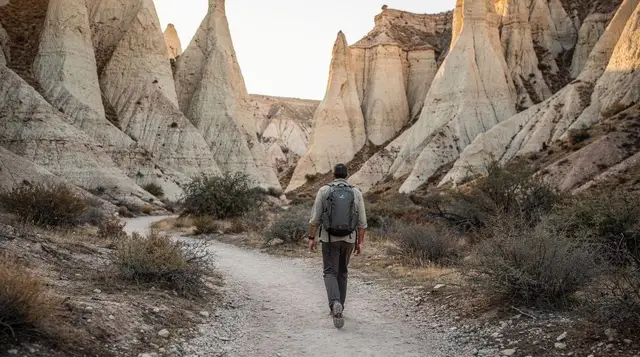
The valley holds two branches, Aşağı Soğanlı (Lower Soğanlı) and Yukarı Soğanlı (Upper Soğanlı), threaded through a working farming village. Along the cliffs above the fields, roughly ten Byzantine-era rock-cut churches are carved into the rock, several with domed ceilings and faded fresco fragments, the same building tradition that produced the churches at Göreme and Ihlara, just further from the highway and further from the tour-bus turnaround points that keep other sites crowded.
If you have already done Göreme’s open-air museum and walked part of Ihlara Valley, Soğanlı gives you a third look at the same rock-cut church tradition, this time without a ticket queue or a tour group blocking the doorway. If Soğanlı is your first or only rock-church stop in Cappadocia, it is a considerably weaker choice than either of those two, because the churches here are, on the whole, in rougher condition and less clearly signposted.
Two valleys, one shared history
The split between Aşağı Soğanlı and Yukarı Soğanlı isn’t dramatic on the ground, more a short walk between clusters than two separate destinations, but it does organise a visit into two distinct halves. Aşağı Soğanlı, nearer the modern village, holds the more accessible churches and is where most guided groups spend the bulk of their time. Yukarı Soğanlı sits further up the valley, requires more walking over uneven ground, and sees noticeably fewer visitors even on a Blue Tour day, since coach schedules rarely allow enough time to cover both halves properly.
The churches themselves are domed and cross-shaped in the manner typical of the region’s monastic architecture, carved by monks and hermits from roughly the ninth to thirteenth centuries. Some retain carved architectural detail on their domes and traces of painted fresco on the walls; others have lost their façades to erosion or were later used as stables, storerooms and pigeon houses by the village, which blackened or scraped away whatever paint survived. None of this is presented with the interpretive signage you get at Göreme’s museum. What you get instead is a scattering of doorways in a cliff face, most unlocked, most empty of other visitors, and a village that still farms the valley floor around them exactly as it always has.
The rag-doll sellers
At the entrance to the valley, and along the short walk between the two halves, local women from the village sell hand-sewn rag dolls, a craft specific to Soğanlı rather than a generic souvenir imported for tourists elsewhere in the region. Prices are modest and negotiable, and buying one is a reasonably direct way to put money into the village rather than into a tour operator’s margin. It’s a low-pressure stall setup, nothing like the carpet-shop routine you may meet elsewhere in Cappadocia, and most visitors who stop find it one of the more genuine small-scale interactions of the day.
Why the crowds never arrive
It’s worth being blunt about the mechanics here, because the honest answer disappoints some readers expecting a hidden gem story. Soğanlı is not empty because it is secret, and not empty because the churches are unremarkable. It is empty because of logistics: no scheduled dolmuş runs there, the drive from Göreme takes over an hour each way on secondary roads, and the standard day-tour split (Red Tour north, Green Tour south-west) never routes through it. Only the Blue Tour, the least-sold of the three colour-coded circuits, makes Soğanlı its centrepiece, and Blue Tour bookings run well behind Red and Green in every Göreme agency.
That leaves a narrow set of visitors who actually reach the valley: people on the Blue Tour, people with a rental car and a free afternoon, and people booking a private or small-group tour built specifically around Soğanlı, sometimes bundled with Gümüşler Monastery near Niğde. Everyone else in Cappadocia, the large majority of visitors on a three- or four-day trip working through Göreme, Uçhisar and the northern valleys, simply never gets this far south, not through any active decision to skip it, but because the standard itinerary never brings it up.
Getting there
By car
The drive from Göreme takes roughly 1 h 15 on paved roads via Kayseri or Yeşilhisar, dropping into farmland well south of the main tourist cluster. Roads are in reasonable condition but narrow in places near the village itself, and signage for the two valley entrances is modest, so a mapped route or offline map is worth having before you set off. See the guide to driving in Cappadocia if you haven’t rented a car in the region before, and car rental in Cappadocia for what a few days of self-drive typically costs.
On the Blue Tour
The Blue Tour is the only regularly scheduled way to reach Soğanlı without your own transport. It typically combines the valley with Kaymaklı Underground City and a stop in Mustafapaşa or at Keslik Monastery, run as a full-day coach itinerary from Göreme, Ürgüp or Avanos hotels. It sells in noticeably smaller numbers than the Red or Green tours, which in practice means smaller groups and a less rushed pace at each stop. Read the full breakdown of Red, Green and Blue tours before choosing, since combining Blue with either of the other two in a single day isn’t realistic; they run in opposite directions and each fills a full day on its own.
Private and small-group options
A private driver or small-group tour built around Soğanlı gives more time in each valley and, usually, the option to extend to Gümüşler Monastery, roughly the same distance again to the south-west. This suits travellers who want the rock-cut churches without a coach group, or who are combining the trip with a wider look at Niğde province.
a full-day tour built specifically around Soğanlı Valley covers the drive and both valley halves at an unhurried pace, generally with a smaller group than a standard coach circuit.
For the standard route, the Blue Tour pairing Soğanlı with Kaymaklı Underground City is the most commonly booked way to see both without arranging your own transport.
If you’d rather skip the group entirely, a private tour combining Soğanlı with Keslik Monastery sets its own pace and timing, useful if you’re travelling with children or anyone who tires on uneven paths.
What a Soğanlı visit costs
| Option | Typical cost per person | Time from Göreme | Notes |
|---|---|---|---|
| Blue Tour (shared coach) | 35-55 EUR | Full day, 8-9 hours | Includes Kaymaklı and a Mustafapaşa or Keslik stop |
| Private/small-group tour | 60-90 EUR | Half to full day | More time per stop, flexible route |
| Self-drive | 40-70 EUR (fuel, rental share, entry) | Half day | Entry fee at the site gate, cash preferred |
Prices move with fuel costs and the lira’s exchange rate, so treat these as a planning range rather than a fixed quote, and check current figures when booking.
Combining Soğanlı with the rest of a trip
If you’re driving, the most logical pairing is Gümüşler Monastery near Niğde, a similar distance again south-west, which holds its own well-preserved rock-cut churches and frescoes; it has a separate page, so this guide won’t repeat that detail here. Trying to add Ihlara Valley to the same day as Soğanlı is possible on paper but long in practice, given Ihlara’s own half-day of walking; most travellers who want both split them across two separate days, which fits comfortably into a slower four- or five-day Cappadocia trip rather than a rushed three-day one.
For a shorter stay, Soğanlí is one of the easiest sites to drop without real loss. If you’re building a three-day plan and deciding what earns a place, the general guide to seeing Cappadocia without a tour and the wider cave churches and frescoes guide both help weigh Soğanlı against Göreme’s museum and Ihlara before you commit a half-day to the drive.
Who should skip it
Skip Soğanlí if this is your first trip to Cappadocia and you have three days or fewer. The open-air museum at Göreme and Ihlara Valley cover the same rock-cut church tradition more efficiently, with better-preserved sites and far less driving time. Skip it too if you’re relying on public transport without a car and don’t want to book an organised tour; there is no realistic independent route in. And skip it if uneven, unshaded walking between two valley clusters, with modest signage and no visitor centre, doesn’t appeal on a day already spent travelling.
Go if you’ve already worked through the northern valleys and Göreme’s museum and specifically want a quieter version of the same experience, if you’re already booked on the Blue Tour for Kaymaklı and Soğanlí comes as part of the package, or if you’re renting a car for several days and have a free afternoon that a longer drive doesn’t bother you to fill.
Practical notes
Wear closed shoes; the paths between churches cross loose stone and dirt tracks with no paving. There is little shade in the valley, so carry water, particularly between May and September. Entry is via a modest gate fee, generally payable in cash at the site. Mobile signal is patchy inside the valley itself, so download offline maps before setting out if you’re driving yourself. The village at the entrance has a small number of basic cafés for a tea or simple lunch, but nothing on the scale of Göreme’s or Ürgüp’s restaurant options, so eat before you arrive or plan to eat after you’re back.
For a wider look at how a longer Cappadocia trip fits sites like this in, see the four-day itinerary and the general guide to where to stay in Cappadocia, which covers how far Göreme sits from the southern sites covered here.
Frequently asked questions about visiting Soğanlı Valley
How far is Soğanlı Valley from Göreme?
About 1 h 15 by car or organised tour, on quiet roads through Kayseri and Niğde province farmland. There is no direct dolmuş service, which is the main reason independent travellers skip it.
Can I visit Soğanlı Valley without a car or a tour?
Not easily. There is no scheduled public transport running directly to the valley, so the practical options are a rental car, a private driver, or the Blue Tour, which stops here as its main attraction.
What is there to see in Soğanlı Valley?
Two neighbouring valleys, Aşağı Soğanlı and Yukarı Soğanlı, hold around ten rock-cut churches, several with carved domes and faded frescoes, cut into the cliffs above a small farming village. At the entrance, local women sell hand-sewn rag dolls, one of the few crafts still made and sold on site rather than imported for the tourist market.
How does Soğanlı compare to Göreme Open-Air Museum?
Göreme’s museum packs a denser cluster of better-preserved churches into a small area and draws heavy midday crowds. Soğanlı spreads a similar idea over two open valleys with rougher paths, weaker signage, and far fewer visitors, so it rewards patience more than convenience.
Is Soğanlı Valley part of the Blue Tour?
Yes. It is the headline stop on the Blue Tour, usually paired with Kaymaklı Underground City and a stop in Mustafapaşa or Keslik Monastery, and it is the main reason that itinerary exists as a separate day from the Red and Green tours.
How much time do I need at Soğanlı Valley?
Most visitors spend 45 minutes to 1 h 30 walking between the two valley entrances and the main churches. Add the return drive and it fills half a day rather than a full one, unless combined with another southern stop such as Gümüşler.
Are the churches at Soğanlı Valley well preserved?
Unevenly. Some retain carved domes and traces of fresco; others have collapsed façades or blackened, badly faded paintwork from centuries of use as stables and storage. None matches the condition of Göreme’s Karanlık Kilise, and that gap in polish is part of what keeps Soğanlı quiet.
Should I combine Soğanlı with other sites in one day?
If you have a car, pairing Soğanlı with Gümüşler Monastery near Niğde makes a sensible loop, since both sit south of the main Cappadocia cluster. Trying to add Ihlara Valley to the same day is possible but long, and most people who want both split them across two days.