Göreme Open-Air Museum: cave churches and frescoes
What is the Göreme Open-Air Museum?
It's a UNESCO-listed cluster of Byzantine cave churches carved into one small canyon on the edge of Göreme, dating mostly from the 10th and 11th centuries. Most churches are covered by the standard entry ticket; the Karanlık Kilise (Dark Church) needs a separate ticket and has its own guide. Visiting at opening, before around 10am, avoids the worst of the midday crowding.
One canyon, not a scattered site
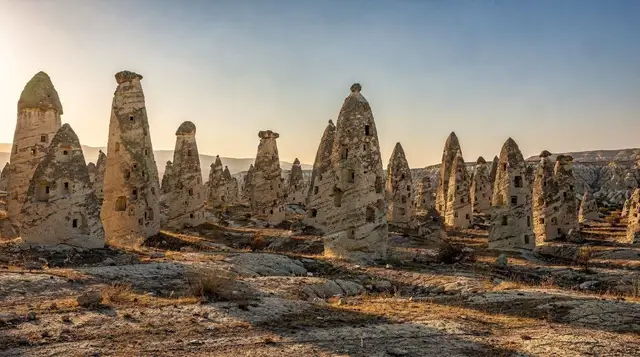
The Göreme Open-Air Museum is easy to misunderstand from photos alone. It isn’t a museum with display cases; it’s a short, steep-sided canyon on the eastern edge of Göreme, maybe 500 metres end to end, where a community of monks carved roughly thirty churches, chapels and refectories into the tuff between the 10th and 11th centuries. About ten of those spaces are open to visitors today, all reachable from a single signed path that loops up and down the canyon walls on metal stairways and walkways.
That compactness is the main thing that separates it from Cappadocia’s other rock-cut sites. Zelve and Çavuşin spread their churches and dwellings across whole hillsides and several valleys, so you walk much further between things and see far fewer people at any one point. Here, everything sits within a few hundred metres, which is exactly why the museum feels crowded at times when Zelve, a fifteen-minute drive away, does not. The site was inscribed as part of the Göreme National Park and the Rock Sites of Cappadocia on the UNESCO World Heritage list in 1985, and it remains the single most visited historical site in the region.
The route: what you’ll actually walk through
Entry is at the bottom of the canyon, near the ticket office and a car park shared with tour buses. From there the path climbs past a series of churches, most named by locals long after they were carved, often for a visible feature rather than any historical record: Elmalı Kilise (Apple Church), Azize Barbara Şapeli (St Barbara Chapel), Yılanlı Kilise (Snake Church), Karanlık Kilise (Dark Church, ticketed separately and covered in its own guide), Çarıklı Kilise (Sandals Church), and the larger Tokalı Kilise, which sits slightly apart from the main cluster, just outside the ticket gate on the road side.
Each church is a single room or a small cluster of rooms cut directly into the rock, with no supporting structure beyond the stone itself. Ceilings are often domed or barrel-vaulted in imitation of built Byzantine churches, complete with carved columns and cornices that serve no structural purpose since the whole thing is one solid mass of tuff. Some are large enough for a dozen visitors to stand comfortably; others fit four or five people at a time, which is where the bottlenecks form.
Walkways and stairways connect the upper and lower levels, and a nunnery and a monks’ refectory, both carved as multi-storey complexes, sit near the entrance. These give a sense of the site as a working monastic community rather than a gallery of individual chapels: kitchens, dining halls with long stone tables, and small cells for sleeping are all part of the same rock.
The frescoes: what survives, and why
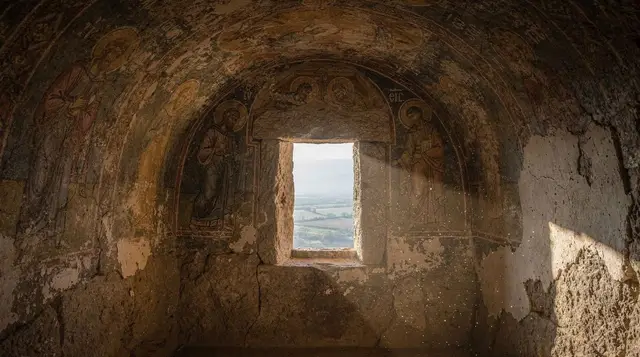
The frescoes are the reason the museum matters, and they’re also the reason expectations need managing. These are not grand cycles on the scale of a cathedral. They’re modest in size, painted directly onto plastered rock in rooms that are often dim and low-ceilinged, and their real value is age and survival rather than visual spectacle. Most date from the 10th and 11th centuries, with painting styles ranging from simple red ochre geometric patterns, the earliest and plainest layer, through to fuller narrative scenes of the life of Christ added later, once the community had the resources for pigments like lapis-derived blue.
Condition varies a lot from church to church. Some frescoes are vivid, with faces, robes and haloes still legible; others have lost whole sections to damp, smoke from centuries of use as stables and pigeon houses, and flaking plaster. A recurring and jarring detail in several churches is the deliberate scratching-out of eyes and faces on painted figures, a mix of iconoclast-era damage, later vandalism, and, in some cases, folk beliefs about eye ailments that led people to scrape pigment from a saint’s face for use as a remedy. None of this is explained in much depth on site, so it’s worth knowing before you go in rather than guessing at it in front of the wall.
Photography rules inside the churches have changed over the years and are applied unevenly by whichever attendant is on duty that day; check the signage at each entrance rather than assuming a blanket rule applies across the whole site.
When to go: the crowd problem
This is the museum’s real weak point. The canyon is narrow, the churches are small, and the site draws both independent visitors and every version of the Red Tour, which nearly always starts here. In July and August, between roughly 10am and 3pm, it’s common to queue at the entrance to individual churches and to be moving in a slow shuffle rather than walking freely.
Two windows work better. Arriving at opening, generally 8am, and being inside within the first hour beats the tour buses, which tend to land from around 9:30am onward. The last hour before closing is quieter for a different reason: most day tours have already moved on to their next stop by then. Midweek is marginally better than weekends, but the difference is smaller than the difference between early morning and midday.
| Time of day | Typical experience |
|---|---|
| Opening to around 9:30am | Quiet, churches accessible without queuing |
| 9:30am to 10am | Tour buses begin arriving |
| 10am to 3pm (summer) | Busiest window, queues at smaller churches |
| Last hour before closing | Quieter again, most tours have left |
Tickets, prices and hours
Prices for both the main ticket and the Karanlık Kilise supplement have risen with inflation in recent years, so treat any figure as a rough guide rather than something fixed. As of the most recent seasons, the standard entry ticket runs in the range of several hundred to just over a thousand Turkish lira, with the Dark Church requiring an additional ticket bought inside the grounds.
Museum passes covering multiple sites across the region are sometimes worth it if you’re also visiting Derinkuyu or other ticketed sites, and are worth checking against the individual ticket prices before buying. The site typically opens around 8am and closes in the late afternoon, with slightly longer hours in summer; hours shift by season, so it’s worth checking the posted times for the month you’re travelling rather than relying on a fixed schedule.
Cash and card are both generally accepted at the ticket booths, though queues move faster with cash in hand.
Getting there from Göreme
The museum sits about a fifteen- to twenty-minute walk uphill from central Göreme, or a five-minute drive or taxi ride. It’s an easy add-on to a walking day around Göreme if you don’t mind the climb, and it’s the standard first stop on the Red Tour, which bundles it with Paşabağ, Zelve, Avanos and a viewpoint over Uçhisar. If you’re visiting independently rather than on a coach, going early and walking or taking a short taxi ride avoids the parking congestion that builds up around the site once the tour buses start arriving.
a guided walk through the main churches is worth it if you want the fresco cycles and the monastic layout explained rather than guessed at from a signboard. For something quieter, a private out-of-hours visit avoids the daytime crowd entirely, at a higher price. If the museum is just one stop among several for you, the Red Tour that pairs it with Paşabağ, Zelve and Avanos covers the whole northern circuit in a single day.
What the museum leaves out
Two things get bundled into “the open-air museum” in casual conversation that are worth separating out. The Karanlık Kilise, the best-preserved fresco cycle on the entire site because its lack of natural light protected the pigments from fading, requires its own ticket and its own visit logic; it has a full guide of its own rather than a paragraph here.
The other separation is geographic. The museum is one canyon with one route. If you want the wider troglodyte-village experience, with tunnels, multiple valleys, and far fewer people, that’s Zelve, inhabited until 1952 and evacuated for structural risk rather than opened as a museum. Çavuşin is closer still, a five-minute drive from Göreme, with one of the region’s oldest churches and an abandoned hillside village above it. Neither delivers the fresco density of the open-air museum, but both are quieter and give a better sense of Cappadocia as lived-in rock rather than curated site.
Nearby, on the same visit
A few stops sit close enough to combine with the museum without much extra driving. Paşabağ, with its double- and triple-capped fairy chimneys, and Devrent, the Imagination Valley, which has no churches or carvings at all, just eroded rock shapes, are both ten to fifteen minutes from Göreme and pair naturally with a museum visit on a single morning or afternoon. If you’re building a full one-day Cappadocia itinerary or working from a fixed one-day plan, the museum is the logical anchor to build a morning around, given how early it needs to be tackled to avoid the crowds.
For broader planning, the guide to avoiding common itinerary mistakes and the best time to visit both cover how museum crowding interacts with the wider question of when to travel; the best time tool is useful if you’re still choosing a month. If museums and rock-cut art are the main draw for your trip, it’s also worth browsing the wider museums and art category and the dedicated activity page for the museum for other options nearby.
Setting expectations
The Göreme Open-Air Museum rewards patience rather than awe. Nothing here is large in scale: the churches are small rooms, the frescoes are faded and partial, and much of what you’re looking at has been damaged, scratched, or worn down by close to a thousand years of use, abandonment and reuse as farm storage before restoration began in the 20th century. What makes it worth the entry fee and the crowds is age and concentration, not spectacle. Go early, expect modest rooms rather than grand naves, and treat the Karanlık Kilise as a separate, optional add-on rather than the headline of the same visit.
Questions about the Göreme Open-Air Museum
What is the Göreme Open-Air Museum?
It’s a UNESCO World Heritage site on the edge of Göreme: around ten Byzantine cave churches from the 10th and 11th centuries, carved into one compact canyon and grouped on a single walking route. The Karanlık Kilise (Dark Church) sits inside the same grounds but requires a separate ticket.
How long should I plan for a visit?
Most people need one and a half to two hours to walk the main route and step into each open church. Add 20 to 30 minutes if you also buy the ticket for the Karanlık Kilise.
Is the Karanlık Kilise included in the standard ticket?
No. The main entry ticket covers the open churches along the route; the Dark Church needs its own ticket, bought at a separate booth inside the site.
What’s the best time to arrive?
Arrive at opening, before around 9:30 to 10am, or come in the last hour before closing. Between 10am and 3pm in summer, the paths and stairways inside the smaller churches get genuinely congested.
Are the frescoes original?
Yes, the paintings are original 10th- and 11th-century work, though many have faded, flaked, or been damaged by centuries of smoke, graffiti and, in some churches, deliberate scratching of faces and eyes.
Can I take photographs inside the churches?
Photography without flash is generally tolerated in the open churches, but rules have shifted over the years and are enforced inconsistently by site staff, so check the signage at each doorway rather than assuming.
Is the museum part of the Red Tour?
Yes, it’s usually the first stop on the Red Tour, alongside Paşabağ, Zelve and Avanos. It can also be visited on its own, independently or with a guide.
Do I need a guide?
The route works fine without one, since paths are marked and most churches have basic information boards, but a guide adds context on the fresco cycles and monastic life that the signage doesn’t cover.
Museum & art tours on GetYourGuide
Verified deep-linked GetYourGuide tours. Book through these links and we earn a small commission at no cost to you.
GetYourGuide does not provide a product photo for this activity — the image shows the meeting point, photographed by us.