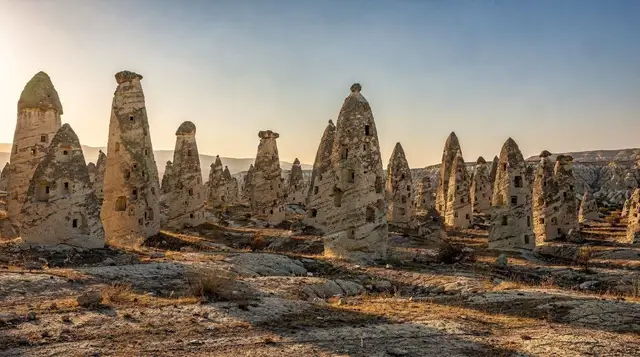
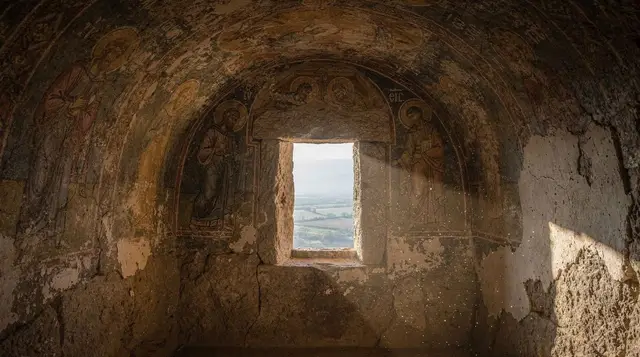
The dark church at Göreme open-air museum
Why does the dark church at Göreme open-air museum cost extra?
Karanlık Kilise, the 'dark church', kept almost no windows for centuries, so its frescoes were shielded from light and daily wear and are now the best preserved in the museum. That preservation is the reason the site sells its ticket separately from the general museum entrance, rather than folding it into the standard price.
Why one church in the museum has its own ticket booth
Walk through the Göreme open-air museum and you’ll pass through around ten rock-cut churches on a single general ticket. Then, near the end of the loop, a separate ticket window appears for one more building: Karanlık Kilise, the dark church. It isn’t an upsell for the sake of it. This guide covers only that one church — for the layout, the other churches and the practicalities of the wider site, see the full Göreme open-air museum guide.
The museum itself, along with the wider rock-cut landscape around it, has been a UNESCO World Heritage Site since 1985, and Karanlık Kilise is usually singled out as the reason to add the extra ticket rather than skip it. Understanding why comes down to one simple fact about how the church was cut into the rock in the first place.
Why the ticket is sold separately
Most of the churches in the Göreme open-air museum were carved with window openings, letting natural light into the nave. Over ten centuries, that daylight did what daylight does to painted plaster: the pigments in Cappadocia’s other rock-cut churches have dulled, flaked, or vanished from whole sections of wall.
Karanlık Kilise was cut differently. It has almost no windows of its own, reached instead through a narrow passage and a small courtyard that block most outside light. For centuries that made it a dim, unremarkable-looking church from the outside — which is exactly why its interior survived so well. Without direct sunlight reaching the plaster, the frescoes inside kept their colour and detail far better than anywhere else on the site.
The museum’s answer to that is a second, separate ticket bought at Karanlık Kilise’s own entrance, in addition to the general admission that gets you into the museum grounds and its other churches. This guide won’t quote the exact add-on price, since it has shifted more than once in recent years and a figure printed here would likely be wrong by the time you read it — check the price board at the ticket window on the day. What’s worth knowing in advance is simply that the supplement exists, that it is the one add-on inside the museum genuinely worth paying, and that it isn’t included if you only buy the standard entrance.
What actually looks different inside
Once you’re through the entrance, the difference from the museum’s other churches is immediate. Where a church like the ones nearby often shows patchy plaster with only fragments of colour surviving, Karanlık Kilise’s ceiling and walls carry full biblical scenes in reds, blues and ochres that are still legible as scenes rather than as faint outlines.
The church dates, like most of the museum’s rock-cut churches, from the tenth and eleventh centuries, and its layout follows the same cross-in-square plan carved into tuf that you’ll see elsewhere in the museum. What sets it apart is readability: figures have faces, robes have folds and colour, and the overall scheme of the ceiling and apse reads as a coherent programme rather than a collection of faded traces. If you’ve already walked through several of the museum’s other churches before reaching Karanlık Kilise, the jump in clarity is the point — it’s the clearest single argument for the extra ticket.
Don’t expect Karanlık Kilise to look like a different building type or scale, though. It’s a compact, single church, not an additional site with its own grounds. The value is entirely in the state of what’s painted on the walls, not in the size of the space.
The entrance: narrow, dim, and true to the name
The name Karanlık Kilise means dark church, and it isn’t a stretch. The passage in is tight, the courtyard outside dims quickly once you step through the doorway, and the interior itself has none of the daylight you’ll have grown used to in the museum’s other churches. Some visitors are caught slightly off guard by how enclosed it feels after the open courtyards elsewhere on site.
That said, this isn’t a serious mobility obstacle for most people. There’s no significant elevation change once you’re through the entrance, and the floor, while uneven stone in places like much of the museum, doesn’t require scrambling or ducking through anything as tight as a tunnel. Anyone who has already managed the museum’s other churches and the stepped paths between them will manage this one too. The people who should think twice are those genuinely uncomfortable in confined, low-lit spaces, since there’s no way to see the frescoes without standing inside the dim nave itself for a few minutes.
Bring nothing more than what you’d carry through the rest of the museum. A phone light is enough to help your eyes adjust; large bags and tripods aren’t practical in the tight passage and aren’t necessary either.
How much extra time to budget
The Göreme open-air museum as a whole takes roughly 1.5 to 2 hours to walk through properly. Karanlık Kilise doesn’t add much to that total — a visit inside the church itself runs a matter of minutes, since it’s one building rather than a separate complex. What can add time is the queue: because the space inside is small, staff limit how many people are let in at once, and during the museum’s busiest hours, roughly 10am to 3pm, that queue can run longer than the visit itself.
Building in some slack for a wait is more realistic than assuming you’ll walk straight in. If your schedule allows it, visiting the museum near opening or in its last couple of hours before closing cuts both the general crowd and the specific wait for Karanlık Kilise.
Fitting it into a museum visit, guided or not
Nothing about Karanlık Kilise requires a guide. You buy the add-on ticket at its own booth inside the museum grounds and walk through independently, the same as any other church on the loop. Travellers piecing together their own Cappadocia day without a tour can simply add the extra ticket to their normal museum visit and lose only a few minutes to it.
That said, a guided visit does add something here specifically: context on which scenes you’re looking at. A straightforward Göreme open-air museum tour walks the whole complex with commentary, which is useful given how much of the museum’s value is in reading scenes correctly rather than just seeing colour on a wall. If you’d rather have someone talk you through the frescoes scene by scene as you go, a guided walk through the open-air museum covers exactly that.
For a quieter alternative to the daytime crowd, some visitors choose a private out-of-hours visit to the museum by moonlight — worth knowing about if the 10am–3pm crush is the main thing putting you off, though you should confirm with the operator in advance whether Karanlık Kilise’s own ticket booth is included in that slot, since it keeps separate hours from the main site.
And for travellers combining the museum with one of the region’s underground settlements in a single outing, a private tour pairing the open-air museum with an underground city saves arranging both separately.
Where the ticket fits against the rest of the museum
| Ticket | What it covers | Worth it? |
|---|---|---|
| Museum general entrance | Around ten rock-cut churches, the refectory and monastic kitchens | Yes — this is the standard visit and covers the bulk of the site |
| Karanlık Kilise add-on | One additional church, with the museum’s best-preserved frescoes | Yes — of the museum’s optional extras, this is the one that delivers |
How to look once your eyes have adjusted
Give yourself a minute just inside the doorway before moving on. The dimness that makes the church so well preserved also means the first impression is mostly shadow, and the painted scenes only emerge as your eyes adapt. Start with the ceiling and the apse, where the composition is easiest to follow, then work down the walls rather than darting from one bright patch to another.
It helps to arrive knowing that these paintings were made to be read. Before most visitors could read at all, scenes from the Gospels were laid out as a sequence on the walls, and a church like this one tells a story in order. If you have walked through the museum’s other churches first, you already have a sense of the visual vocabulary, so the clearer scenes here feel like the same language finally spoken without static. The broader background is in the guide to cave churches and frescoes, which is worth skimming the evening before.
Keep your voice low and move slowly. The space is small, the passage is tight, and the people behind you are waiting their turn. Photography rules inside such churches are set by the museum staff on the day, so follow what the attendant at the door asks of you rather than assuming the rules match those elsewhere on site.
Pairing it with the rest of your Göreme days
The dark church sits comfortably inside a wider plan. On a first visit, many travellers fold the museum into a compact itinerary such as Cappadocia in two days or the fuller three days in Cappadocia, keeping the museum for a morning and leaving the afternoon for a valley walk. The matching two-day itinerary shows how that rhythm works in practice.
If your interest is specifically in painted churches, the village of Çavuşin and the Zelve open-air museum give a different, less polished picture of the same tradition, which makes the clarity of Karanlık Kilise easier to appreciate. For another church with a good reputation among visitors, the Ihlara Valley hike combines rock-cut chapels with a river walk, and Soğanlı offers quieter churches far from the tour buses.
Those travelling with someone who tires easily, or who finds dim and enclosed spaces hard, may want to read Cappadocia with limited mobility and Cappadocia with kids before deciding how to pace the day. Children often enjoy the sense of entering a hidden place, but a short, calm explanation beforehand makes the dim passage far less surprising. For a broader reality check on how busy the site gets, Cappadocia crowds hour by hour is a useful companion.
After the dark church
Once you’re back outside, the rest of the Göreme open-air museum is worth finishing properly rather than treating Karanlık Kilise as the final stop and heading straight for the car park. If you want more of the same theme — painted rock-cut interiors rather than valley scenery — the wider subject of cave churches and frescoes across the region puts Karanlık Kilise in context against sites like the abandoned village and church at Çavuşin and the troglodyte settlement at Zelve, a short drive away.
For planning the rest of the day around the museum, a Göreme walking guide covers what’s reachable on foot from the village itself, and a one-day Cappadocia itinerary or the matching one-day itinerary shows where the museum typically sits alongside a valley walk or a viewpoint in Ürgüp. If timing your visit around the crowds matters more than any single site, the general guide to the best time to visit Cappadocia has the seasonal detail; for the museum specifically, the short version is: get there early.
Karanlık Kilise: frequently asked questions
Why does Karanlık Kilise have its own ticket?
The museum’s general entrance covers around ten rock-cut churches, but Karanlık Kilise is sold as an add-on. Its frescoes are markedly better preserved than the rest, and the separate ticket is the museum’s way of managing numbers inside a small, unlit space rather than pricing it into everyone’s entry.
What makes its frescoes different from the other churches in the museum?
Most churches in the open-air museum had window openings, so their painted plaster has faded or flaked over ten centuries of daylight. Karanlık Kilise was cut with almost no windows, so its reds, blues and ochres, and its biblical scenes, read far more clearly than anywhere else on site.
Why is it called the dark church?
Karanlık Kilise translates as “dark church”, and the name describes the building rather than a marketing angle. The near-absence of window openings that kept it dim for visitors over the centuries is exactly what kept the frescoes from bleaching out.
How much time does a visit take?
The Göreme open-air museum as a whole takes 1.5 to 2 hours. Karanlık Kilise adds only a few extra minutes once you are inside, since it’s a single church rather than a separate site, but factor in a short queue at busy times because entry is limited.
Is the entrance narrow, and is that a problem for mobility?
The doorway and passage are tight and dim, consistent with a rock-cut interior that was never built with large window openings. It isn’t a serious mobility barrier for most visitors, but anyone unsteady on uneven stone, or uncomfortable in confined spaces, should know what to expect before queuing.
When should I visit to avoid the crowds?
The wider museum gets saturated between 10am and 3pm, and Karanlık Kilise feels that crush more than most churches because only a limited number of people are let in at a time. Arriving close to opening, or in the last couple of hours before closing, cuts the wait noticeably.
Is Karanlık Kilise part of the standard Göreme open-air museum entrance?
No. The general ticket gets you into the museum grounds and most of the churches, but Karanlık Kilise requires its own additional ticket bought at the same site. Skip it and you’ll see the museum’s other churches, just not its best-preserved frescoes.
Should I book a guided tour, or is it easy to see alone?
You can buy the add-on ticket and walk through independently; nothing about the church requires a guide. A guided visit mainly adds context on the scenes and the wider museum, and can help on a day when queuing is unpredictable.
Museum & art tours on GetYourGuide
Verified deep-linked GetYourGuide tours. Book through these links and we earn a small commission at no cost to you.
GetYourGuide does not provide a product photo for this activity — the image shows the meeting point, photographed by us.