Devrent Valley: Cappadocia's rock-shape viewpoint
Is Devrent Valley worth visiting in Cappadocia?
Devrent Valley, also called Imagination Valley, is worth a short stop for its isolated fairy chimneys shaped like recognisable figures, seen mostly from the roadside. It has no marked trail and no entrance fee, and most visitors spend 15 to 20 minutes there as part of the Red Tour alongside Paşabağ and Zelve.
What Devrent Valley actually is
Devrent Valley sits on the road between Göreme and Avanos, about fifteen minutes from Göreme by car. Locally it’s usually called Imagination Valley, and the name is the whole pitch: this is a stretch of eroded tuff dotted with isolated fairy chimneys whose weathered outlines happen to resemble recognisable shapes — a camel, a seal, a dolphin, a mother and child, depending on who’s looking and from where. There’s no ticket booth, no gate, and no fixed hours. You pull off the road, look, and move on.
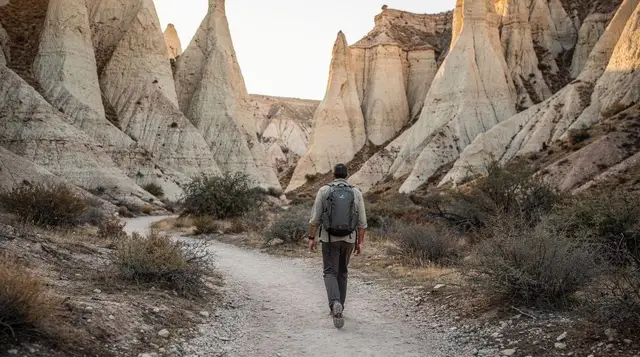
That last part matters for how you should plan around it. Devrent is not a destination in the way Rose Valley or Zemi Valley are, where the point is to walk for an hour or two through a landscape that changes as you go. Devrent’s terrain is genuinely walkable — flat, open ground with a few informal paths worn into the dust — but there is nowhere it leads. The formations you came to see are visible from the car park and the roadside within a few minutes, and once you’ve seen them, you’ve seen the site. Treat it as a viewpoint you stop at, not a hike you set aside a morning for.
Why it’s different from the valleys you walk
Cappadocia’s valleys fall into two rough categories, and mixing them up is the most common way people misjudge their day. Rose Valley, Red Valley, Zemi Valley and Pigeon Valley are corridors: you enter at one end, follow a path (sometimes marked, sometimes not) through cliffs and cave churches, and exit somewhere else, usually an hour to three hours later. They reward proper shoes, water, and a route plan, because the interest is cumulative — one turn after another.
Devrent is the opposite shape. It’s not a corridor but an open basin visible almost in its entirety from a single vantage point beside the road. The fairy chimneys stand apart from each other rather than crowding into a canyon, which is exactly why the individual shapes read as shapes — there’s nothing behind or beside them to compete for attention. You lose the immersive, hour-by-hour experience of a valley walk, but you gain something a genuine hike can’t offer: the whole site in view at once, from a car park, in under twenty minutes.
This also means Devrent asks nothing of you in terms of fitness or preparation. No 380-step descent like Ihlara, no scrambling like parts of Zemi or Rose Valley, no risk of taking a wrong branch and adding an hour to your day. If you’re short on time, travelling with people who don’t want a hike, or simply pacing yourself between more demanding stops, Devrent is the low-effort inclusion on the day’s plan.
The shapes, and why they’re inconsistent
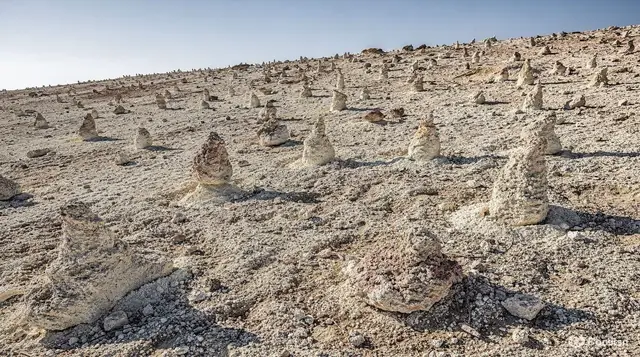
The formations at Devrent are the product of the same process that shaped the rest of Cappadocia: soft volcanic tuff, laid down by the eruptions of Erciyes and Hasan Dağı, eroded unevenly by wind and rain into columns that survive where a harder cap of rock has protected the softer stone beneath. What makes Devrent distinct isn’t the geology — it’s the same tuff and the same process as everywhere else in the region — but the fact that here the chimneys stand isolated enough, and at a scale close enough to human proportions, that the eye starts finding figures in them.
The most reliably pointed-out shape is a fairy chimney resembling a camel, usually the first thing a guide or driver will gesture towards on arrival. Beyond that, what people see genuinely varies: a seal, a pair of dolphins, a mother holding a child, occasionally an entire nativity scene claimed by more imaginative drivers. None of this is official or fixed — it’s pattern recognition, and it depends on the angle you’re standing at and the position of the sun. Don’t expect a labelled trail with signs pointing out “the camel” and “the seal” the way you might at a more curated site; you’ll be told, or you’ll have to look for yourself.
If you want the most from those few minutes, walk a little further into the open ground rather than staying at the first pull-in — the angle changes quickly over even twenty or thirty metres, and shapes that are obvious from one spot disappear from another. Morning and late-afternoon light does more for the site than midday sun, which flattens the texture of the rock and makes the outlines harder to pick out.
Where Devrent fits on the Red Tour
Devrent Valley is a standard stop on the Red Tour, the northern-loop day tour sold by nearly every agency in Göreme. A typical Red Tour itinerary runs the Göreme Open Air Museum, a viewpoint over Uçhisar, Çavuşin, Paşabağ, Devrent Valley, and Avanos for pottery, sometimes with a wine stop added. Within that itinerary, Devrent is consistently one of the shortest stops — where the Open Air Museum gets ninety minutes to two hours, Devrent gets fifteen to twenty.
It’s worth being clear about how Devrent differs from its near neighbour on the same tour. Paşabağ, a few minutes’ drive away, has structures: the double and triple-capped fairy chimneys the valley is known for, and the rock-cut hermitage of St Simeon, which you can climb into. Devrent has none of that — no churches, no hermit cells, no interiors to explore, just the exterior shapes of the rock. If you’ve only got time or patience for one of the two, Paşabağ gives you more to actually do; Devrent gives you the photograph. Full detail on Paşabağ’s own sites is covered in its dedicated guide rather than repeated here.
The other frequent pairing is Zelve, the abandoned troglodyte village a short drive further on, which was inhabited until 1952 and is a proper walk-through site with tunnels and stairs across three valleys. Between Paşabağ, Devrent, and Zelve, Devrent is the pause — a stop where nobody gets out of the vehicle for long, cameras come out, and the group moves on.
Visiting independently
Because Devrent sits directly on the paved road between Göreme and Avanos, it’s one of the easiest sites in the region to reach without a tour, provided you have your own transport. If you’re driving or have hired a car for the day — see our notes on driving in Cappadocia — it’s a simple detour on the way to Avanos, with room to pull in and park near the main viewpoint. Cyclists and e-bike riders doing a loop through Çavuşin and Paşabağ can easily add it; see cycling and e-bikes in Cappadocia for the wider route options.
There’s no dolmuş that serves Devrent Valley specifically, since it isn’t a village or a settlement with any resident population to serve. Without a car, your realistic options are a taxi arranged for a couple of hours (which can also cover Paşabağ and Zelve on the same run), a Red Tour, or one of the small-group or private options that build the valley into a wider itinerary — quad and jeep tours through this part of the region often pass through or near it. For a broader look at doing Cappadocia’s sights independently rather than on a packaged tour, see seeing Cappadocia without a tour.
a private half-day tour built around the fairy chimneys and Devrent Valley is one way to see the valley properly paired with its neighbours, without waiting on a group’s pace. For something with more movement built in, a quad bike tour through the Cappadocia valleys and a jeep tour of the valley both cover this stretch of terrain as part of longer routes, which suits travellers who want more distance and a few valleys strung together rather than a single short stop.
Practical details at a glance
| Devrent Valley | |
|---|---|
| Distance from Göreme | About 15 minutes by road |
| Entrance fee | None |
| Opening hours | None — open access at any time |
| Typical time on site | 15–20 minutes |
| Terrain | Flat, open ground beside the road; no waymarked trail |
| Facilities | Minimal — a car park area, informal stalls sometimes present |
| Best light | Early morning or late afternoon |
| Usually paired with | Paşabağ, Zelve, on the Red Tour |
| Reachable without a car | Yes, but only by taxi or tour — no dolmuş stop |
When to go, and what to skip if you’re short on time
If you’re on a Red Tour, the stop is fixed for you and there’s little to plan. If you’re building your own day and time is tight, Devrent is the easiest thing on a northern-loop itinerary to shorten or drop without real loss — it doesn’t have the depth of the Open Air Museum, the climbable interior of Paşabağ, or the scale of Zelve. It earns its place as an add-on to a route you’re already driving, not as a reason to make a special trip.
Where it does earn a deliberate visit is photography timed around good light, since the shapes read far better in low, angled sun than at midday. If your itinerary has you passing this stretch of road early in the morning or in the last hour or two before sunset — heading to or from Avanos, say — that’s the version of Devrent worth pausing longer for. Otherwise, fold it into whichever tour or drive already takes you past it, and don’t let it eat into time better spent in the valleys built for walking.
For those, Rose Valley and Zemi Valley (covered in best hikes in Cappadocia) are the stronger picks if what you actually want is a few hours on foot among the fairy chimneys rather than a short stop to look at them. If you’re deciding how to split your first day across the region, Cappadocia in one day and the one-day itinerary both slot Devrent in at the right scale — a quick stop, not a headline stop.
Devrent Valley: frequently asked questions
The questions below cover what most visitors want to know before adding Devrent Valley to a Cappadocia itinerary — how long it takes, what it costs, and how it differs from the sites it’s usually paired with.
How long does it take to visit Devrent Valley?
Fifteen to twenty minutes covers it for most visitors. There’s a roadside pull-in with the best-known shapes visible on arrival, and a short flat stretch you can wander if you want a closer look. It is not a half-day stop like Ihlara or the Göreme Open Air Museum.
Is there an entrance fee for Devrent Valley?
No. Devrent Valley is open, unfenced land with free access at any time. There’s no ticket booth, no opening hours, and no museum pass involved, unlike Göreme Open Air Museum or the underground cities.
Can you walk into Devrent Valley, or is it just a roadside stop?
Both. The famous shapes are visible from the road and the car park, which is enough for most people. You can also walk a short way into the open ground beside the road for different angles, but there’s no waymarked trail through the valley the way there is at Rose Valley or Zemi Valley.
Is Devrent Valley the same as Paşabağ?
No, they’re two separate stops a few minutes apart on the same road, and tour groups usually visit both back to back. Paşabağ has the double and triple-capped fairy chimneys and the hermitage of St Simeon; Devrent has no structures at all, just eroded rock shapes.
What is the famous camel rock at Devrent Valley?
It’s a fairy chimney whose eroded silhouette, seen from a specific angle near the car park, resembles a camel. It’s the single most photographed formation in the valley, though which shapes you can pick out shifts with the light and where you stand.
Is Devrent Valley included in the Red Tour?
Yes. Devrent Valley is one of the standard stops on the Red Tour, usually grouped with the Göreme Open Air Museum, Paşabağ, Zelve, and Avanos. It’s typically one of the shorter stops on the itinerary.
Can you visit Devrent Valley without a tour?
Yes, easily. It sits directly on the main road between Göreme and Avanos, so it works well as a stop if you’re driving, cycling, or have arranged a taxi for the morning. There’s no dolmuş that stops specifically at the valley, so without a car or tour you’d need a taxi or a lift.
Is Devrent Valley good for photography?
It suits quick, opportunistic photography more than a planned shoot. Early or late light picks out the texture of the rock and the shapes read more clearly than at midday, but most people are only there for a matter of minutes, so it’s rarely worth a dedicated sunrise or sunset trip on its own.
Hiking & nature tours on GetYourGuide
Verified deep-linked GetYourGuide tours. Book through these links and we earn a small commission at no cost to you.
GetYourGuide does not provide a product photo for this activity — the image shows the meeting point, photographed by us.