Paşabağ (Monks Valley): what to expect
What is Paşabağ (Monks Valley) and how long do you need?
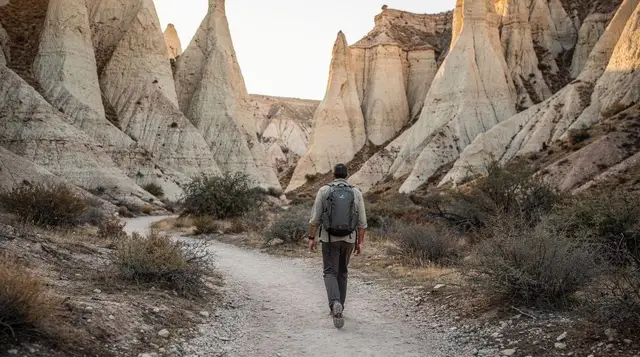
Paşabağ is a short, mostly flat site near Zelve with some of Cappadocia's best-known multi-headed fairy chimneys and a small rock-cut chapel inside one of them. Most visitors spend 20 to 40 minutes there, walking a short distance from the car park rather than hiking a trail.
Paşabağ, commonly translated as Monks Valley, is one of the smallest and most visited sites on the Red Tour, and it is often misunderstood before people get there. It is not a valley you walk through for an hour, and it is not a hike. It is a compact cluster of fairy chimneys next to a car park, most of them within a few minutes’ walk of where the coach or car stops. Set expectations accordingly and it works well; expect a trail and you will wonder why everyone left after twenty minutes.
What makes Paşabağ different from other chimney sites
Cappadocia has fairy chimneys scattered across dozens of locations, but Paşabağ is where some of the best examples of a specific type are concentrated: chimneys with double and even triple caps. These form when a single column of soft tuff is capped by more than one layer of harder volcanic rock, so instead of one mushroom-shaped top, the formation branches into two or three separate caps sitting side by side or stacked, balanced on a shared trunk of eroded stone.
This is the reason Paşabağ appears on so many postcards and social feeds of the region: the double- and triple-capped chimneys here are unusually tall, unusually photogenic, and clustered close enough together that you can see several from one spot. Nowhere else in the region packs quite this concentration of multi-headed formations into such a small, easily walked area.
The hermitage inside the rock
One of the taller chimneys near the entrance has a small chamber carved into its base, traditionally associated with Saint Simeon, an early Christian ascetic. The cell is reached by a short set of steps and a narrow opening; inside it is dim, plain and undecorated, a single room rather than a chapel with frescoes. It reflects the kind of solitary monastic life that gave the valley its name in the first place: hermits and small religious communities lived in isolated rock-cut cells like this one across Cappadocia between roughly the sixth and eleventh centuries.
Do not expect the painted interiors you will find at the Göreme Open-Air Museum or in the cave churches and frescoes elsewhere in the region. This is a bare hermit’s cell, valuable for what it represents rather than for anything decorative to look at.
How much time to set aside
Most visitors are done at Paşabağ in twenty to forty minutes. The paths from the car park to the main chimney cluster and the hermitage cell are short and mostly flat, with a gentle slope in places but nothing that requires proper hiking footwear, though closed shoes are still sensible on loose gravel. There is no marked trail looping through a wider valley here the way there is at Rose Valley or Red Valley; Paşabağ is a viewpoint-and-walk-around site, not a walking route.
If you are building your own day rather than joining an organised tour, treat Paşabağ as a stop of half an hour, not a morning activity. It pairs naturally with Devrent Valley, which takes about the same amount of time, and with a visit to Zelve Open-Air Museum a few minutes down the road, which needs considerably longer.
Sun exposure: the main practical issue
The single biggest thing to plan around at Paşabağ is the lack of shade. The site sits in open, exposed ground between the chimney formations, with very little tree cover anywhere near the main viewing areas. In July and August, when afternoon temperatures regularly reach 30 to 35 degrees, this short walk can feel considerably longer than twenty minutes if you arrive without water or sun protection.
A hat, sunscreen and a bottle of water matter more here than at shadier stops on the same tour. If you are visiting independently and have flexibility, an early morning visit avoids both the heat and the crowds that build once tour buses start arriving mid-morning.
Paşabağ on the Red Tour
Paşabağ is a fixture of the Red Tour, the half-day circuit covering sites north and around Göreme. It is almost always grouped with Devrent Valley and Zelve Open-Air Museum, sometimes with a stop at the Göreme Open-Air Museum or a viewpoint over Uçhisar depending on the operator. Because these three sites sit so close together, a Red Tour itinerary typically allocates Paşabağ the smallest block of time of the group, which matches how little there actually is to see beyond the chimney cluster and the hermitage cell.
If you are travelling without a car, joining an organised tour is the simplest way to reach Paşabağ, since it is combined with other stops rather than sold as a destination on its own.
a half-day tour combining Zelve Open-Air Museum and Paşabağ covers both sites back to back, which suits most visitors better than arranging separate transport for each. For a fuller morning that folds in the open-air museum as well, the Red Tour with Zelve Open-Air Museum and Paşabağ is the standard version most agencies in Göreme sell under slightly different names.
Getting there independently
Paşabağ sits around ten minutes by road from Göreme, close enough that a taxi or rental car makes it an easy self-drive stop, usually combined with Devrent Valley on the same short loop. There is a car park directly at the site, and the main chimney cluster is visible within a minute or two of walking from it.
For those without a car, a private driver covers Paşabağ far more efficiently than public transport does, since dolmuş routes do not run directly to the site. a jeep tour taking in this valley and nearby sites is one way to combine Paşabağ with other terrain that is harder to reach independently, and a quad tour through the Cappadocia valleys is a more active alternative if you want to extend the visit into a longer outing rather than a twenty-minute stop.
What Paşabağ is not
It is worth being clear about what this site does not offer, since some tour descriptions blur the line. Paşabağ is not Zelve: Zelve is a much larger former cave village with three separate valleys, a tunnel and considerably more walking, covered in its own Zelve Open-Air Museum guide.
Paşabağ is not Devrent Valley either, though the two are often visited back to back; Devrent has no religious structures at all and is purely about erosion shapes, while Paşabağ’s defining feature is the combination of chimney form and the hermitage cell. And it is not a hike in the sense of Rose Valley or the Ihlara Valley: there is no sustained walking route, no elevation change worth mentioning, and no need for hiking-specific gear beyond closed shoes and sun protection.
Photography at Paşabağ
The multi-headed chimneys are among the most photographed formations in the region, and the site rewards a short amount of patience: tour groups tend to cluster at the same two or three vantage points near the car park, so walking a little further along the paths often opens up quieter angles of the same formations. Morning light works better than midday here, both for the low sun angle on the chimney caps and because the heat and glare by early afternoon make lingering with a camera less appealing. For a broader view of where this fits among the region’s photogenic spots, see the Cappadocia viewpoints guide.
How the chimneys got their shape
You do not need a geology degree to enjoy the formations, but a little background changes how you look at them. The soft volcanic tuff that covers this part of Cappadocia erodes quickly, while the harder caps resting on it erode slowly. Wind and rain strip away the soft stone around each cap until a column is left standing. The story of where that tuff came from is told in the volcanoes that made Cappadocia, and it is worth reading before you go. The same slow process is also why the formations are fragile, a theme explored in why the fairy chimneys are crumbling.
Once you know that, the double and triple caps at Paşabağ read differently. Each head marks a separate hard layer, and the trunk beneath it is the part the weather has not yet finished with. Stand back from the cluster for a minute and compare the heads before you start taking photographs.
Walking the site in a sensible order
Because the site is small, the order you take it in matters less than how you pace it. A simple approach is to walk once around the main cluster without stopping, then return to the places that caught your eye. That second pass is when you notice the details: the doorways cut into the lower trunks, the stairs worn into the stone, and the way the caps lean at slightly different angles.
Take the hermitage cell at a moment when the group ahead of you has moved on. The opening is narrow, and a few people waiting behind you make the visit feel rushed. If you are with children, keep them close to the base of the chimneys and ask them to stay off the loose stone, since the ground around the formations is uneven in places. For more on family travel in the region, see Cappadocia with kids.
Combining Paşabağ with nearby stops
Paşabağ is a short stop, so its value lies in what you pair it with. Three combinations work well:
- A valley morning. Start at Paşabağ, continue to Devrent Valley, then give the remaining time to Zelve and the Zelve Open-Air Museum. This is the classic version, and it keeps driving to a minimum.
- A village add-on. Pair the chimneys with Çavuşin and its old village, described in the guide to Çavuşin church and old village. Both are about the history of rock-cut life rather than scenery alone.
- A pottery afternoon. After the chimneys, continue to Avanos and browse the workshops covered in the Avanos pottery workshops guide or the Avanos walking guide.
If you are weighing how much of the region to fit into a trip, the Cappadocia in one day and Cappadocia in two days plans both show where a short stop like this sits. The Red Tour versus Green Tour comparison is useful too if you are still choosing between circuits, and the Paşabağ destination page gives a quick overview of the site.
Tour or independent visit
Both approaches work, and the choice depends mostly on how you like to travel. An organised tour removes the question of transport and gives you a guide who can explain the formations, but it sets the pace and the order of stops. An independent visit lets you choose your own hour, which matters here because the light and the crowds change a great deal over a morning. The trade-offs are discussed in guided tour versus self-drive and in seeing Cappadocia without a tour.
If you are driving, driving in Cappadocia and car rental in Cappadocia cover the practical side. If you are not, getting around without a car lists the realistic options.
Crowds and timing
Paşabağ is small, so a handful of coaches arriving together can change the feel of the place within minutes. The pattern is the same across the region, and Cappadocia crowds hour by hour explains it in more detail. In short, arriving early or choosing a quieter moment gives you room to look at the chimneys without a queue for every vantage point. The season matters as well: see best time to visit Cappadocia if your dates are still open.
What to bring
Keep the kit simple. Closed shoes with some grip, a hat, sunscreen and water cover nearly everything. A light layer is useful in the cooler months, when the open ground can feel exposed to the wind. The Cappadocia packing list goes through the rest, and hiking safety in the valleys is worth a look if you plan to extend the day into longer walks.
If you want more time among the formations
Visitors who find twenty minutes too short often want a longer walk through the same kind of landscape. Several guides cover that. Pigeon Valley trail, Love Valley walk and Rose Valley hike all offer sustained routes, while best hikes in Cappadocia compares them. For a different way to cover the terrain, valleys on foot, quad or horseback sets out the options, and ATV and quad tours in Cappadocia and jeep safari in Cappadocia describe the motorised ones.
Practical summary
| Detail | What to expect |
|---|---|
| Time needed | 20 to 40 minutes |
| Terrain | Flat to gently sloping gravel and packed earth |
| Shade | Very little; plan for full sun exposure |
| Ticket | No separate paid entry at the site itself; confirm locally |
| Best paired with | Devrent Valley, Zelve Open-Air Museum |
| Best time of day | Early morning, for light and lower heat |
| How to reach it | Car, taxi or organised Red Tour; no direct dolmuş route |
Frequently asked questions about Paşabağ (Monks Valley)
How long does a visit to Paşabağ take?
Twenty to forty minutes covers it for most people. The site is compact, the paths from the car park are short, and there is no long trail to follow. It works well as a stop between Devrent and Zelve rather than a destination for a full morning.
Is Paşabağ a hike or a walk?
It is a walk, not a hike. The ground is flat to gently sloping gravel and packed earth, covering a small area around a cluster of fairy chimneys. There are no significant climbs and no route-finding involved.
Can you climb inside the fairy chimneys at Paşabağ?
You can look into the lower chambers and the small rock-cut chapel from ground level, but climbing on or into the upper cones is not permitted and is discouraged for safety and preservation reasons. The formations are fragile tuff, not a climbing structure.
Is Paşabağ part of the Red Tour?
Yes. Paşabağ is a standard stop on the Red Tour, usually paired with Devrent Valley and Zelve Open-Air Museum on the same half-day. It is rarely sold as a stand-alone excursion.
Is there shade at Paşabağ?
Very little. Most of the site is open ground between the chimneys with minimal tree cover, so it gets hot fast in summer. A hat, water and sun protection matter more here than sturdy hiking boots.
What is the chapel inside the fairy chimney at Paşabağ?
It is a small hermitage cell associated with Saint Simeon, carved into one of the taller multi-headed chimneys. You can step inside the lower chamber; it is a plain, dim space rather than a decorated church.
Is Paşabağ the same as Zelve?
No. Paşabağ and Zelve are separate sites a few minutes apart by road, both on the Red Tour route. Paşabağ is a small chimney cluster you walk through in under an hour; Zelve is a larger former village with its own valleys and a separate guide.
Do you need a ticket for Paşabağ?
Paşabağ itself does not require a separate paid ticket in the way the Göreme Open-Air Museum or the underground cities do; it is an open site with a car park. Confirm current arrangements locally, since ticketing rules do change.
Hiking & nature tours on GetYourGuide
Verified deep-linked GetYourGuide tours. Book through these links and we earn a small commission at no cost to you.
GetYourGuide does not provide a product photo for this activity — the image shows the meeting point, photographed by us.