ATV quad tours in Cappadocia
Are ATV quad tours worth it in Cappadocia?
They are a genuine way to cover valley terrain that jeeps cannot enter, usually 1.5 to 3 hours from Göreme, but the experience is dominated by engine noise and the dust thrown up by the machines ahead of you. If you want a quiet nature outing, a horse ride or a walking route suits better; if you want a motor activity through fairy chimney terrain, this delivers.
What a quad tour in Cappadocia actually involves
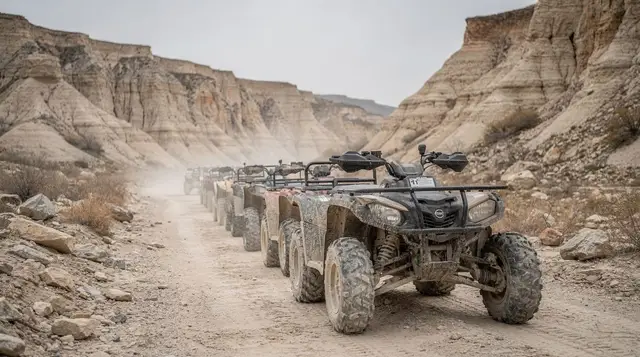
An ATV quad tour out of Göreme is a guided convoy of four-wheeled quad bikes riding single file along compacted tuf tracks through the valleys that ring the village. It is sold as an outdoor activity and it does put you inside terrain a car or jeep cannot reach, but the honest framing matters: this is a motorised activity first, and a valley experience second.
The engines are loud enough that conversation with the rider ahead is impossible once the group is moving, and the volcanic dust the tyres throw up hangs in the air behind each machine. If your mental picture is a quiet ride through fairy chimneys with birdsong in the background, that is not what this is. If you want a motor activity that happens to run through some of the more striking rock formations in Cappadocia, it delivers exactly that.
Groups meet in Göreme, usually mid-morning, midday, or at sunset, and get a short safety briefing plus a practice loop on flat ground before the convoy sets off. A guide leads at a pace set by the slowest confident rider, with a second guide often sweeping the back of the group. Tours are typically sold as single-rider quads with an option to ride as a passenger behind someone else, or occasionally as a shared buggy.
a guided ATV quad route through the valleys around GöremeWhere the quads actually go
Operators draw their routes from the network of valleys within easy reach of Göreme, most commonly stretches near Red Valley, Rose Valley, Love Valley, and the open tuf badlands around Devrent Valley and Çavuşin. These are wide, sandy-to-rocky tuf corridors rather than technical trails, which is why an automatic quad with no gears to manage suits first-time riders. A typical loop climbs onto a ridge for a viewpoint, usually timed for sunset departures, then drops back through a valley floor before returning to Göreme.
What the route is not is fixed. Two operators running “the same” tour on different days can end up covering different ground, because access to specific valley sections shifts with the season and with which tracks each company holds informal permission to use. Treat any published route map as indicative rather than a guarantee.
Why some valley sections are closed to quads
Göreme National Park and the Rock Sites of Cappadocia has been a UNESCO World Heritage Site since 1985, and the tuf that makes the valleys so striking is also soft and easily eroded by repeated vehicle traffic. As a result, sections of several protected valleys are closed to motorised vehicles altogether, and the boundaries of what is open move by season and by operator.
A track that carried quads last spring may be roped off this year, and a company that used one valley last summer may be running a different loop by autumn. This is not an oversight on the operator’s part; it is a genuine, moving restriction, and it is the reason no fixed itinerary should be treated as reliable more than a season out. If a specific valley matters to you for a photograph or a memory from a previous trip, ask the operator directly whether it is currently included rather than assuming.
Quad, jeep safari, or horse: how they actually differ
The three motorised-and-animal options sold around Göreme cover overlapping but distinct ground, and picking the wrong one for what you actually want is the most common regret travellers report afterwards.
| ATV quad | Jeep safari | Horse riding | |
|---|---|---|---|
| Group size per vehicle | 1 (or 1+1 passenger) | 6–8 typical | 1 rider per horse |
| Terrain covered | Valley floors, ridge tracks | Wider pistes, longer distances | Narrow, steep, or tight corners |
| Noise level | High, continuous engine noise | Moderate, engine noise but enclosed | Low |
| Dust exposure | High, worse towards the back of the convoy | Lower, riders are inside the vehicle | Low |
| Typical duration | 1.5–3 hours | 2–4 hours | 1–2 hours, longer for sunset rides |
| Physical demand | Moderate: balance, arm and core strength on uneven ground | Low: seated passenger | Moderate: core and leg engagement |
A jeep safari, such as the Göreme jeep safari through the wider Cappadocia valleys or the jeep tour departing from Göreme, carries more people per vehicle and covers longer distances on more open pistes, since a jeep needs a wider, more graded track than a quad does. It suits groups who want to see a lot of ground without physical effort, and riders inside an enclosed vehicle avoid most of the dust a quad convoy generates.
A horse, by contrast, goes places a quad and a jeep both cannot: narrow rock clefts, steep switchback paths, and tight corners between fairy chimneys that no wheeled vehicle can pass. A sunset horseback ride through the Göreme valleys trades speed and ground covered for access to the quieter, tighter terrain, with none of the engine noise. Riders who want the valleys to actually feel peaceful, rather than mechanically loud, tend to be happier on a horse than on a quad, even though the horse route usually covers less distance overall.
None of the three is objectively better. A quad tour is the right pick if you specifically want the sensation and pace of riding a motor vehicle over rough ground; a jeep safari is right if you want maximum ground covered with minimum effort; a horse is right if quiet and access to tight corners matter more to you than distance covered.
The dust and noise problem, honestly
This deserves its own section because it is the single most common complaint from riders who did not anticipate it. Quad convoys run single file on narrow tuf tracks, and the tuf itself is a soft, pale volcanic rock that turns to fine, powdery dust in dry conditions, which describes most of the riding season. Every machine in the convoy throws that dust into the air, and it does not settle quickly.
Riders near the front of the group get comparatively clean air; riders in the middle and especially towards the back spend much of the ride breathing, tasting, and wearing the dust kicked up by everyone ahead of them. By the end of a 2-hour tour, a rider at the back of a dusty convoy will typically have visibly dust-coated clothing, gear, and exposed skin.
There is no way to avoid this entirely if you are riding your own quad in a group, short of asking to ride at the very front, which not every operator can accommodate for every guest. A buff or scarf over the nose and mouth, and clear goggles rather than sunglasses, make a real difference. If dust is a genuine concern, for a respiratory condition or simply personal preference, a jeep safari or horse ride will suit you better than a quad tour.
Noise works the same way in reverse: it comes from your own machine rather than the group, but it is continuous and loud enough that helmet-to-helmet conversation is essentially impossible while moving. Guides communicate with hand signals and by stopping the group at intervals rather than by talking over engine noise.
What it costs and what is included
Prices for quad tours around Göreme vary by tour length, whether you ride solo or as a passenger, and whether the departure is a standard daytime slot or a sunset run, which sometimes carries a premium. As a rough guide, a 1.5 to 2-hour solo quad tour tends to sit at the lower end of the region’s adventure-activity pricing, with 3-hour and sunset departures costing more. Passenger seats behind another rider are usually discounted from the solo-rider price. Fuel, helmet, and a basic safety briefing are standard inclusions; goggles and a dust buff are included by some operators and sold or lent by others, so it is worth asking before you book rather than assuming.
Payment on the ground is typically accepted in Turkish lira, though many operators in Göreme also take cards or euros for tourist activities; carrying some cash in lira is still the safer default for smaller operators.
Practical details before you book
Closed shoes are effectively mandatory; sandals are not accepted by most operators for safety reasons. Trousers, rather than shorts, protect against both dust and minor scrapes from loose stones. Sunscreen goes on before the helmet, since exposed skin around the neck and lower face gets both sun and dust exposure. A change of clothes back at the hotel is a reasonable idea, since dust from a 2-hour tour tends to work its way into clothing seams.
The riding surface is loose, dry tuf, similar to the ground described in guides to hiking safety in the valleys: dusty, occasionally slippery on inclines, with very little shade. Heat in the July–August period makes midday tours more tiring than sunrise or sunset departures, and winter tours run in noticeably colder conditions with the possibility of frozen or muddy patches after rain or snow. Mobile phone signal is unreliable inside the deeper valley sections, the same limitation that applies to walkers and horse riders in the same terrain.
Anyone with back problems, recent joint surgery, or limited grip strength should be cautious: holding a quad steady on uneven, sometimes rutted tuf for 1.5 to 3 hours is more physically demanding on the forearms, shoulders, and core than it looks from a promotional photo. Pregnant travellers are generally excluded by operator policy, and most companies set a minimum age for solo riders, commonly 16 or 18, with younger children accepted only as a passenger behind an adult.
Who this tour actually suits
A quad tour makes most sense for travellers who specifically enjoy motorsport-adjacent activities, or a group looking for something more active than a jeep safari without the walking commitment of a full valley hike such as the Rose Valley hike or the routes covered in best hikes in Cappadocia. It suits people travelling without children under the minimum age, and it suits anyone who has already done a jeep safari or a valley walk on a previous Cappadocia trip and wants a different way to see similar ground.
It suits less well anyone hoping for a quiet, contemplative experience of the valleys, anyone sensitive to dust or engine fumes, and larger families with a mix of ages, where a jeep safari or a horse riding tour usually accommodates the group more comfortably. If you are undecided between all three, the comparison in valleys on foot, quad, or horseback walks through the trade-offs in more detail, and cycling and e-bikes in Cappadocia covers a quieter, self-paced alternative for travellers who want to cover ground under their own power rather than an engine’s.
Most visitors treat a quad tour as one activity within a longer stay rather than the centrepiece of a trip; it pairs naturally with a hot air balloon flight earlier in the same visit, since the balloon flight happens at dawn and the quad tour is more often run later in the morning, at midday, or at sunset, leaving no scheduling conflict between the two.
Cappadocia ATV quad tours: frequently asked questions
How long does an ATV quad tour in Cappadocia last?
Most operators in Göreme run tours of 1.5 to 3 hours, including a safety briefing and a short practice loop before the group heads into the valleys. Sunset departures tend to run at the shorter end because of fading light.
Do I need a licence to ride a quad in Cappadocia?
No driving licence is normally checked for the standard tourist quads used around Göreme, though operators set a minimum age, usually 16 or 18 to drive solo, with younger riders taken as passengers. Policies vary by company, so confirm at booking if you are travelling with teenagers.
Is the ATV tour better than a jeep safari?
They are different activities rather than one being simply better. A quad tour gets you into narrower, more textured sections of valley on your own machine; a jeep safari covers more ground in comfort with a driver, seats more people per vehicle, and produces far less dust for anyone riding in it.
Why do quad tours in Cappadocia feel dusty?
The tracks are compacted volcanic tuf, a soft, pale rock that turns to fine dust in dry weather. A convoy of quads throws that dust into the air continuously, and riders towards the back of the group spend much of the route breathing and eating what the lead machines kick up.
Can quads go everywhere in the Cappadocia valleys?
No. Sections of several protected valleys are closed to motorised vehicles, and which sections are open changes by season and by operator, partly to limit erosion of the tuf. Expect the guide to describe the day’s route rather than promise a fixed itinerary.
What should I wear for a quad tour?
Closed shoes, trousers rather than shorts, and clothing you do not mind getting dusty are the practical minimum. A buff or scarf to cover the nose and mouth helps considerably in the back half of the convoy, and most operators supply a helmet and goggles as standard.
Is an ATV tour suitable for beginners?
Standard tourist quads are automatic and operators run a briefing plus a short practice section before setting off, so no prior riding experience is assumed. Riders who are nervous on uneven ground or unused to handling a motorised vehicle may still find the loose tuf surface more demanding than expected.
Adventure & outdoor activities on GetYourGuide
Verified deep-linked GetYourGuide tours. Book through these links and we earn a small commission at no cost to you.
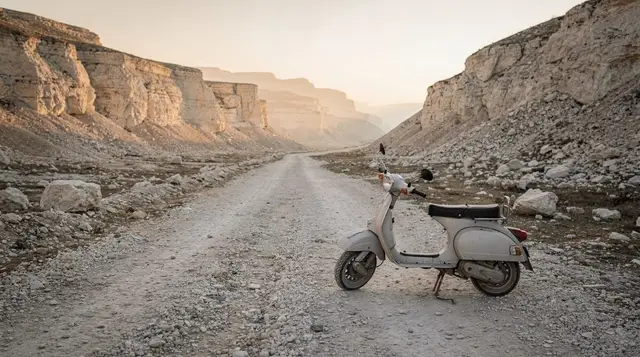
GetYourGuide does not provide a product photo for this activity — the image shows the meeting point, photographed by us.