Why the fairy chimneys are crumbling
The rock underneath is not built to last
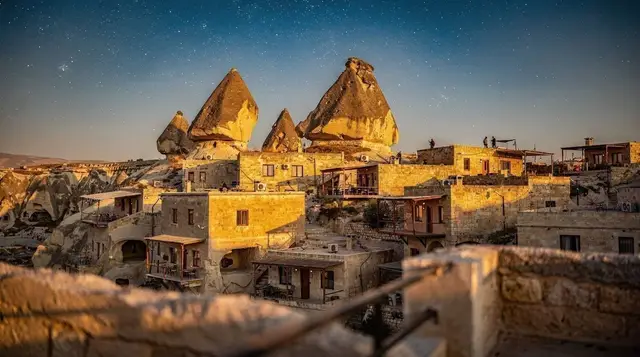
The first time I stood in Pasabag and looked up at a triple-capped chimney, my instinct was to think of it as a monument — something old, fixed, permanent. It isn’t. Every fairy chimney in Cappadocia is a structure actively being taken apart, on a timescale that runs from decades to a few centuries rather than millennia, and the ones I was looking at that afternoon are not the ones a visitor will see in fifty years.
The mechanism is simple once you know it, and once you know it you cannot unsee it. The plateau here is built from tuf, a rock formed from volcanic ash that fell from the Erciyes and Hasan Dağı eruptions and compacted over time. Tuf is soft — soft enough to carve with hand tools, which is exactly what generations of local people did to make cave houses, storage rooms and churches. Left exposed to weather, it erodes fast.
Sitting on top of many columns is a cap of basalt or another harder rock, debris from the same eruptions, and that cap does one job: it keeps rain off the tuf directly underneath it. The tuf around the cap, with no such shield, wears away faster. Over time this difference in erosion rate is what carves a flat plateau into standing columns with dark stone hats — the shape everyone recognises from a Göreme postcard.
What actually finishes a chimney off
Rain does most of the slow work, but it isn’t rain alone. Cappadocia’s winters bring genuine cold, and water that seeps into cracks in the tuf during the day and freezes overnight expands as ice, prising the crack a little wider each time. A single winter of freeze-thaw cycles can do more visible damage to a column than a whole summer of rain. It’s a strange thing to register while looking at snow settled on a chimney’s cap in January — it looks postcard-still, but that same snowmelt refreezing overnight is quietly working on the narrowest part of the neck below it.
Because the cap only protects the tuf directly beneath it, the column below keeps narrowing at the edges while the cap itself stays roughly the same size. Eventually the neck gets too thin to carry the weight above it, and the whole thing goes over. I’ve walked past enough stumps in Devrent Valley and around Zelve to know this isn’t a hypothetical: a chipped, headless pillar with rubble scattered at its base is simply what a fairy chimney looks like partway through its collapse, not after some unusual event.
Formations lose their caps or their balance on a regular basis here — it’s the ordinary state of the landscape, not an anomaly, and it’s part of why some trails or viewpoints get roped off after a slope is judged unstable. I don’t know of a published schedule for this, and I’d be suspicious of anyone who claimed one; it depends on the specific rock, the specific winter, and how exposed that particular stretch of path is.
A different kind of ruin
It’s worth separating this from the crowding conversation, because they get lumped together and they’re not the same thing. Whether the Göreme Open-Air Museum is unpleasantly busy at 11am is a logistics question with a logistics answer — go early, go late, pick a quieter valley. Whether a chimney in Rose Valley or Red Valley is structurally sound has nothing to do with tourist numbers at all. It’s geology running on its own clock, indifferent to season and to how many people are queuing for a photo. The two things happen to overlap in the same valleys, which is confusing, but one is about comfort and the other is about physics.
What struck me most, walking through Love Valley and later around Çavuşin, is how visibly mid-process everything is. Some columns still have their full cap and a thick, sturdy neck. Others have lost the cap entirely and stand as bare, tapering fingers of tuf, clearly on borrowed time. A few have already gone, leaving only a stub and a fan of rubble. It isn’t a museum of finished shapes — it’s a landscape caught at every stage of the same slow collapse, and the eroded husk of an old chimney is just as much the point as the intact one beside it.
What this means if you’re walking the valleys
None of this is a reason to avoid the valleys — people have lived in and around this rock for over a thousand years, and it isn’t going anywhere overnight. But it changes how I think about the marked paths. Staying on the trail in Uçhisar or through Devrent isn’t just tidiness or a rule someone made up for the sake of having a rule. The tuf really is soft, cracks really do widen with weather, and a slope that looks solid can be more fragile than it appears, especially near a chimney that has already lost its cap. A path that skirts wide around an exposed formation is usually doing that on purpose.
If you want to actually watch this process rather than just read about it, look closely at the chimneys around you for the tells: a hairline crack near the neck, a cap that looks slightly off-centre from the column beneath it, or a base ringed with loose debris. None of that is dramatic and you won’t see anything move while you’re standing there — this is a story that plays out over years, not afternoons. But it’s happening under every cap rock in the region, and it’s the reason this landscape keeps changing shape long after the volcanoes that made it went quiet.
For more on where that raw material came from, our guide to a hot air balloon ride over the fairy chimneys is one of the better ways to see the full scale of it from above, and a Göreme and Paşabağ valley day tour gets you close enough on foot to spot the cracks for yourself. If you’d rather watch the sunrise light hit the caps without flying, a sunrise balloon-watching outing over the fairy chimneys covers that from the ground.
Further reading
tours.Nature
Verified deep-linked GetYourGuide tours. Book through these links and we earn a small commission at no cost to you.
GetYourGuide does not provide a product photo for this activity — the image shows the meeting point, photographed by us.