Buying a carpet in Cappadocia
Do I have to buy a carpet after a demonstration in Cappadocia?
No. Accepting tea and watching several rugs unrolled creates no obligation to buy, however much pressure follows. A genuinely old or hand-knotted piece should come with a certificate of authenticity, and an opening price described as fixed that then drops sharply is a sign to negotiate harder or simply leave.
How a carpet demonstration actually starts
Walk into almost any carpet shop in Göreme, or in the nearby towns of Ürgüp or Avanos, and the pattern is close to identical. You are offered a seat and a glass of çay before anyone mentions a price. This is not a courtesy you are expected to reciprocate — it is part of how the shop operates, and it costs the owner very little. Sitting down and drinking the tea does not commit you to anything, and shop staff know that perfectly well; most people who accept the tea do not buy.
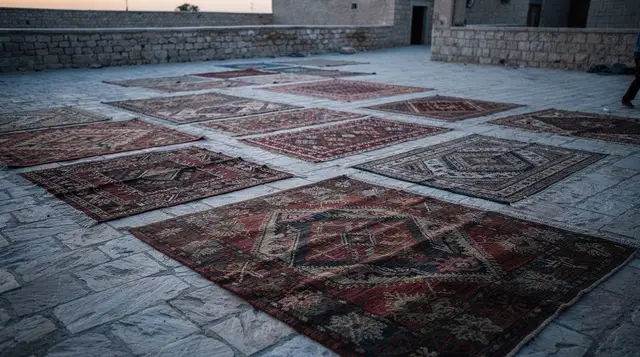
Once you are seated, an assistant, sometimes the owner, begins unrolling rugs one at a time onto the floor in front of you. Each one is placed, explained, then pulled back to reveal the next. It is a deliberate rhythm: a new piece keeps your attention on the floor rather than on a clock, and by the fifth or sixth rug it can feel harder to say no to all of them than it did to the first. That is the intended effect, not an accident of hospitality. If you know at the outset that you are not buying, it is entirely reasonable to say so before the first rug comes out — a shop used to tourism will usually accept that and either end the visit or continue anyway, without further pressure, if you seem genuinely curious.
Demonstrations like this happen whether you wander in independently from a walk around Ortahisar or Mustafapaşa, or arrive with an organised group. A Turkish Carpet Shopping Tour sold specifically around this experience, such as the carpet shopping tour built around workshop visits and a guided explanation of the craft, is more transparent about what you are signing up for than an unplanned stop tacked onto a Red Tour, but the mechanics inside the shop do not really change.
Knots, wool, silk, and where the story comes from
Somewhere in the demonstration, usually while a rug is still on the floor, someone will turn a corner over to show you the back and talk about the knot. Hand-knotted rugs are tied one knot at a time, and a finer, denser knot generally does represent more hours of work than a coarser one. Wool-on-wool pieces are the most common and the most affordable; wool-on-cotton is a step up; silk, or a silk highlight woven into a wool base, is sold as the premium tier and priced accordingly. All of that is real craft information, and it is worth listening to.
Where it gets harder to verify is provenance. You will often be told a rug’s village or region of origin, sometimes a family name, sometimes an age — “from Kayseri,” “over eighty years old,” “woven by a workshop connected to Avanos.” Some of this may be accurate. None of it is something you, standing in the shop, can confirm. A wear pattern, a faded vegetable dye and an old-looking wool base can all be reproduced on a rug made much more recently, and a confident, detailed story is not evidence on its own. Treat the knot and material explanation as useful technical information, and treat the story about age and origin as a claim that a proper certificate, not a verbal account, is supposed to back up.
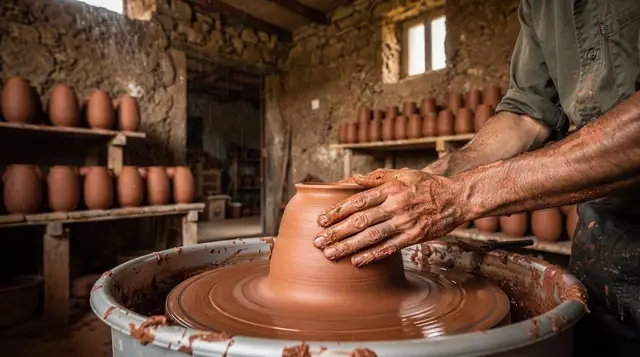
If the craft side interests you more than the sales pitch, watching artisans work without a purchase attached is easier at a dedicated pottery workshop in Avanos, where demonstrations of the potter’s wheel are the main event rather than a lead-in to negotiation, or on a guided pottery experience that focuses on technique rather than a sale.
The negotiation: how the price actually moves
After the demonstration comes the part most visitors find uncomfortable: a number. It is routinely presented as close to final — “this is already a good price,” “I cannot go much lower” — and then, over the following ten or fifteen minutes of conversation, it moves. A drop of a third or more between the opening figure and the one eventually accepted is not unusual. That gap is not a sign you have found a rare bargain; it mainly tells you the opening figure was set with room built in.
Because currency and price levels have moved a great deal in recent years, this guide will not give you a number to aim for — any figure printed here would likely be out of date within months, and quoting one risks anchoring you to the wrong price for the rug in front of you rather than its own quality. What is more useful is process advice:
- Ask the price of two or three comparable rugs before focusing on one, so you have a sense of the shop’s own range rather than a single anchor.
- Treat the first number as a starting point for discussion, not a ceiling or a floor.
- Take a real pause — step outside, discuss it between yourselves, sleep on it if the shop is still open the next day — before agreeing to anything you are not fully sure about.
- Decide your own top figure before the conversation gets detailed, and be willing to leave at that point even if the seller keeps talking.
A shop that responds to “we need to think about it” with sudden urgency — a “final” lower price offered only if you decide in the next few minutes, or a claim that the piece will be sold to someone else by evening — is applying pressure, not making you an exceptional offer. A rug that is genuinely available today is, in almost every case, still available tomorrow.
Certificates, provenance, and what “antique” should mean
If a rug is presented to you as old or antique, ask directly for a certificate of authenticity — a dated, written document from the seller that states the rug’s age, material and origin as they are representing it, ideally with the shop’s contact details on it. A shop confident in what it is selling will produce one without hesitation. A shop that becomes vague, changes the subject, or tells you the certificate “isn’t necessary because I can tell you myself” is giving you real information, even if it is not the information they intend to give.
A certificate does not turn a claim into proven fact — it is closer to a receipt for what you were told, which matters if you later want to insure the rug, resell it, or dispute the description. For anything sold and priced as a genuine antique rather than a well-made new piece, walking away without a certificate is a reasonable line to hold, whatever else about the visit felt honest.
What should actually worry you
Most carpet shops around Göreme, Ürgüp and Avanos are ordinary businesses selling a real, skilled product at a markup, in a way that is legal and broadly normal for the region. Three things, specifically, are worth treating as warning signs rather than routine sales technique:
| Signal | What it usually means |
|---|---|
| Insistent pressure to decide within minutes | Designed to stop you comparing prices or thinking it over |
| A price called “fixed” or “final” that then falls sharply | The opening figure was never really fixed |
| No certificate offered for a rug sold as antique or hand-knotted | The age or origin claim cannot be backed up in writing |
| Being told a rug is “the last one” or “sold to someone else tonight” | A manufactured urgency, common regardless of actual stock |
| Reluctance to let you leave and think it over | The seller is relying on the moment, not the product, to close the sale |
None of these on their own means the rug is fake or the shop is dishonest. Together, or repeated insistently, they are reason enough to leave, and leaving costs you nothing beyond the tea you already drank.
You are never obliged to buy
This is worth stating plainly: accepting a seat, drinking the tea, watching every rug in the shop be unrolled, and spending forty-five minutes hearing about knots and provenance creates no obligation to purchase anything. A clear “no, thank you” ends the visit. If it does not — if the conversation keeps circling back to price, or a manager appears to offer “one more” discount, or you are made to feel that the time spent means you now owe the shop a sale — that pressure is the shop’s choice, not a debt you have incurred. Leaving without buying is a completely ordinary outcome of a carpet demonstration, and shop staff who do this regularly expect it more often than they expect a sale.
Travellers uneasy about the whole dynamic are not obliged to enter a carpet shop at all. A walk through Göreme or Ürgüp can be done without stopping in any of them, and browsing the daily stalls covered in the guide to local markets involves far less commitment of time than a formal demonstration.
How this differs from onyx and jewellery shops
Carpet demonstrations are often mentioned in the same breath as the onyx and jewellery shops that also appear on organised tour routes, but the mechanics are not identical. Onyx workshops usually lead with a short, genuine demonstration of the polishing process before moving to a sales floor, and the pressure there tends to focus on gemstone claims and set prices for smaller items rather than a long negotiation over one large piece.
Carpets involve a bigger single purchase, a longer demonstration, and a negotiation phase that can run much longer than an onyx sales pitch. If you want the specifics of how the stone side works, that is covered separately in the guide to onyx and jewellery — the two are related but distinct enough to be worth reading independently before either kind of visit.
If you do want to buy
None of the above means a carpet is a bad purchase — hand-knotted rugs from this region are a genuine, long-established craft, and plenty of visitors buy one they are happy with for years afterwards. A few practical points make the process easier regardless of where you buy:
- Measure the space you intend the rug for before you travel, in centimetres, so you are not guessing against a shop floor.
- Ask what is included in the price — shipping, insurance and any import paperwork are sometimes bundled, sometimes charged separately, and it is worth knowing which before you agree a figure.
- If the rug is shipped rather than carried home, get a written timeline and tracking details; shipping itself is routine, but a vague answer about how or when it will arrive is not.
- A private shopping tour with a guide who can translate and explain what is being said removes some of the ambiguity, since the guide’s job is to represent your interests through the conversation rather than the shop’s.
- If shopping is not the point of the day and you would rather spend it on the landscape instead, a full-day tour built around the valleys and a wine tasting rather than shop stops is a straightforward way to see the region without a demonstration on the itinerary at all.
Carpet shop visit vs a dedicated shopping tour
| Wandering into a shop independently | A dedicated carpet shopping tour | |
|---|---|---|
| Time commitment | Open-ended, set by the shop | Scheduled, usually a fixed block of the day |
| Who explains the process | Shop staff, selling as they explain | Often includes a guide or workshop visit alongside the sales floor |
| Negotiation pressure | Can be intense with no third party present | Similar pressure, but a guide is present throughout |
| Best suited to | Confident negotiators who want to browse freely | First-time buyers who want structure and an explanation of the craft |
Neither format removes the negotiation itself — that is simply how these shops price their stock — but a guided visit gives you a second person in the room whose role is not to close the sale, which some buyers find makes the whole process considerably less pressured.
Carpet shopping in Cappadocia: common questions
Do I have to buy after accepting tea and a demonstration?
No. Tea, time and a friendly welcome are part of how these shops operate, not a transaction you have entered into. Shop owners in Göreme know that most visitors who sit down do not buy that day, and a straightforward no ends the visit without further obligation.
How long does a typical carpet demonstration last?
Thirty minutes to an hour is normal once tea, several rugs and an explanation of knots and materials are included. If you have said no twice and the visit is still being extended with new pieces or a manager stepping in, that is a pressure tactic, not genuine hospitality.
What does the knot count actually tell me?
A higher knot density generally means finer, more time-consuming work, and shops will often show you the back of a rug to demonstrate it. It is a real quality signal, but it is not proof of age or origin on its own, and a high knot count is sometimes used to justify a price that has little to do with the rug’s actual history.
Why did the price drop so much during negotiation?
Opening prices in these shops are frequently set high precisely so they can fall a long way and still leave a profit. A drop of a third or more between the first figure and the one eventually accepted is common and does not necessarily mean you found a bargain — it mainly tells you the first number was not a real price.
How can I tell if a carpet is genuinely old?
You mostly cannot, not from a single viewing under shop lighting. A wear pattern, vegetable-dye fading and a wool base can all be simulated on a new rug. A dated, itemised certificate of authenticity from the seller, and a willingness to have it checked independently, are the closest thing to reassurance available to a buyer with no textile background.
Are shops in Göreme different from those on an organised tour?
Not fundamentally. Both the Red Tour and independent walks through Göreme, Ürgüp or Avanos can end at a carpet shop, and drivers and guides sometimes receive a commission for bringing groups in. The demonstration itself follows the same pattern either way — tea, several rugs, an explanation, then negotiation.
What happens if a rug is shipped rather than carried home?
Shipping is routinely offered for larger pieces and is normal practice. Ask for a written shipping timeline, insurance details and a tracking method before paying, and treat a shop that is vague about any of the three as a reason to buy something you can carry yourself, or not to buy at all.
Is bargaining expected, or rude?
Bargaining is expected and is not considered rude in this context — it is how the shop’s own opening price is designed to be treated. What is worth resisting is being rushed into a number before you have had time to think, or made to feel that walking away without buying would be impolite. If the whole dynamic feels like more than you want to navigate, seeing Cappadocia without stepping into a shop demonstration at all is entirely possible — see the guide to seeing Cappadocia without a tour or the budget tool for planning a trip on your own terms, and the guide to safety and scams for the wider picture beyond carpets specifically.
Shopping & market tours on GetYourGuide
Verified deep-linked GetYourGuide tours. Book through these links and we earn a small commission at no cost to you.
GetYourGuide does not provide a product photo for this activity — the image shows the meeting point, photographed by us.