Buying onyx and jewellery in Cappadocia: what to know before you pay
Is it safe to buy onyx or jewellery in Cappadocia?
You can buy safely if you treat it as ordinary retail shopping, not a guaranteed investment. Natural, dyed, and reconstituted onyx can look identical to a non-specialist, and certificates handed over in-store are not independent proof. Buy only what you'd be happy to own at the price on the tag, whatever the paperwork says.
Onyx and jewellery: a different shop, a different set of risks
Cappadocia has three craft-retail stops that show up again and again on organised circuits: pottery workshops around Avanos, carpet and kilim demonstrations, and onyx or jewellery showrooms. They get bundled together in itineraries because they all sit well on a driving loop between valleys, but they are not the same product and they don’t carry the same pitfalls. The carpet trade has its own demonstration format, its own negotiation rhythm, and its own detailed page — see buying a carpet in Cappadocia for that. This page is only about onyx and jewellery: what’s actually being sold, why it’s harder than it looks to judge, and what a sensible, unhurried buyer does about it.
Nothing here is gemmological advice. Identifying and grading stones properly is a specialist skill that takes years to build and equipment a shop floor doesn’t offer you. The point of this page is the opposite: to explain why you, as a visitor with no lab and no loupe, should not expect to be able to tell what you’re looking at, and what that means for how you shop.
What “onyx” usually means in a Cappadocia showroom
The region sits on volcanic geology, not a gemstone belt, but Kayseri and central Anatolia have a long tradition of carving and polishing banded stone — commonly sold under the name “onyx,” though the material is often banded calcite or agate rather than true onyx in the strict mineralogical sense. That distinction rarely matters to how the shop prices or presents the piece; it’s used as a broad commercial name for a category of polished, often translucent, striped or swirled stone worked into eggs, chess sets, bowls, small animal figures, worry beads, pendants, and rings, frequently set with silver.
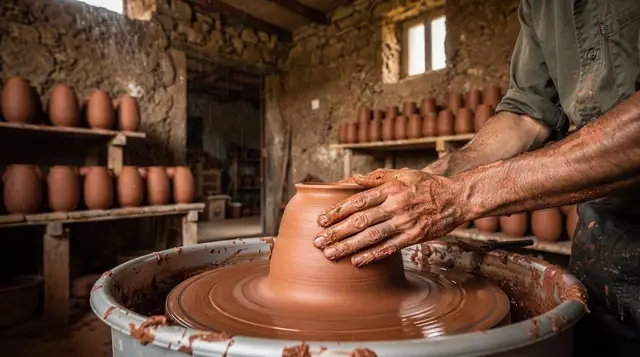
Workshops attached to these shops sometimes let you watch a piece being turned or polished, in the same way pottery shops in Avanos demonstrate the wheel — see the pottery workshops guide for that comparison. The demonstration is usually genuine craft work. What happens in the retail room afterwards is a separate question.
Why you can’t reliably tell what you’re buying
This is the single most important thing to carry into one of these shops: colour, shine, and even weight are not reliable indicators to an untrained eye. Three things get sold side by side, often on the same shelf, without a visible difference between them:
- Natural stone, cut and polished as it came out of the ground.
- Dyed stone, where colour has been added or intensified to make a pale or uneven piece look richer.
- Reconstituted or composite material, made from stone dust or fragments bound together and shaped, which can be finished to resemble a solid natural piece.
None of this is something you can settle by holding a piece up to the light in a shop, however confident the explanation you’re given sounds. Shop lighting is warm, directional, and chosen to flatter the display case, which makes judging true colour even harder than it would be in daylight. If distinguishing these matters to you, the honest position is that a holiday purchase, under time pressure, in a shop that also wants to sell you the piece, is not the setting in which that judgement can be made reliably.
Certificates: read them as marketing, not proof
Many onyx and jewellery shops in the region offer a certificate of authenticity with a purchase. Treat this the way you’d treat any document produced by the seller about their own product: it tells you what the shop is claiming, not what an independent party has verified. A certificate becomes worth something only when it names a specific, checkable laboratory or authority whose findings you could in principle look up or query independently — not when it’s a printed card with the shop’s own letterhead and a stamp.
A useful, low-effort check before you’re at the till: ask the seller directly which organisation issued the certificate and whether it’s independent of the shop. A clear, specific answer you could verify later is a different thing from a vague reassurance. If the answer is vague, price the piece as decorative jewellery bought on holiday, not as a graded or certified stone, and decide whether you’re happy to pay that price on that basis.
How the tour stop actually works
If you’re on an organised day tour rather than shopping independently, the onyx or jewellery stop tends to follow the same shape as the other workshop visits on the circuit: a short demonstration, a walk through the retail floor, tea or coffee offered while you look around, and staff available to talk through pieces.
It is a scheduled, expected part of several multi-stop itineraries, in the same way a pottery stop or a wine-cellar visit is — see Ürgüp’s wine cellars for the drinks-trade version of the same pattern. Some tour operators and drivers have referral arrangements with particular shops, which is a normal part of how these circuits are commercially structured; it doesn’t make the craft on display fake, but it’s worth knowing the stop is also there because it’s a sales opportunity, not purely a cultural detour.
You are not obliged to buy anything. Walking the showroom, having tea, and leaving without a purchase is completely ordinary and won’t cause friction with staff, who see it constantly. If you’d rather skip the retail stop altogether, ask your guide or driver in advance whether it’s built into the fixed schedule or whether you can use that stop’s time differently — on some circuits it’s flexible, on others it’s fixed into the group’s timing.
The table below is a rough map of where these stops sit relative to each other on the standard colour-coded circuits explained in full in the Red, Green and Blue Tour guide.
| Workshop stop | What’s demonstrated | Typical stop length | What’s being sold |
|---|---|---|---|
| Pottery (Avanos) | Wheel-thrown clay, often let you try | 30–45 minutes | Painted and glazed ceramics |
| Onyx / jewellery | Cutting or polishing of stone | 20–40 minutes | Carved objects, rings, pendants |
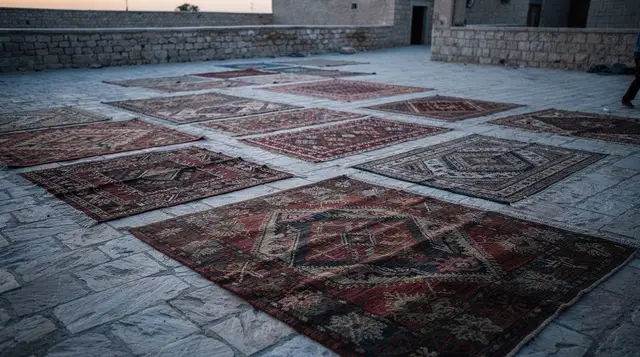
| Carpet / kilim | Weaving, sometimes a rug “reveal” | 45–90 minutes | Hand-knotted and machine rugs |
| Wine cellar (Ürgüp area) | Cellar tour, tasting | 30–60 minutes | Bottled wine by the case or bottle |
Durations vary by operator and group size, and none of these figures should be read as fixed.
Prices and negotiation
Prices in onyx and jewellery shops are, like most craft retail in the region, generally set with room to move rather than fixed. Small carved pieces such as worry beads or a single pendant can run from a few hundred to a couple of thousand Turkish lira; larger carved objects like eggs, bowls, or chess sets climb well beyond that, and set jewellery with silver or claimed gemstones varies enormously depending on size and what’s actually in the piece. These are wide, approximate ranges, not quotes — the lira is volatile and shop pricing for tourists shifts with the season, so ask locally and expect to negotiate rather than anchoring on any number you read in advance.
A slower pace generally works better than aggressive back-and-forth: ask questions, take your time, compare a few pieces, and be genuinely willing to leave without buying. Sellers who sense you’re on a fixed group-tour clock sometimes press harder; stepping back and saying you’ll think about it is a legitimate response, not rude.
If you decide to buy: general precautions
None of the following requires expertise — it’s ordinary consumer caution applied to a shop where the product is genuinely hard to assess:
- Price the piece as jewellery or a decorative object you like, not as a certified investment, regardless of what paperwork comes with it.
- Ask specifically whether any certificate names an independent, checkable authority, and if the answer is vague, weigh the price accordingly.
- Compare a few pieces and a few shops rather than deciding at the first stop, if your schedule allows it — the same caution that applies to carpet buying applies here.
- Card payment is accepted in most established shops in Göreme, Ürgüp, and Avanos, which at least gives you a paper trail; cash purchases at informal stalls don’t.
- If a “one-time only” or “today only” price is used to rush a decision, treat that as pressure tactics rather than a genuine limited offer — the same stone will be there, at some price, tomorrow.
- Keep any receipt and certificate together, and photograph both, in case you want to query the purchase after you’ve left the country.
If you’d rather have a guide present specifically to help navigate a shopping stop and translate what’s being said, a private guided option covering this ground exists — a private shopping tour with a guide who can talk through pricing and pieces on the spot — though the caution above about certificates and stone identification applies regardless of who’s translating for you.
Onyx shopping versus the other craft stops
It’s worth being clear about what’s different between the three workshop-and-shop stops that get bundled into Cappadocia itineraries, because the risks aren’t identical:
- Pottery (Avanos): the product is straightforward — glazed or painted ceramic, no authenticity question to weigh, mainly a question of taste and fragility for transport. A hands-on wheel session is offered as a pottery experience where you try the wheel yourself, which is a low-risk way to see the craft without a retail decision attached.
- Onyx and jewellery: the material itself is genuinely hard to verify, which is the whole subject of this page.
- Carpets: a different, more elaborate demonstration and negotiation process, covered on its own page rather than repeated here.
If you’re on a multi-stop day tour that includes several of these — a common pattern on the Red Tour circuit around Göreme — the practical approach is the same at every stop: enjoy the demonstration, treat the retail room as optional, and make any purchase decision on price and taste rather than on unverifiable claims.
Options that bundle a shopping stop into a wider day include a Red Tour day covering several craft and valley stops with lunch included and, for a broader day that pairs craft shopping with a cellar visit, a full-day tour that combines sightseeing with a wine-tasting stop.
Where this fits with the rest of your shopping in Cappadocia
Onyx and jewellery are one category among several worth knowing about before you shop in Göreme, Ürgüp, or Avanos — pottery, textiles, spices, and local produce markets each have their own patterns, covered in the broader souvenirs worth buying guide and the local markets day-by-day guide. For the wider question of tour touts and how commission-based referrals work across Göreme more generally, see how the tour touts of Göreme work, and for a general orientation on scams and pressure tactics across the region, the safety and scams guide covers the wider picture beyond shopping alone.
For an overview of the shopping category as a whole, the shopping and markets hub lists the other stops worth knowing about, and if you’re still building your route, the three-day Cappadocia itinerary shows where a shopping stop typically sits alongside Ürgüp, Ortahisar, and central Göreme on a standard schedule.
Onyx and jewellery shopping in Cappadocia: frequently asked questions
Is Cappadocia onyx real onyx?
Much of it is genuine banded calcite or agate, which is what most sellers mean by “onyx” in this market. Some pieces are dyed to even out or intensify colour, and some are composite or reconstituted material. None of this is reliably visible to a non-specialist under shop lighting.
Can I tell natural stone from treated stone by looking at it?
Not reliably. Colour saturation, evenness, and shine are not proof of anything on their own, and shop lighting is designed to flatter the display. Treated and reconstituted pieces are made specifically to look like the natural version.
Are the certificates given with onyx pieces trustworthy?
Treat any certificate handed over at the point of sale as part of the sales material unless it names an independent, checkable laboratory you can verify yourself. A certificate printed by the shop that sold you the stone is not independent verification.
Why do tour buses stop at onyx or jewellery workshops?
These stops are commonly built into multi-stop day tours alongside pottery workshops and wine cellars, and some drivers or agencies receive a referral arrangement from the shop. The demonstration is genuine craft, but the stop is also a scheduled sales opportunity.
Can I say no and skip the shop on a group tour?
Usually yes. The demonstration itself takes a few minutes to watch; you are not obliged to shop afterwards, and walking the showroom without buying is normal and expected by the staff.
Is Cappadocia jewellery a good investment?
Treat any jewellery bought as a souvenir at a fair retail price, not as an investment. Gemstone grading and resale value require independent, verifiable expertise that a holiday purchase cannot substitute for.
Should I bargain for onyx and jewellery?
Prices in these shops are usually set with room to negotiate, as with most Cappadocia craft retail. A slower, unhurried conversation and a willingness to walk away typically does more than aggressive haggling.
Where else do these workshop stops happen?
The same pattern shows up at pottery workshops in Avanos and at carpet and kilim demonstrations, which run on a similar structure but with their own negotiation dynamics covered separately.
Shopping & market tours on GetYourGuide
Verified deep-linked GetYourGuide tours. Book through these links and we earn a small commission at no cost to you.
GetYourGuide does not provide a product photo for this activity — the image shows the meeting point, photographed by us.