Aksaray and Güzelyurt day trip
What are Aksaray and Güzelyurt, and are they the same as Ihlara valley?
Aksaray is the provincial town on the road southwest from Göreme, and Güzelyurt is a troglodyte village about 20 minutes further on. Neither is Ihlara valley itself. They sit on the same road as the valley and are usually visited on the way to or from it, but Güzelyurt has its own cave houses, churches and monastery quarter that have nothing to do with the Ihlara canyon.
Not the same trip as Ihlara valley
Aksaray and Güzelyurt sit on the same road southwest out of the Cappadocia plateau that leads to Ihlara valley, and most visitors see them on the way to or from the canyon. But neither is the valley itself. Ihlara valley has its own entrance stairs, riverside path and separate page on this site with full walking detail. This page covers the two stops either side of it: Aksaray, the provincial town, and Güzelyurt, a troglodyte village with its own cave houses and rock-cut churches that have nothing to do with the Ihlara canyon walk. Treat them as an add-on to a longer day on this road, not as a substitute for the valley.
Where this sits on the map
Aksaray and Güzelyurt lie to the west of the Cappadocia plateau, on the same general axis as Tuz Gölü and Sultanhanı further along the same road toward Konya. From Göreme, Aksaray is roughly an hour and a half by road, and Güzelyurt around the same, since it branches off before the town centre.
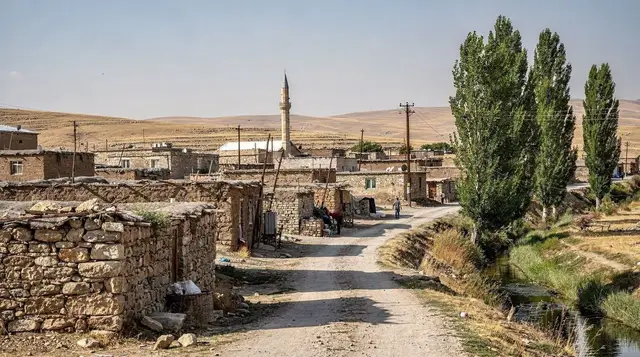
This is open plateau driving — flat, straight roads through wheat and potato fields, a long way from the cheminée-de-fée scenery around Göreme. If you are combining several stops on this route in one day, see the separate pages on Sultanhanı’s caravanserai and the Tuz Gölü salt lake day trip for what each adds — this page does not repeat their detail.
Aksaray: a functional stopover, not a destination
Aksaray is a provincial capital of a little over 100,000 people, with government offices, banks, supermarkets and ordinary town traffic. It is not styled or arranged for visitors, and it should not be sold as an attraction on the same level as Güzelyurt or the villages of central Cappadocia. Its practical use is as a lunch or fuel stop and a road junction: the routes to Ihlara valley, Güzelyurt, Sultanhanı and on to Konya all pass through or near it. If you are driving yourself, plan on Aksaray as a twenty-minute pause rather than a sight to walk around. There is little reason to detour into the town centre if your day is built around Güzelyurt and Ihlara.
Güzelyurt: cave houses without the crowds
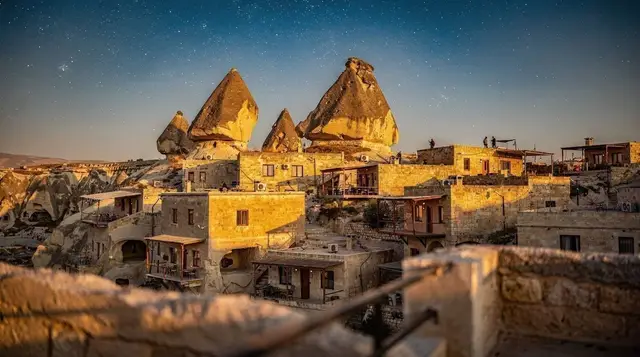
Güzelyurt is where the actual interest of this route lies. It is a village of around 5,000 people built into and around a valley of soft volcanic rock, much like the villages closer to Göreme, but without the ticket gates, souvenir stalls or scheduled tour buses. Houses here are carved directly into the hillside or built from cut stone blocks fronting rock-cut rooms — some still lived in, some used for storage, a handful converted into small guest houses.
The difference from Üçhisar or Ortahisar is atmosphere rather than geology: those villages have adapted heavily to visitors, with cafés, viewpoints and gift shops built around their rock formations. Güzelyurt has not, and walking its lanes feels closer to visiting an ordinary Anatolian village that happens to be carved from tuff.
The village was known as Karvala, then Gelveri, before the population exchange of 1923 sent its Greek Orthodox residents to Greece and brought Muslim families from Greece and the Balkans in the other direction — a history that parallels Mustafapaşa near Göreme, though Güzelyurt is far less visited and far less restored. Empty churches, a former monastery quarter and stone houses with carved doorways carry that history without much explanation on site, so it helps to know the background before you arrive.
| Stop | Distance from Göreme | Typical time on site |
|---|---|---|
| Aksaray | ~1 h 30 | 20–30 min (stop, not sight) |
| Güzelyurt village | ~1 h 15 | 60–90 min |
| Sarıca church and monastery valley | within Güzelyurt | 30–45 min |
The Sarıca church and Güzelyurt’s monastery quarter
On the edge of Güzelyurt, a shallow valley holds a cluster of rock-cut churches and former monastic cells, of which the Sarıca church is the best known. It is a carved church rather than a built one, cut into the cliff in the same tradition as the churches at Göreme’s open-air museum, but far quieter: there is usually no queue, no timed entry and often nobody else there.
The frescoes are patchier and less complete than the best-preserved churches near Göreme, which is the trade-off for the solitude. This is a stop for people who want to see the cave-church tradition without the crowds of the core sites, not for anyone expecting the condition of the Karanlık Kilise. Sturdy shoes help — the paths into the monastery valley are uneven rock and dirt, similar underfoot to the walking valleys around Göreme.
How Güzelyurt differs from central Cappadocia’s valleys
It is worth being explicit about what Güzelyurt is not. It is not a formation like Love Valley or Rose Valley, where fairy chimneys and canyon walls are the point and the walk is the product. Güzelyurt’s rock is the same volcanic tuff as the rest of the region, but the interest here is the village built into it and its layered history, not a scenic hiking route.
If what you actually want is a fairy-chimney valley walk, the pages on Rose Valley, Ihlara valley or the general best hikes in Cappadocia roundup are the better starting point. Güzelyurt is closer in spirit to a quiet, unrestored version of Mustafapaşa or a smaller cousin of Gümüşler monastery near Niğde, which has a comparable rock-cut monastery and church, better preserved but also more geared up for visitors.
Combining with Tuz Gölü and Sultanhanı
Aksaray and Güzelyurt sit conveniently between Cappadocia and two other stops on the same westward road: the Tuz Gölü salt lake and the Seljuk caravanserai at Sultanhanı. Both have their own detailed pages and are not covered here in depth, but the geography is worth noting for planning: a driver heading from Göreme toward Konya on the same day could realistically string together Güzelyurt, Aksaray, Sultanhanı and a stop at Tuz Gölü, though that is a full and fairly long driving day on top of whatever time you give Ihlara valley itself.
Read the Sultanhanı caravanserai day trip and salt lake day trip guides before deciding how much to combine in one outing, since both add meaningful driving time.
How to get there and how long to allow
Without a car, this route is difficult to do independently: there is no useful dolmuş service between Göreme and Güzelyurt, and the walk from any bus stop into the monastery valley is not signed for casual visitors. The realistic options are a rental car, a private driver, or a tour built specifically around this corner of the region rather than the standard Green Tour, which typically stops at Derinkuyu or Kaymaklı and Ihlara valley but skips Güzelyurt.
a guided day trip from the Aksaray side that pairs an underground city with a hilltop church covers some of this ground with a driver included, which removes the need to self-navigate the back roads into Güzelyurt. For a broader day that also takes in Ihlara valley and the southern underground cities, the Green Tour covering the south of Cappadocia is the standard packaged option, though as noted above it does not usually detour into Güzelyurt itself. If your plan is more open-ended, a general Cappadocia day trip with a private guide can be built to include Aksaray and Güzelyurt specifically if you ask in advance — worth confirming before booking, since it is not the default stop on most listings.
If you are driving yourself, allow a full day for Güzelyurt, Aksaray and Ihlara valley together: roughly an hour and a quarter each way from Göreme, plus 60–90 minutes in Güzelyurt, 30–45 minutes at the Sarıca church and monastery valley, a short stop in Aksaray, and whatever time you give Ihlara valley and Selime at the other end of the canyon. Departing by 8:00–8:30 keeps the day manageable; leaving later usually means cutting either Güzelyurt or the far end of Ihlara valley short.
What it costs
Entry to the Sarıca church and monastery valley in Güzelyurt is a modest site fee, in the same low range as the smaller regional churches rather than the flagship price of Göreme’s open-air museum. Aksaray itself has no entry cost since it is a town, not a site. Fuel and driver costs dominate the budget for this route given the distance from Göreme — a private driver for a full day covering Güzelyurt, Aksaray and Ihlara valley typically runs into the same range as a full-day Green Tour once fuel and time are factored in. For a fuller breakdown of typical daily spending across Cappadocia, see what a Cappadocia trip costs.
Practical notes
Güzelyurt sits noticeably higher and can feel a few degrees cooler than Göreme, so it is worth a layer even in summer if you are stopping at midday. There are a handful of small cafés and a guest house or two in the village, but nothing like the density of options in Göreme or Ürgüp — plan lunch either in Aksaray or bring your own if you are continuing straight on to Ihlara valley.
Mobile signal is patchy in the monastery valley itself, similar to the canyon at Ihlara. If you are self-driving, see the general notes on driving in Cappadocia and car rental before setting out, since road conditions and signage on this western stretch are more basic than the main tourist loop around Göreme.
FAQ about Aksaray and Güzelyurt
Are Aksaray and Güzelyurt the same trip as Ihlara valley?
No. Ihlara valley is a separate canyon walk with its own entrance, stairs and riverside path. Aksaray and Güzelyurt sit on the road to and from Ihlara and are usually added to the same day, but they are two distinct stops with their own sights, not an alternative name for the valley.
Is Aksaray worth stopping in for its own sake?
Not really. Aksaray is a working provincial capital with government offices, shops and traffic. It is useful as a fuel or lunch stop and a road junction, not as an attraction to plan a day around. Güzelyurt, 20 minutes away, is the actual reason to detour off the main Ihlara road.
What makes Güzelyurt different from Cappadocia’s better-known valleys?
Güzelyurt is a lived-in village rather than an arranged site. Its cave houses are still partly inhabited or used as storage, the streets are ordinary village streets, and there is no ticket gate or crowd management. It reads as a place people live rather than a site set up for visitors.
What is the Sarıca church in Güzelyurt?
It is a rock-cut church in Güzelyurt’s monastery valley, part of a wider group of carved churches and monastic cells cut into the cliff face on the edge of the village. It is smaller and far less visited than the churches at Göreme’s open-air museum.
Can I combine Aksaray and Güzelyurt with Tuz Gölü or Sultanhanı?
Yes, they sit on the same west-of-plateau route. Tuz Gölü and Sultanhanı have their own pages with full detail; this page does not repeat them. A full day combining Ihlara, Güzelyurt and one of those two stops is realistic if you start early and have a car or a private driver.
How much time should I set aside for Aksaray and Güzelyurt?
Güzelyurt itself takes an hour to ninety minutes on foot. Aksaray rarely needs more than a stop for food or fuel. Both together, without Ihlara valley, fit into two to three hours — but most visitors fold them into a longer day that also covers Ihlara or Selime.
Do organised tours from Göreme include Güzelyurt?
Most standard Green Tour itineraries focus on Derinkuyu or Kaymaklı, Ihlara valley and Selime, and skip Güzelyurt entirely. Reaching Güzelyurt usually means a private driver, a rental car, or a tour specifically built around this route rather than the standard packaged circuit.
Best day trips from Cappadocia on GetYourGuide
Verified deep-linked GetYourGuide tours. Book through these links and we earn a small commission at no cost to you.
GetYourGuide does not provide a product photo for this activity — the image shows the meeting point, photographed by us.