Most people who reach Güzelyurt do it by accident, on the tail end of an Ihlara Valley day that has run long. That is roughly the right way to arrive, and it is also why the village gets undersold. It is not a valley of fairy chimneys, and it has none of the balloon-launch drama of Göreme. What it has is a working village built almost entirely from cut stone, a large former church that has stood through three religions, and a short cave-church valley of its own that very few of the coaches doing the Green Tour circuit ever stop for.
Güzelyurt sits on the western edge of Cappadocia proper, closer to Aksaray than to Nevşehir, at a slightly higher and cooler elevation than Göreme. Until 1923 it was Karvala (also written Gelveri), a Greek Orthodox town whose population was moved to Greece under the compulsory population exchange that followed the Greek-Turkish war, and whose vacated stone houses were resettled by Muslim families arriving from Greek Macedonia in the opposite direction.
That double history is written into the streets more plainly than almost anywhere else in the region, including Mustafapaşa, which had the same fate. The difference is that Mustafapaşa now sells itself hard on that story, with restored mansions turned into boutique hotels, while Güzelyurt has stayed a plain, functioning agricultural village that happens to have a remarkable church at its centre.
A village, not a valley stop
The distinction matters for planning. Ihlara Valley and Selime are landscape and monument stops: you park, you walk a canyon or climb through a rock-cut monastery, and you leave. Güzelyurt is a place people still live in, with a market square, tea houses, and streets where washing hangs between stone balconies. There is no single ticketed site that defines a visit the way the Ihlara staircase or Selime Cathedral does. Instead there is a cluster of things worth twenty minutes each: the old church-turned-mosque on the square, the short walk into the monastery valley behind the village, and simply walking the older streets before the newer concrete infill takes over.
That makes Güzelyurt a poor standalone target from Göreme. At roughly 1h15 each way, a dedicated round trip for a village that rewards an hour or two of unhurried walking is a lot of driving for the return. It makes far more sense as an add-on to a day that is already going to Aksaray or Ihlara, since Güzelyurt sits only 10–15 minutes from both. If your day already includes the Ihlara Valley hike and a stop at Belisırma, Güzelyurt is the natural coda rather than a separate excursion.
Karvala before 1923
Güzelyurt’s Greek Orthodox history goes back much further than the population exchange, and further than most other Greek villages of central Anatolia. The area was already a Christian centre in late antiquity: Saint Gregory of Nazianzus, one of the most important theologians of the fourth-century Cappadocian Fathers, was born near here, and local tradition ties the region’s oldest churches to that period. Through the Byzantine and later Ottoman centuries, Karvala remained a substantial Greek-speaking, Greek Orthodox town rather than a village of a few families, which is part of why its stone architecture is so much more developed than the modest cave dwellings found elsewhere in Cappadocia.
The 1923 exchange, agreed between Greece and the new Turkish Republic, was compulsory and based on religion rather than language or self-identification — most Karvala Greeks by that point spoke Turkish as their first language, written in Greek script, a hybrid known as Karamanlidika. They left for Greece, mostly resettling around Nea Karvali near Kavala, a name that still preserves Karvala’s memory.
Muslim families displaced from Greek Macedonia arrived to take up the empty houses. It is the same mechanism that reshaped Mustafapaşa, and the same one described in the region’s broader Mustafapaşa and Sinasos guide — but Güzelyurt’s version of the story is less polished for visitors, which for some travellers is exactly the appeal.
The church on the square
The centrepiece of the village is a large former church standing directly on the main square, converted to a mosque after 1923 and still functioning as one today — visitors are welcome to look at the exterior and, when it is not in use for prayer, to see inside, though this guide will not promise specific opening times, since access follows prayer schedules rather than a fixed visitor timetable.
Architecturally it is unmistakably a nineteenth-century Greek Orthodox basilica: a bell tower, a stone facade with carved detail far more elaborate than the plain rock-cut churches found in the valleys around Göreme, and an interior scale that has no real equivalent in the smaller cave churches of the Göreme Open-Air Museum. Seeing it next to a working village square, rather than roped off as a monument, is the clearest single image Güzelyurt offers of what Karvala actually was.
Around the square, older stone houses continue the same material and the same period. Many are still lived in; some stand empty with collapsing upper floors. The stonework — carved lintels, arched doorways, occasional Greek inscriptions worn nearly flat — rewards slow walking rather than a single photo stop. This is the same architectural language you find in Mustafapaşa’s mansions, executed here at village scale rather than merchant-house scale, and with far fewer restorations smoothing out the wear.
Manastır Vadisi: the monastery valley
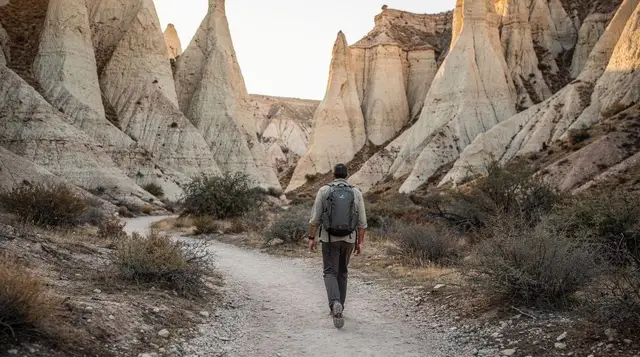
Behind the village, a short valley — locally known as Manastır Vadisi, the monastery valley — holds a scatter of rock-cut churches and hermitage cells cut into the cliffs, echoing the cave-church tradition of Ihlara and Zelve but on a much smaller, quieter scale. It is not signposted or promoted the way the Ihlara canyon is, and it sees a fraction of the visitors.
Where the best hikes in Cappadocia tend to mean multi-hour valley walks with real elevation change, this one is closer to a thirty-to-sixty-minute stroll: enough to see several cave openings and get a sense of a monastic settlement, without the logistics of a full canyon walk. Paths are informal tuf tracks rather than a maintained trail, so the general caution that applies to any of the region’s valley hikes — closed shoes, water, no reliable phone signal once you’re in among the rock — applies here too, on a smaller scale.
Because it is unticketed and unmanaged, do not expect information panels, a marked route, or anyone selling tickets or guiding at the entrance. What you get instead is quiet: on most days you will have the valley to yourself or close to it, which is not something you can say about Ihlara’s main gorge in the middle of a Green Tour morning.
Güzelyurt versus Mustafapaşa
Travellers who have already done Mustafapaşa sometimes ask whether Güzelyurt is more of the same. It shares the theme — a Greek Orthodox village emptied in 1923 — but the experience is different enough to justify both if you have the time, or to pick based on what you want.
| Güzelyurt | Mustafapaşa | |
|---|---|---|
| Distance from Göreme | About 1h15 | About 20 minutes |
| Character | Working agricultural village, little tourism infrastructure | Restored mansions, boutique cave hotels, more polished |
| Main draw | Converted basilica on the square, monastery valley walk | Carved stone mansion facades, Greek churches, wine tasting |
| Typical visitor | Combined with an Ihlara Valley day | A stand-alone half-day from Göreme or Ürgüp |
| Crowds | Very light | Light to moderate |
If you only have time for one and you are not already near Ihlara, Mustafapaşa is the easier choice logistically. If your day is built around Ihlara Valley and Aksaray anyway, Güzelyurt costs you almost nothing extra and shows a rawer version of the same history.
Getting to Güzelyurt
There is no practical dolmuş route from Göreme to Güzelyurt for a same-day round trip; village-to-village minibuses in this direction run on light, infrequent schedules aimed at local traffic between Aksaray and the surrounding villages, not at day-tripping visitors. In practice this means a rental car, a private driver, or a customised tour. General notes on driving in Cappadocia and car rental in Cappadocia apply here — roads to Güzelyurt are paved and easy, mostly open agricultural land rather than mountain driving, so this is one of the more forgiving self-drive legs in the region.
Travellers without a car who still want to see Güzelyurt should look at private options built around Ihlara and Aksaray, or ask a driver already booked for an Ihlara day to add the roughly fifteen-minute detour; see the broader case for and against organised transport in seeing Cappadocia without a tour.
Most of the standard Green Tour itineraries sold in Göreme do not include Güzelyurt at all — they focus on Derinkuyu or Kaymaklı, the Ihlara canyon walk, Selime, and Pigeon Valley, and the day is already full. If Güzelyurt matters to you specifically, it is worth asking an agency directly whether a given Green Tour departure stops here, rather than assuming, since itineraries vary between operators even under the same “Green Tour” name.
a standard Green Tour covering Derinkuyu and Ihlara Valley is the most common way independent travellers see this part of the region, though it will not include Güzelyurt unless you confirm it in advance. For a version with a seated meal built in, a guided Green Tour with lunch included covers the same ground at a more relaxed pace. Travellers who want to combine the Ihlara side of the region with a cave-hotel stay and a balloon flight in one package can look at a combined cave hotel, Ihlara and balloon flight package, which puts you within easy reach of Güzelyurt for a self-arranged half-day extension.
Combining Güzelyurt with an Ihlara day
The most efficient shape for a day that includes Güzelyurt without repeating what a standard Ihlara Valley visit already covers: start early at the main Ihlara staircase, walk the roughly 4km maintained stretch of the canyon down toward Belisırma, stop for lunch there by the river, then continue on to Selime to see the rock-cut monastery at the valley’s far end.
Güzelyurt fits at the close of that loop, on the way back toward Aksaray or Göreme, as a stone-village counterpoint to a day that has otherwise been canyon and cave-church scenery. Treat it as an hour to ninety minutes: the church square, a walk through a few of the older streets, and — if you still have energy after the canyon walk — a short pass through the monastery valley.
Trying to add Güzelyurt to a Red Tour day, or to any itinerary based around Göreme’s northern valleys, does not work geographically; it belongs firmly on the Aksaray–Ihlara side of the region, and the Red Tour, Green Tour and Blue Tour explained guide is worth reading first if you are still deciding which circuit fits your interests.
Travellers building a longer, unhurried route through this side of Cappadocia and on to Konya may also find the pacing notes in a slow five-day Cappadocia itinerary or Cappadocia and Konya in four days useful for where a Güzelyurt stop fits without turning the day into a forced march.
Practical notes
There is no significant hotel infrastructure in Güzelyurt itself; nearly all visitors base themselves in Göreme, Ürgüp or one of the cave-hotel villages and see Güzelyurt as a day stop rather than a place to sleep. A handful of simple village lokantas around the main square serve straightforward Turkish food — soups, stews, gözleme — at prices well below anything in Göreme’s tourist-facing restaurants; there is no real “dining scene” here, and that is more or less the point. Bring cash: card acceptance in a village this small and this lightly touristed is not something to count on, even where a machine is present.
The village sees essentially no aggressive touting, carpet-shop pressure or the kind of tour-reselling common outside Göreme’s more visited sites — one of the quieter upsides of a place that has not been built around tourism. What it also lacks is any real visitor infrastructure: no ticket booth staff to ask questions of, limited signage, and no guarantee that the church interior will be accessible at the time you arrive. Travellers who need a fully organised, ticketed, predictable stop should treat Güzelyurt as a bonus rather than the anchor of their day; travellers happy to wander a stone village on its own terms will get more out of it than the guidebooks suggest.
Frequently asked questions about visiting Güzelyurt
Is Güzelyurt the same as Karvala or Gelveri?
Yes. Güzelyurt is the Turkish name given to the town after 1923; before the population exchange it was known as Karvala, also spelled Gelveri, and was a substantial Greek Orthodox town rather than a small village.
How far is Güzelyurt from Ihlara Valley?
Around 10–15 minutes by car, which is why nearly every visitor combines the two rather than treating Güzelyurt as a separate destination from Göreme.
Can I visit Güzelyurt without a car?
Not easily as a same-day round trip from Göreme. There is no tourist-oriented public transport link, so a rental car, private driver, or a tour that includes Güzelyurt in its Ihlara itinerary are the realistic options.
Is the old church in Güzelyurt open to visitors?
The former basilica on the main square now functions as a mosque, and it is generally possible to see the exterior and, outside prayer times, the interior. This guide does not state fixed visiting hours, since access follows the mosque’s prayer schedule rather than a set visitor timetable.
Is Güzelyurt worth visiting compared to Mustafapaşa?
They cover similar history but differently: Mustafapaşa is more restored and easier to reach from Göreme on its own, while Güzelyurt is rawer, quieter and only really worth the drive as part of an Ihlara Valley day.
How much time should I set aside for Güzelyurt?
An hour to ninety minutes is enough for the church square, a walk through the older streets, and a short pass through the monastery valley behind the village, assuming it is added onto an existing Ihlara or Aksaray day.
Does the Green Tour include Güzelyurt?
Most standard Green Tour itineraries do not stop in Güzelyurt; they focus on Derinkuyu or Kaymaklı, the Ihlara canyon, Selime and Pigeon Valley. If Güzelyurt matters to you, confirm with the operator before booking rather than assuming it is included.
Is there anywhere to stay overnight in Güzelyurt?
Very little formal accommodation exists in the village itself. Almost all visitors base themselves in Göreme, Ürgüp or a nearby cave-hotel village and see Güzelyurt as a half-day stop rather than an overnight base.