Selime Cathedral: Cappadocia's Largest Rock-Cut Monastery
What is Selime Cathedral and is it worth visiting?
Selime Cathedral is a large rock-cut monastic complex at the northern end of the Ihlara Valley, built around a vaulted great hall and a courtyard climbing several levels into the cliff. It sits apart from the main valley walk and works either as its finishing point or as a standalone stop, and it is worth the visit for the scale of the hall alone.
A monastery built for scale, not for quiet corners
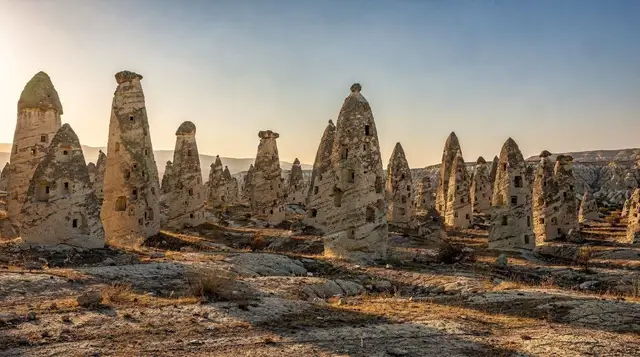
Most of the rock-cut sites around Göreme are small: a chapel here, a handful of cells there, a fresco you have to crane your neck to see properly. Selime Cathedral is the exception. At the northern mouth of the Ihlara Valley, above the village of Selime, the cliff face has been hollowed into a monastic complex big enough that first-time visitors often ask, out loud, how anyone carved something this size by hand. The answer is centuries of patient work in soft volcanic tuf, the same rock that shaped the Ihlara Valley itself.
This page covers the cathedral as a destination in its own right, separate from the mechanics of the valley walk. If you are planning the walking route along the Melendiz river, with its stairs, distances, and timing between the trailhead and Belisırma, that belongs on the Ihlara Valley hike guide. What follows here is what you find once you arrive at Selime: the layout, the great hall, the climb, and how the site fits into a day that starts elsewhere.
Why “cathedral” and not “church”
The name is a later, informal one. Selime Cathedral was never a bishop’s seat in the way a cathedral technically requires. It earned the label because of its principal chamber: a barrel-vaulted hall large enough to feel closer to a nave than to the small, single-room chapels scattered across the rest of Cappadocia. Locally it is also called Selime Monastery, and both names refer to the same complex, so do not expect two separate sites if you see the alternative name on a map or a tour itinerary.
The complex was carved as a working monastery, not a single church. Alongside the great hall you will find what were once a kitchen with a soot-blackened chimney flue, sleeping cells arranged over multiple floors, stables cut low into the rock, storage niches, and a smaller chapel with faint traces of paint rather than the fuller fresco cycles found elsewhere. It reads less like a monument built to be admired and more like a settlement that happened to be carved rather than built, which is a useful way to think about it before you go in.
The great hall
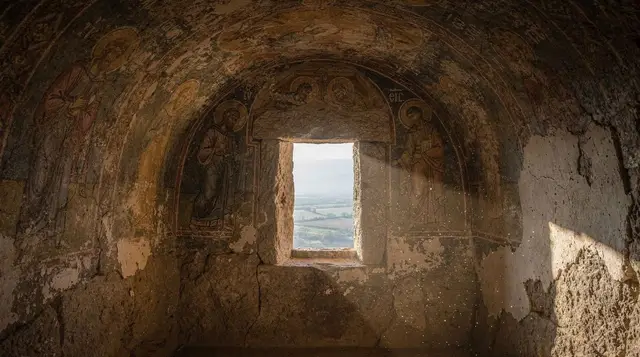
The hall is the reason most people remember Selime Cathedral after they have forgotten the smaller stops on a Green Tour itinerary. Columns and a vaulted ceiling have been left standing in the rock rather than added to it, carved away from the surrounding stone so that what remains reads as architecture rather than a cave. Light comes in through a handful of openings, enough to make the space usable without a torch on a clear day, but dim enough that the scale takes a moment to register once your eyes adjust.
The hall’s size and setting have made it a location for film and television productions over the years, and guides at the site are usually happy to point out where crews have worked in the past. Treat that as a detail worth asking about on the day rather than something to plan a visit around, since productions come and go and the hall’s real appeal is architectural rather than cinematic.
The climb: a courtyard on several levels
What sets Selime Cathedral apart from a straightforward walk-through site is the vertical layout. A rock-cut courtyard behind the main hall climbs through several levels via a mix of tunnels, narrow passages, and worn stone steps, connecting the kitchen, cells, and stables that were carved at different heights into the same cliff face. There is no single route through it; passages branch, double back, and occasionally open onto small terraces with views over the Ihlara Valley and the village of Selime below.
This climb is the main reason to budget more than a quick look at Selime Cathedral. It is also the part of the site that demands the most care. The passages narrow enough in places that taller visitors will duck, the steps are irregular and smoothed by centuries of use rather than cut to a consistent rise, and there is little to no artificial lighting or handrail support once you move away from the great hall. None of this makes the site dangerous for a reasonably careful visitor, but it is not the place for flip-flops, and it is worth going slowly rather than rushing through in a group.
Where Selime Cathedral sits on the map
Selime village sits at the far northern end of the Ihlara Valley system, downstream from Belisırma and close to the district of Güzelyurt. The cathedral itself is a short, signposted walk up from the village, separate from the riverside path that runs through the valley proper.
| Coming from | Route | What it means for your day |
|---|---|---|
| Belisırma, on foot | Continue north along the valley path | Selime Cathedral becomes the natural finishing point of the walk, reached after the riverside stretch rather than before it |
| Belisırma or Ihlara village, by road | Short drive north | Skips the valley walk entirely; suits a shorter visit focused on the monastery itself |
| Güzelyurt | Short drive south | Convenient if you are combining Selime with a look at Güzelyurt or Gümüşler Monastery on the same day |
| Aksaray | Short drive | Selime is the closer of the two directions when approaching from Aksaray rather than from Göreme |
If your route brings you up from Belisırma along the valley floor, Selime Cathedral is the logical place to stop walking and meet a vehicle, since there is little reason to backtrack once you have covered the main stretch. Coming the other way, starting at Selime and working south towards Belisırma, the cathedral becomes the opening stop of the day rather than the closing one. Either direction works; what matters is deciding which way round before you book transport, since public options thin out at both ends.
Selime versus the rest of the Ihlara system
Selime Cathedral is often mentioned in the same breath as Ihlara Valley and Belisırma, but the three offer different things, and conflating them leads to disappointed expectations.
| Site | What it actually is | Typical time needed |
|---|---|---|
| Selime Cathedral | A large, multi-level rock-cut monastery you climb through | 45 minutes to an hour |
| Ihlara Valley walk | A riverside path past dozens of smaller rock-cut churches | Covered separately on the Ihlara Valley hike guide |
| Belisırma | A riverside hamlet with trout restaurants, roughly midway along the valley | A lunch stop rather than a sightseeing destination in itself |
| Gümüşler Monastery | A separate rock-cut monastery near Niğde, known for a well-preserved fresco of a smiling Virgin Mary | Best treated as its own outing; see the Gümüşler Monastery guide |
Selime Cathedral rewards the climb and the scale of the hall; the valley walk rewards the accumulation of small, quiet churches along the river. Trying to do both properly in the time left over from a half-day tour usually means shortchanging one of them, so it is worth deciding in advance which is the priority for your day.
Visiting as part of a tour
Selime Cathedral is a standard stop on Green Tour itineraries, which run south from Göreme to cover the underground cities, the Ihlara Valley, and Selime in a single day. It also appears on more focused itineraries built specifically around Ihlara Valley and Selime, which spend proportionally more time here rather than treating it as one stop among five or six.
a Green Tour that pairs a section of the Ihlara Valley with a visit to Selime Cathedral is the most common way to see the site without organising your own transport, and it typically bundles lunch and an underground city into the same day. If Selime and the valley walk are the actual priority rather than a box to tick alongside the underground cities, a guided hike through Ihlara Valley that finishes at Selime Monastery spends more of the day on foot and less of it on a coach. For a longer day that adds Derinkuyu to the same itinerary, a deluxe tour covering Ihlara Canyon, Derinkuyu, and Selime is worth comparing against the standard Green Tour on price and group size before booking.
If you would rather understand how Green, Red, and Blue tours differ before choosing one, the comparison of Cappadocia’s colour-coded tours lays out what each itinerary actually covers.
Visiting independently
Driving to Selime independently makes sense if the cathedral, rather than the full valley walk, is your priority, or if you are combining it with Aksaray or Güzelyurt on the same day rather than with Göreme’s other sights. Notes on vehicle hire and road conditions are covered on the car rental and driving in Cappadocia guides rather than repeated here.
Without a car, reaching Selime independently is harder than reaching the closer sites around Göreme; the guide to getting around without a car covers what public transport and dolmuş routes can and cannot do this far south, and for most visitors without their own vehicle a tour remains the more practical option.
Reading the site as a village carved into a cliff
It helps to arrive with the right question in mind. Instead of looking for the one great sight, look for how a community lived here: where food was prepared, where animals were kept, where people slept, and where they gathered. The soot-darkened kitchen flue, the low stable openings and the stacked cells all make sense once you see them as parts of one household of monks. Walking the courtyard with that picture in your head turns a set of empty rooms into something readable, and it is the same logic that explains the underground cities further south, where daily life also moved into the rock.
The soft volcanic stone is the other half of the story. It is easy to carve when freshly cut and hardens with exposure, which is why entire facades could be shaped into rooms and why the surfaces you touch are so smooth. If the geology interests you, the volcanoes that made Cappadocia explains where this rock comes from, and the why the fairy chimneys are crumbling article is a sobering reminder that the same softness makes these structures fragile.
Photography and light
The hall photographs best when you let your eyes adjust and then shoot toward the openings, where the contrast between dim interior and bright sky gives the columns their shape. Wide-angle views are hard to get indoors, so expect to take the hall in sections rather than in a single frame. On the upper terraces the reward is the view over Selime village and the valley, and these frames work well whenever the sun is not directly overhead. If photography is the main purpose of your trip, the photography itinerary shows how a day this far south can be balanced against the balloon viewpoints and valleys closer to Göreme.
Be considerate with the narrow passages: stopping to take a photograph in a tunnel blocks everyone behind you, so step onto a terrace or into a wider chamber first.
Pairing Selime with an underground city
Because the cathedral lies so far from Göreme, most people see it as part of a long day, and the underground cities are the usual companion. If that is your plan, a day tour that combines an underground city, the Ihlara Valley and Selime Monastery keeps the logistics in one place. To choose between the two best-known underground sites, the Derinkuyu or Kaymaklı comparison helps, and the Derinkuyu guide covers that stop in more detail. Anyone uneasy about tight spaces should read underground cities and claustrophobia before booking a day that includes both.
Who will enjoy Selime most
Selime suits curious, steady-footed visitors who like to explore rather than be guided along a fixed path. Families with older children often enjoy the scrambling and the sense of discovery, though the Cappadocia with kids guide is worth a look first, because small children need close supervision on uneven steps. Visitors with limited mobility will find the interior difficult, and the guide for limited mobility suggests easier alternatives. Solo travellers can reach the site comfortably on a tour, and the solo travel guide covers how to approach a long day alone.
Choosing the season for your visit
The interior stays cooler than the open valley, which makes Selime a pleasant stop on a hot day, while the approach and the upper terraces are exposed to the sun. In the colder months the rock can feel damp and the steps slippery, so take extra care. For help choosing when to go, see the best time to visit Cappadocia and the Red Tour versus Green Tour comparison, which explains why the southern itinerary suits some travellers better than the northern one.
What to expect on arrival
The approach from the village involves a short uphill walk before you reach the entrance to the complex, so factor that in on a hot afternoon. Once inside, there is no fixed route; you can spend as little as twenty minutes seeing the great hall and turning back, or closer to an hour working through the upper levels of the courtyard. Groups on a tight tour schedule often get the shorter version by default, so if the climb is the part you actually want to see, say so to your guide before the group heads back down.
Bring water even for a short visit, since the climb inside is more physically demanding than it looks from the entrance, and wear shoes with grip rather than anything open-toed. A phone light or small torch is useful in a few of the darker inner chambers, though the great hall itself gets enough natural light to see comfortably.
For general context on rock-cut churches and how to read the surviving fresco fragments across the region, the guide to cave churches and frescoes is a useful companion, and if Selime is one stop on a longer day built around Aksaray and Güzelyurt, the day trip guide covering both lays out how the pieces fit together. Walkers planning routes beyond the valley floor may also want the broader best hikes in Cappadocia overview for how Selime compares to other walking options in the region.
Museum & art tours on GetYourGuide
Verified deep-linked GetYourGuide tours. Book through these links and we earn a small commission at no cost to you.
GetYourGuide does not provide a product photo for this activity — the image shows the meeting point, photographed by us.