Cappadocia in the snow: what actually changes on the ground
What does snow actually do to a Cappadocia trip?
Snow settles on top of the fairy chimneys and softens the whole landscape, which is the reason people chase it with a camera. It also glazes the tuff paths in the valleys, closing or slowing some of the easiest walks, and it comes with the worst balloon cancellation rate of the year.
Cappadocia in winter is already covered elsewhere on this site, with the temperatures, the crowd drop and the general price picture for the cold months. This page stays on one narrower question: what does snow itself do, on the ground, once it actually falls. It is a different topic from winter in general, because whether or not it snows on a given trip is close to a coin toss even within the coldest months, and the practical effects are specific enough to deserve their own page rather than a paragraph inside a broader one.
If you are still deciding when to come, Cappadocia in winter and the month-by-month overview set the wider picture, and the best time to visit Cappadocia compares snow with the other seasons. For a ready-made plan built around the cold, see the winter itinerary.
The look, and why people chase it
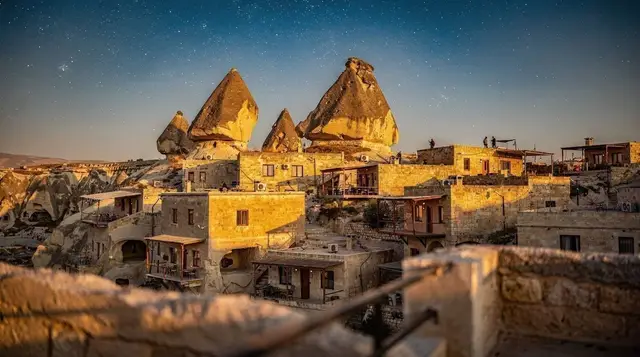
The fairy chimneys are cones of tuff with a harder cap of basalt or a resistant layer sitting on top, which is the whole reason they exist rather than eroding flat like the rest of the plateau. That same irregular shape holds snow unusually well. A modest overnight fall does not read as a dusting the way it would on flat farmland; it sits on top of every cone and pinnacle as a distinct white cap, with the ochre and pink tuff still showing on the vertical faces underneath. The contrast is the whole effect, and it is the reason photographers plan trips around a forecast rather than a season.
The valleys themselves go quiet in a way that is hard to get any other time of year. Rose Valley and Red Valley, usually walked by a steady trickle of people, empty out almost completely after snow, partly because the trails get harder and partly because visitor numbers in general drop through winter. Love Valley’s rock pillars under a cap of snow are one of the more photographed sights in the region for exactly this reason. Devrent Valley, which has no churches or structures to look at and is normally treated as a quick stop, changes character more than most: with nothing but eroded shapes and snow, it reads closer to a sculpture park than a roadside curiosity.
Morning light on fresh snow is particular here. The plateau sits at altitude, the air is dry, and a clear morning after a snowfall produces a low, sharp light that picks out every ridge and cone shadow across a valley. It does not last; by mid-morning the snow on sunlit slopes is already retreating and the flat, even light that follows is far less dramatic. If the forecast shows snow overnight, the two or three hours after sunrise are the window that matters.
If you want to know how these cones came to be in the first place, the story of the volcanoes that made Cappadocia explains it, and why the fairy chimneys are crumbling is a useful companion read for anyone watching the rock under snow.
Where the effect shows up best
Not every site benefits equally, and some are worth skipping on a snow day in favour of others.
Uçhisar Castle and the village below it sit at the highest point in the region, and the view from the top under fresh snow takes in a wide sweep of the valleys around Göreme rather than a single formation. It is reached by a short paved climb rather than a valley trail, so it stays workable even when the ground underfoot elsewhere has turned to ice. The panorama viewpoint above Göreme itself gives a comparable wide view with almost no walking at all, which makes it the easiest stop on a morning when trails are questionable.
Rose Valley and Red Valley, best known as sunset walks in warmer months, are worth reconsidering under snow: the colour contrast that gives them their names is still there, but it now sits under white caps rather than under a summer sky, and the light works differently. Paşabağ, known in English as Monks Valley for its double- and triple-capped chimneys and the hermitage cut into one of them, is a short, mostly flat stop that holds up well in snow without demanding a real hike. The Göreme Open-Air Museum, with its cluster of rock-cut churches in a small cirque, photographs well with snow on the surrounding cones, though the site itself is a paved and stepped circuit rather than open ground, which matters for the next section.
Each of these stops has its own page if you want the detail: Uçhisar Castle, the Göreme panorama, Paşabağ, Rose Valley, Red Valley and the Göreme Open-Air Museum.
Walking the valleys after snowfall: what actually changes
This is the part that trips people up, because the same valleys that are an easy, unremarkable walk in September become a genuinely different proposition after snow.
The paths through Rose Valley, Red Valley, Love Valley and the rest are cut into tuff, which is soft and dusty in dry weather and turns slick fast once it is wet or frozen. Snow itself is manageable if it stays powdery, but the freeze-thaw cycle that is common on the plateau in winter turns a snowy path into a sheet of ice on shaded, north-facing sections by the following morning, even after the surface elsewhere has cleared. Steps carved directly into the rock, common on approaches to viewpoints and church entrances, are the worst of it: there is no traction to be had on an icy stone step, and a slip there is a real fall rather than a stumble.
Some valley sections close outright after a heavy fall, at the discretion of local operators and municipal staff rather than on any fixed schedule, and reopen once conditions ease. There is no central notice board for this. The only reliable way to know what is open on a given morning is to ask locally: your hotel, a tour desk in Göreme, or the drivers who run the region’s organised circuits will know which sections are currently walkable and which are not, because they have usually been out on them already that day.
Where trails stay open, plan on moving slower than you would in summer and add real time for it. A walk that normally takes ninety minutes can easily take twice that with careful footing on icy sections, and a route that loops back on itself, common in these valleys, is not the place to discover a closed section partway through.
Ordinary winter hiking boots with proper tread are enough; nothing technical is required, but smooth-soled trainers or fashion boots slide almost immediately on packed snow over stone. If you are set on a valley walk specifically because of the snow, it is worth reading a dedicated guide on hiking safety in the valleys and one on the region’s best hikes before picking a route, since not every valley walk carries the same exposure to steps and narrow ledges.
Our guides to hiking safety in the valleys and the best hikes in Cappadocia help you choose a route, and the Rose Valley hike is the one most people ask about. Skipping the paths altogether is also an option: the valleys on foot, by quad or on horseback compares the ways of getting out there.
For anyone who would rather see the valleys without walking them on a potentially icy day, a jeep safari covers several of the same formations from tracks rather than footpaths.
a Göreme jeep safari through the valleys is a reasonable way to get the visual payoff of the snow without betting on trail conditions, and it runs regardless of what the paths are doing that morning.
The underground cities are unaffected, and that is useful
One advantage of a snowy day: the underground cities at Derinkuyu and Kaymaklı sit below the weather entirely, and neither the walking nor the access changes because of snow on the surface. If the valleys are closed or too icy to enjoy, an underground city is a straightforward way to fill half a day without depending on conditions outside. The same is true of Göreme Open-Air Museum in the loose sense that it stays open, though as noted above its paved paths and stone steps do ice over and deserve caution rather than being treated as automatically safe just because they are not a dirt trail.
Both cities have their own write-ups, Derinkuyu and Kaymaklı, and Derinkuyu or Kaymaklı helps you pick one. More ideas for a day when the weather wins are in rainy-day activities in Cappadocia.
A guided circuit that bundles several sites together, including a stop at one of the underground cities, takes the day-to-day judgement calls out of your hands.
a guided Red Tour with lunch runs on a fixed route with a driver who already knows which stops are open that morning, which is one less thing to work out yourself in uncertain conditions.
Snow and the balloon flights
The winter page already covers the balloon cancellation rate for the cold months in general; the relevant point here is narrower. Snow on the ground is not, by itself, what grounds a flight. It is usually the wind and visibility that come with the same weather system that also brings the snow, and those are exactly the conditions the aviation authority is strictest about. Practically, the two are correlated closely enough that a snowy forecast should be read as a flight-risk forecast too, and it is already the case that this stretch of the year carries the worst cancellation odds of any season.
The only real protection is the one already established for winter generally: book a sunrise balloon flight over Cappadocia for the first morning you can, so that a cancellation still leaves a second or third attempt later in the trip rather than losing the flight altogether. If you do fly on a morning with snow on the ground but clear air above it, it is worth knowing that a snow-capped valley from a balloon basket looks distinctly different from the same valley in green or gold, and it is one of the more striking versions of the view if the weather cooperates.
The full story of why flights are called off is in balloon flight cancellations and wind, and the morning the flight was cancelled shows what it feels like from the ground.
For people who decide not to gamble on a flight at all, watching the balloons without flying from a fixed viewpoint on a clear, cold morning is a genuine alternative rather than a consolation prize, and one worth reading up on before you write it off. For anyone who wants the fuller picture on how the authority handles wind and cancellations through the year, that detail sits in the dedicated hot air balloon guide and the page on flight cancellations and wind, rather than repeated here.
Photographing the snow
The window is short and the logistics matter more than the gear. The two or three hours after sunrise on a clear morning following overnight snow are consistently the best light, because the snow on sunlit slopes starts retreating by mid-morning and the flat light that follows loses the contrast that makes the shots work in the first place. A wide viewpoint, rather than a valley floor, tends to give the most useful vantage: it lets you frame a whole hillside of capped chimneys rather than a single formation close up, and it does not require betting on an icy trail being open. Uçhisar Castle and the Göreme panorama viewpoint both work for this without much walking.
If balloons are flying that morning, the combination of white-capped valleys and colour in the sky is one of the more photographed scenes in the region, though it depends on both the snow and the flights lining up on the same clear morning, which is not guaranteed. A dedicated guide to the region’s balloon photography spots and one covering viewpoints more broadly go into camera positions and timing in more detail than fits here.
For camera positions, see balloon photography spots and the viewpoints guide; the viewpoint cafés in Göreme are a warm place to wait for the light.
Practical notes for a snowy day
A few things are specific to snow itself, distinct from the general cold-weather advice already covered on the winter page. Ordinary winter boots with real tread handle the paved and stepped sites; anything with a smooth sole is a liability on both icy steps and packed snow over tuff.
Dolmuş services between Göreme, Uçhisar, Ürgüp and Avanos generally keep running through snow, since the roads connecting the villages are cleared reasonably quickly, but services can still slow or thin out during and immediately after a heavy fall, so build in extra time if you are relying on them rather than a private transfer. Cave hotel courtyards and the stone steps common to older properties ice over exactly like the sites do, so the same caution applies from the moment you step outside your room, not just once you reach a valley trail.
Layers matter as much as boots, and the packing list covers them. If you would rather not deal with roads at all, airport transfers and getting around without a car are worth reading, while driving in Cappadocia is the one to check before renting a car in winter. Evenings are well served by Göreme after dark and the hamam, and cave hotel spas suit a cold day.
None of this should discourage a trip timed around snow. It produces some of the most distinctive images the region offers, and the crowds that fill the valleys and the open-air museum in warmer months are largely gone. It simply asks for slower mornings, a willingness to change plan on short notice if a trail or a flight is off, and shoes that were actually bought for winter rather than for a city break.
Snow in Cappadocia: frequently asked questions
Does it actually snow on the fairy chimneys?
Yes. The tuff cones and their harder caprocks hold snow well because the rock is porous and the shapes are irregular, so a light fall reads as a full white cap rather than a dusting. It photographs more dramatically than snow on flat ground.
How long does snow stay on the ground in Cappadocia?
It depends entirely on the storm and the sun after it. A light overnight fall can be gone from south-facing slopes by mid-morning, while shaded valley floors and north-facing rock keep patches for several days. There is no fixed number to plan around.
Are the valley trails open when there is snow?
Some are closed outright after a heavy fall, and the rest are open but slower and more slippery than usual. Staff and locals use their own judgement day to day, so the only reliable check is asking at your hotel or a tour desk the same morning.
Is the Göreme Open-Air Museum open in the snow?
Usually yes, since it sits on a paved circuit rather than an open trail, but the stone steps and courtyards between the rock-cut churches ice over and get genuinely slippery. Move slowly and skip it entirely after freezing rain.
What happens to balloon flights when it snows?
Snow itself is not always disqualifying, but the wind and visibility conditions that bring snow usually are, and this is the season with the highest cancellation rate of the year. Book your flight for the first available morning of your stay so a cancelled slot still leaves you a second chance.
Do I need special footwear for snow here?
Normal winter hiking boots with real tread are enough; nothing technical is required. What matters more than the boot itself is avoiding smooth-soled trainers or fashion boots, which slide on packed snow over tuff almost immediately.
Which viewpoints still work well under snow?
Uçhisar Castle and the Göreme panorama viewpoint both stay accessible because they are reached by road or short paved sections, and both give a wide view over snow-capped valleys without committing to a full valley walk.
If the valleys and open-air sites feel like too much of a gamble on a given morning, a full-day tour that mixes driving with shorter stops, including a wine tasting away from the outdoor cold, keeps the day moving regardless of what the trails are doing.
a full-day Cappadocia tour with wine tasting is one way to see several sites without depending on a single trail staying open.
Seasonal experiences on GetYourGuide
Verified deep-linked GetYourGuide tours. Book through these links and we earn a small commission at no cost to you.
GetYourGuide does not provide a product photo for this activity — the image shows the meeting point, photographed by us.